

Table of Contents
- Can Beginners Really Taste the Difference in Single Origin Coffee?
- What Is Single Origin Coffee and Why Does It Matter?
- Single Origin vs Blend Coffee: What Beginners Should Know
- How to Taste Coffee Notes: A Beginner's Sensory Guide
- Using the Coffee Flavor Wheel for Beginners
- The Role of Roast Level and Brewing in Tasting Single Origin
- Budget-Friendly Single Origin Options to Start Your Journey
- Common Mistakes Beginners Make When Tasting Single Origin
Last Updated: August 30, 2026
Can Beginners Really Taste the Difference in Single Origin Coffee?
Yes, beginners absolutely can taste single origin coffee and detect meaningful differences between origins. The question isn't whether you have the ability, it's whether you know what to listen for. At Lux Brew Coffee Co., we work with coffee enthusiasts at every level, and what we've consistently found is that tasting single origin coffee is less about expertise and more about intentionality. Most people have tasted the difference before; they've just never been guided through the process of recognizing it.
The real barrier isn't your palate. It's that nobody teaches beginners how to actually taste. You're handed a cup and expected to detect "notes of blueberry" or "hints of chocolate," but without a framework, those descriptors feel like pretentious nonsense. This guide walks you through exactly how to develop that skill, starting from your next cup.
What Is Single Origin Coffee and Why Does It Matter?
Single origin coffee is coffee sourced from a specific geographic region, farm, or even a single micro-lot, rather than blended from multiple origins. This matters because terroir, the environmental factors like elevation, soil composition, climate, and processing method, creates a distinct flavor profile unique to that location. A coffee from Ethiopia tastes fundamentally different from one grown in Colombia, not because one is better, but because the growing conditions shaped the beans differently.
When you buy a blend, you're getting a balanced, consistent product designed to appeal broadly. Single origin coffee, by contrast, is unfiltered expression of place. The acidity might be brighter. The body might be lighter or heavier. The aftertaste might linger longer. These aren't flaws, they're character.
For beginners, this distinction matters practically. Blends are forgiving. They're designed to taste good across different brewing methods and skill levels. Single origin requires slightly more attention. The same beans brewed two different ways can taste noticeably different. But that's also what makes them interesting. You're not just drinking coffee; you're tasting a specific harvest from a specific place.
Single Origin vs Blend Coffee: What Beginners Should Know
The difference between single origin and blended coffee comes down to intentionality. Blends combine beans from multiple origins to achieve consistency and balance. A coffee roaster might blend Ethiopian and Kenyan beans to smooth out the acidity, or combine Colombian and Brazilian beans to create a fuller body. The goal is a predictable flavor profile that works across brewing methods.
Single origin coffee prioritizes distinctiveness. You get the full expression of that region's terroir without another origin diluting the flavor. This means more complexity, but also more variability. A single origin from the same farm can taste slightly different from harvest to harvest because weather, soil conditions, and processing methods shift year to year.
For beginners, the practical advantage of single origin is clarity. When you're learning to taste, a single origin gives you one story to follow instead of multiple competing flavor notes fighting for attention. You can focus on understanding how elevation affects the coffee's acidity, or how the natural processing method (where the fruit stays on the bean during drying) creates fruitier, more complex notes compared to the washed process (where the fruit is removed before drying).
Here's where many beginners get confused: single origin doesn't automatically mean better. It means different. A well-made blend can be smoother and more approachable than a single origin with challenging acidity or unfamiliar flavor notes. The choice depends on what you want from your coffee at that moment.
How to Taste Coffee Notes: A Beginner's Sensory Guide
Learning to taste coffee notes is a learnable skill, not an innate talent. Your sense of smell is far more developed than you realize, you're just not trained to use it consciously. These steps build that awareness systematically.
Step 1: Smell the Aroma Before Brewing
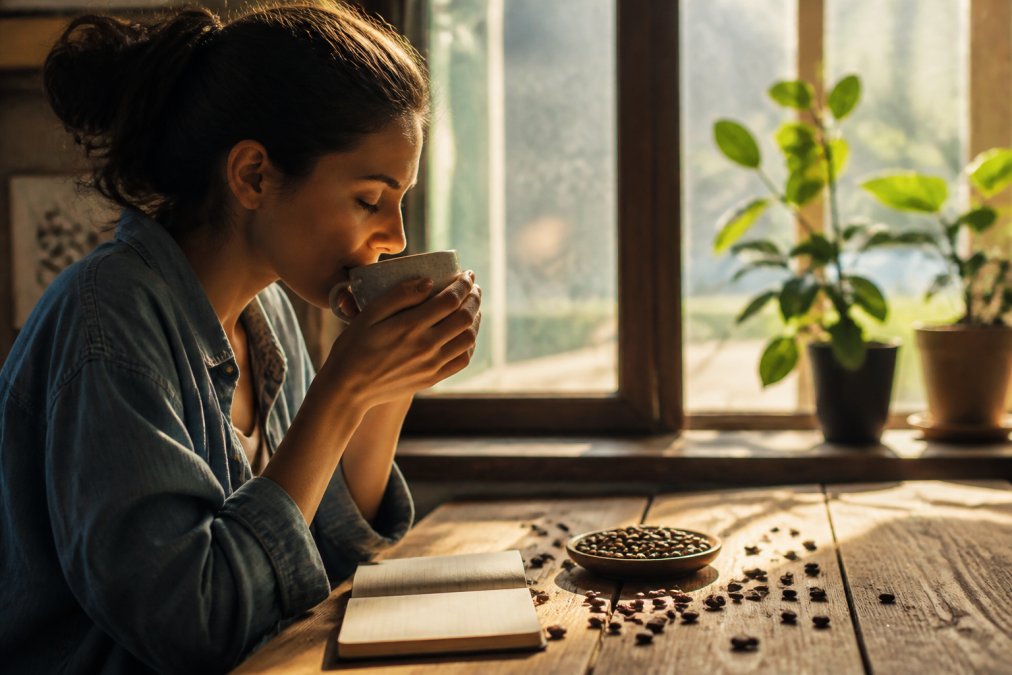
Before the water touches the beans, smell the dry grounds. This is your baseline. Cup your hands around the bag or your grinder and breathe in. You might notice earthy, floral, fruity, or chocolate-like aromas. Don't overthink it, just note what comes to mind. This step trains your brain to associate smell with flavor categories.
Once you've brewed, smell the coffee again while it's still hot. The aroma will be more pronounced. Hot liquid releases volatile compounds that create the scent profile. This is critical because taste is actually smell. When you sip coffee, aromatic compounds travel up the back of your throat to your olfactory receptors. Your tongue only detects sweetness, bitterness, acidity, and body, everything else is smell (peer-reviewed research).
Step 2: Notice the First Sip and Aftertaste
Take a small sip and hold it in your mouth for a few seconds before swallowing. Your tongue will detect the basic sensations: Is it acidic (bright, sharp)? Is it bitter (dry, harsh)? Does it have body (full, heavy, or light, tea-like)? These are the structural elements.
Now pay attention to what happens after you swallow. The aftertaste lingers, sometimes for seconds, sometimes longer. This is where single origin coffees really shine. A good single origin has a clean, interesting aftertaste that tells you something about its origin. A coffee from Kenya might have a fruity, wine-like aftertaste. An Ethiopian natural-process coffee might taste berried and complex. A Brazilian coffee might finish with chocolate and nuts.
The aftertaste is where beginners often discover the most interesting flavors. Your mouth has time to process the sensory information without the heat of the fresh sip overwhelming your palate.
Step 3: Compare Across Multiple Origins
Tasting one coffee teaches you about that coffee. Tasting two side by side teaches you about the difference. This is where the learning accelerates.
Brew two single origins at the same time using the same method. Let them cool slightly so they're at the same temperature. Sip one, then the other, then back to the first. Notice how the acidity differs. How the body compares. What flavors emerge in one that don't in the other.
This comparative tasting is how your palate develops. You're training your brain to recognize patterns. After tasting five or six single origins this way, your palate will start automatically detecting the differences. You won't need to think as hard about what you're tasting, you'll just notice.
A common mistake is trying to taste too many coffees at once. Three is the maximum for a focused tasting session. Beyond that, your palate fatigues and the comparisons become meaningless.
Using the Coffee Flavor Wheel for Beginners
The coffee flavor wheel is a visual tool that organizes flavor descriptors into categories. At the center are the basic taste sensations: sweet, salty, sour, bitter. Moving outward, the wheel branches into more specific descriptors: fruity, floral, nutty, chocolate, earthy. Each category has subcategories. "Fruity" breaks down into berry, citrus, dried fruit, and tropical fruit.
The flavor wheel serves two purposes. First, it gives you permission to trust your palate. If you taste something fruity, you're not imagining it, the wheel validates that as a legitimate coffee flavor. Second, it expands your vocabulary. Instead of "it tastes fruity," you can be specific: "it has citrus notes with a hint of blueberry."
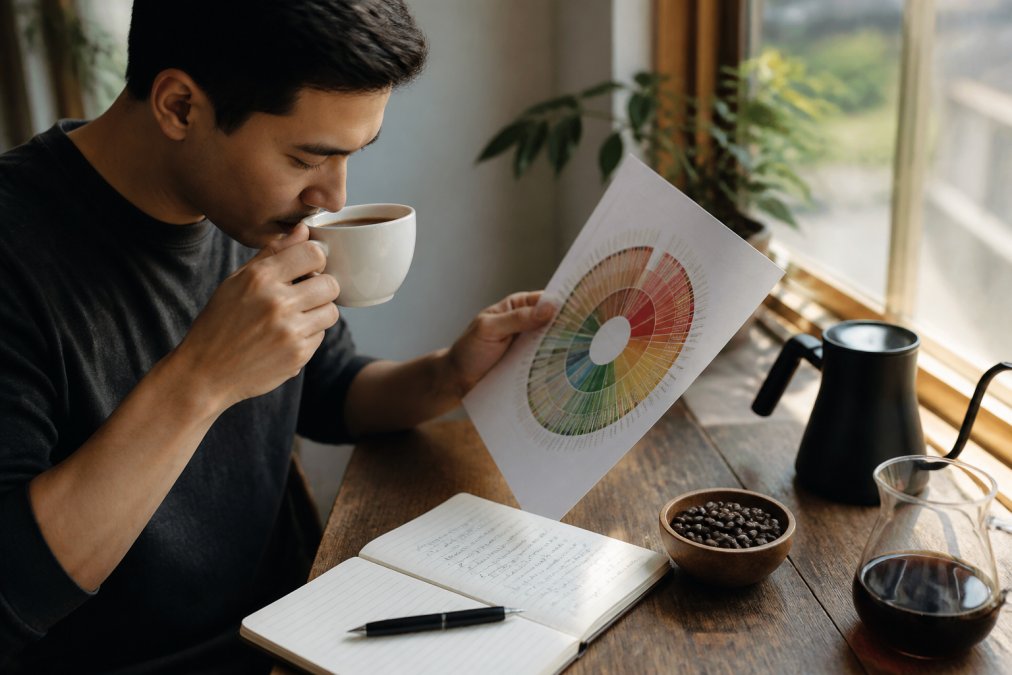
When you're tasting, keep the flavor wheel nearby. After you've taken your sip and noticed the aftertaste, glance at the wheel and see which descriptors resonate. Did you taste something fruity? Which type of fruit? Citrus is bright and acidic. Berries are darker and more complex. Tropical fruit is sweet and sometimes floral.
The wheel isn't meant to be prescriptive. It's not saying "this coffee must taste like blueberry." It's offering a vocabulary for what you actually taste. If you taste something that doesn't fit the wheel's categories, that's fine, write it down anyway. Your personal tasting notes are more valuable than forcing your experience into someone else's framework.
The Role of Roast Level and Brewing in Tasting Single Origin
Here's what most guides skip: roast level and brewing method dramatically affect whether you can taste single origin characteristics. This is why two people can brew the same beans and have completely different experiences.
A light roast preserves the origin's natural flavor profile (peer-reviewed research). The acidity is brighter, the complexity more pronounced. You taste the terroir. A dark roast masks origin characteristics under deeper, roasted flavors. The coffee tastes more like the roasting process than the origin.
For beginners learning to taste single origin, light to medium roasts are your friend. They're more forgiving because the origin flavors are more obvious. You don't need a sophisticated palate to notice the difference between a light-roasted Ethiopian and a light-roasted Colombian. The differences jump out.
Brewing method matters equally. An underextracted cup (brewed too quickly or with water that's too cool) tastes sour and thin. An overextracted cup (brewed too long or with water that's too hot) tastes bitter and flat. Neither lets you taste the coffee's actual character.
For beginners, a simple pour-over or French press works better than espresso. These methods are more forgiving of small variations in technique. You can focus on learning to taste without also wrestling with equipment. Once your palate is trained, you can explore how espresso or AeroPress changes the flavor profile of the same beans.
Budget-Friendly Single Origin Options to Start Your Journey
A common objection to single origin coffee is cost. Premium single origin can be expensive, but entry-level options exist. Many specialty roasters, including Lux Brew Coffee Co., offer single origins at accessible price points. The key is knowing where to look and what to expect.
Start with single origins from high-volume producing regions like Brazil, Colombia, and Ethiopia. These coffees are more affordable because supply is higher. A Brazilian natural-process coffee or Colombian washed coffee can introduce you to single origin tasting without a significant budget commitment.
Avoid the trap of thinking price equals quality. A $20-per-pound single origin isn't automatically better than a $14-per-pound one. Often, the difference is rarity or micro-lot size, not flavor quality. For learning to taste, a solid $12-15 per pound single origin is perfectly adequate.
Another budget strategy is buying smaller quantities. Many roasters sell half-pound bags alongside full pounds. A half-pound is enough for 8-12 cups of coffee, sufficient to taste the coffee multiple ways and really understand its character. Once you know what you like, you can invest in full pounds of your favorites.
The freshness factor matters more than the price point. Coffee roasted within the last two weeks tastes dramatically better than coffee roasted months ago. This is where Lux Brew Coffee Co.'s roast-to-order model creates real value. Coffee roasted and shipped within hours of roasting tastes noticeably brighter and more complex than coffee that's been sitting in a warehouse for weeks.
Common Mistakes Beginners Make When Tasting Single Origin
The biggest mistake is expecting instant expertise. You won't taste a coffee once and detect all its nuances. Tasting is a skill that develops over dozens of cups. After tasting 20 single origins intentionally, you'll start recognizing patterns. After 50, you'll taste with real confidence.
Another frequent error is brewing at the wrong temperature. Coffee brewed with water that's too hot tastes burnt and bitter, masking the origin's actual character. Water that's too cool tastes sour and thin. Most beginners don't realize their brewing temperature is the problem, they assume the coffee is bad. Use a thermometer. Aim for 195-205°F (peer-reviewed research). This single adjustment transforms how single origin tastes.
Tasting on an empty stomach or while rushing creates noise. Your palate is more sensitive and accurate when you're calm and have eaten something light. A rushed tasting session produces unreliable impressions. Set aside 10-15 minutes. Sit down. Actually pay attention.
Many beginners also make the mistake of tasting too many coffees at once or comparing incompatible brewing methods. You can't accurately compare a pour-over with a French press or a light roast with a dark roast. Control the variables. Same brewing method, same roast level, different origins. That's how you learn what terroir actually contributes.
Finally, don't dismiss a coffee after one cup. Single origins often taste different on day two or three after roasting as the beans continue to degas. A coffee that tasted flat on day one might taste complex and balanced on day three. Give the coffee time.
Learning to taste single origin coffee isn't about becoming a snob or developing an elite palate. It's about training your senses to notice what's actually in your cup. The process starts with intention, deliberately smelling, tasting, and comparing instead of just drinking. Within a few weeks of intentional tasting, you'll detect differences that previously seemed invisible. That's when single origin coffee becomes genuinely interesting, not because the coffee changed, but because you learned to listen to what it's saying.
At Lux Brew Coffee Co., we roast single origins specifically for this kind of exploration. Our roast-to-order model means your beans arrive at peak freshness, making it easier to taste the origin's actual character rather than the staleness that masks flavor in older coffee. Start with a light-roasted single origin from a high-volume region like Ethiopia or Colombia, brew it intentionally, and taste it across multiple days. That's how you discover whether single origin coffee resonates with you.
Frequently Asked Questions
Can beginners actually taste the difference between single origin and blend coffees?
Yes, beginners can develop this skill with practice. Single origin coffees have distinct flavor profiles shaped by terroir, elevation, and processing method, while blends balance multiple origins. Start by comparing two very different single origins side-by-side, for example, a fruity Ethiopian with a chocolatey Brazilian. You'll notice the aroma and aftertaste differ significantly. Most people detect these differences within 3-5 tastings once they know what to look for.
What's the easiest single origin coffee for beginners to start with?
Central American coffees are ideal for beginners because they offer balanced, approachable flavor profiles with clear chocolate and nutty notes. Brazilian single origins are also forgiving, they're naturally smooth with low acidity and predictable body. Avoid highly acidic, floral, or complex East African origins until your palate develops. Look for medium roasts, which showcase origin characteristics better than dark roasts, and brew with consistent technique to isolate the coffee's actual flavors from brewing variables.
How to taste coffee notes without expensive equipment?
You don't need special equipment to taste single origin coffee. A standard drip brewer, French press, or pour-over works perfectly. The key is consistency: use the same brewing method and water temperature each time so you're tasting the coffee, not the equipment. A simple flavor wheel (available free online) and a notebook help you identify and remember tasting notes. Focus on basic categories first, fruity, nutty, chocolatey, floral, before diving into specific notes like 'blackberry' or 'hazelnut.'
Does roast level affect what flavor notes I can taste in single origin coffee?
Roast level significantly impacts which notes emerge. Light roasts preserve the origin's bright acidity and fruit-forward characteristics, making them ideal for tasting terroir. Medium roasts balance origin flavors with caramelized sweetness. Dark roasts emphasize body and chocolate notes while muting delicate fruit and floral qualities. As a beginner, start with medium roasts to experience clear flavor profiles, then experiment with light roasts as your palate develops and you're ready to detect subtle nuances.
This article was written using GrandRanker