

Table of Contents
- Understanding Specialty Coffee Flavor Profiles
- What Are Coffee Tasting Notes and How to Identify Them
- The SCA Flavor Wheel Explained
- How Origin and Terroir Shape Your Coffee's Flavor Profile
- Processing Methods and Their Impact on Taste
- Roast Profile and Its Role in Flavor Development
- How to Taste Coffee Like a Professional: A Step-by-Step Method
- Decoding Acidity, Body, Sweetness, and Balance
Specialty Coffee Flavor Profiles: A Complete Guide
Last Updated: July 30, 2026
Understanding Specialty Coffee Flavor Profiles
The difference between a forgettable cup and an exceptional one comes down to understanding what you're actually tasting. What separates specialty coffee from commodity coffee is deliberate attention to how origin, processing, roasting, and brewing method combine to create distinct flavor experiences. When you understand the language of tasting notes, the science behind flavor development, and how to identify specific characteristics in your cup, coffee transforms from a daily caffeine delivery system into a genuine sensory experience.
What Makes Flavor Profiles Matter
Understanding coffee flavor profiles directly impacts your purchasing decisions and brewing satisfaction. When you know what flavor characteristics you prefer, you can confidently select beans that match your palate instead of relying on marketing language or random trial-and-error. This knowledge also helps you troubleshoot brewing problems: if your coffee tastes flat and bitter when you expected bright and fruity, you'll understand whether the issue is grind size, water temperature, extraction time, or the beans themselves.
Flavor profiles also deepen your appreciation for the coffee's origin story. A washed Ethiopian Yirgacheffe tastes completely different from a natural-process Brazilian Cerrado because water, altitude, climate, and processing method interact to shape flavor.
What Are Coffee Tasting Notes and How to Identify Them
Coffee tasting notes are descriptive words that capture the flavors you perceive when you drink coffee. They're not invented flavors added to the beans; they're genuine sensory impressions that arise from the coffee's chemical compounds. When you taste "blueberry" in an Ethiopian coffee, you're tasting volatile compounds that trigger the same flavor receptors your brain associates with blueberries.
The language of tasting notes comes from the Specialty Coffee Association (SCA), which developed standardized descriptors to help professionals and enthusiasts communicate about coffee consistently. The SCA Flavor Wheel provides a structured hierarchy of flavor descriptors that move from broad categories (fruity, floral, nutty) to increasingly specific notes (blueberry, jasmine, almond).
The Language of Flavor Descriptors
Tasting notes follow a hierarchy of specificity. At the broadest level, you have major flavor families: fruity, floral, nutty, chocolatey, spicy, and earthy. Within each family, more specific descriptors branch out. Fruity, for example, includes berry notes (blueberry, strawberry, raspberry), stone fruit notes (peach, apricot, plum), citrus notes (lemon, orange, grapefruit), and dried fruit notes (raisin, fig, date).
Learning to identify tasting notes requires practice. First, smell the coffee, aroma reveals about 80% of what you'll taste, since taste and smell work together. Then take a small sip, let it coat your mouth, and notice the flavors that emerge. Pay attention to the initial taste, the middle notes, and the aftertaste.
Common Flavor Categories: Fruity, Nutty, Chocolatey, and Beyond
Fruity coffees display bright, vibrant flavors that often correlate with higher acidity. These typically come from coffees grown at higher altitudes in regions like East Africa and Central America. Fruity notes range from citrus (lemon, orange, grapefruit) to berries (blueberry, strawberry, raspberry) to stone fruits (peach, apricot, plum).
Nutty coffees present warm, comforting flavors like almond, hazelnut, walnut, and peanut. These notes often appear in coffees from Brazil, Colombia, and Indonesia, and they tend to pair with lower acidity and fuller body.
Chocolatey coffees deliver rich, sweet flavors reminiscent of chocolate, cocoa, or caramel. These notes develop during darker roasting, when the coffee's natural sugars caramelize.
Floral coffees carry delicate, fragrant notes like jasmine, rose, hibiscus, or honeysuckle. These are often subtle and frequently appear in East African coffees, particularly those from Ethiopia.
Earthy coffees present grounding flavors like soil, wood, leather, or tobacco. These notes add depth and complexity, often coming from lower-altitude regions or natural-process coffees.
Spicy coffees show warming flavors like cinnamon, clove, pepper, or cardamom. These notes can come from the coffee's origin or develop during roasting.
The SCA Flavor Wheel Explained
The Specialty Coffee Association Flavor Wheel is the industry standard tool for identifying and communicating coffee flavors. It arranges flavor descriptors in a circular pattern, moving from broad categories at the center to increasingly specific flavors at the outer ring. The wheel includes over 100 flavor descriptors organized into families: fruity, floral, sour/fermented, green/vegetative, spicy, nutty, chocolatey, sweet, and other.
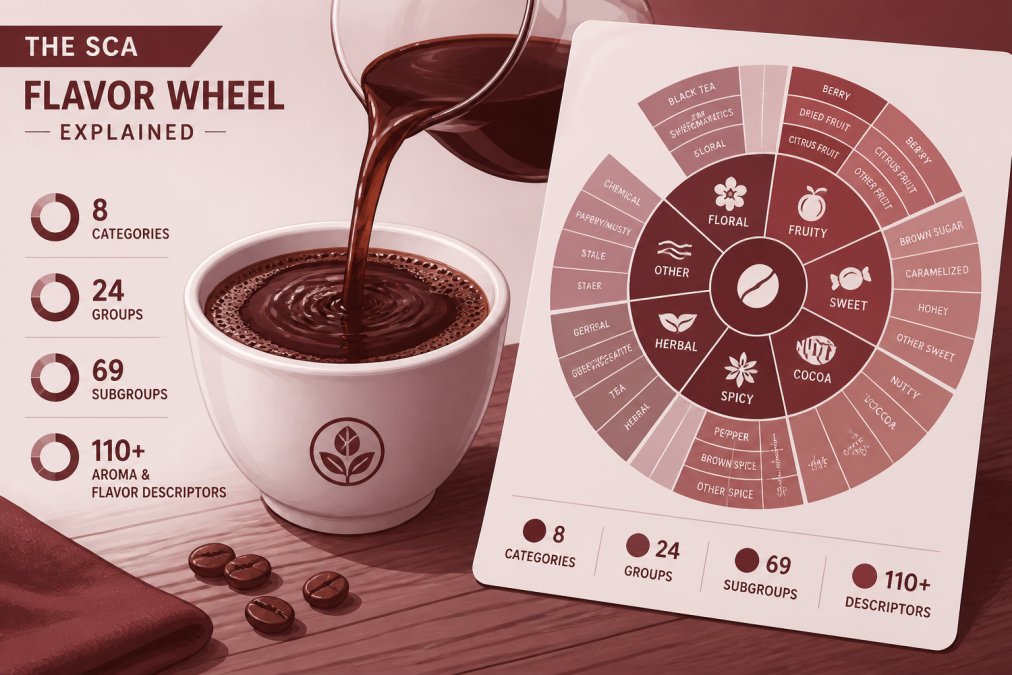
How to Read and Use the Flavor Wheel
Start at the center of the wheel with the broadest categories. If your coffee tastes fruity, move to the fruity section. From there, branch outward to more specific descriptors. Does it taste like citrus, berry, stone fruit, or dried fruit? Keep narrowing until you land on the specific flavor that matches what you're tasting. The wheel isn't a rigid checklist; use it as a reference guide when you're trying to identify a specific flavor you're sensing but can't quite name.
How Origin and Terroir Shape Your Coffee's Flavor Profile
Coffee flavor is fundamentally shaped by where it grows. The concept of terroir, the complete environmental context of a coffee's origin, encompasses altitude, climate, soil composition, rainfall, and seasonal variations. Two coffees from the same country can taste completely different based on their specific microclimates and growing conditions.
Ethiopian coffees typically display fruity, floral, and tea-like characteristics due to the country's high altitudes, volcanic soils, and the coffee plant's native origins there. Colombian coffees often show balanced acidity with nutty, chocolatey, and caramel notes. Brazilian coffees tend toward lower acidity with nutty, chocolatey, and earthy flavors.
Altitude plays a crucial role in flavor development. Higher-altitude coffees develop slower, allowing more complex sugars and acids to form, resulting in brighter acidity and more nuanced flavor profiles. Lower-altitude coffees ripen faster and often display simpler, earthier flavors with less acidity.
Reading the Coffee Origin Flavor Map
East African coffees (Ethiopia, Kenya, Tanzania) typically produce fruity, floral, and tea-like flavors. Central American coffees (Guatemala, Honduras, Costa Rica) often show balanced acidity with chocolate, nuts, and citrus. South American coffees (Colombia, Brazil, Peru) tend toward lower acidity with chocolate, nuts, and earth. Southeast Asian coffees (Indonesia, Vietnam) display earthy, full-bodied, herbal characteristics.
Processing Methods and Their Impact on Taste
How coffee cherries are processed after harvest dramatically shapes the final flavor profile. The three primary processing methods, washed, natural, and honey, each produce distinctly different flavor characteristics.
Washed, Natural, and Honey Processes Compared
The washed process involves removing the fruit from the coffee bean immediately after harvest, then fermenting and washing away the remaining fruit. This method produces clean, bright cup profiles with pronounced acidity and clarity. Washed coffees typically display fruity and floral notes with less body than natural-process coffees.
The natural process dries the entire coffee cherry intact, allowing the fruit to ferment against the bean for weeks. This extended contact with fruit sugars creates deeper, more fruit-forward flavors with higher sweetness. Natural-process coffees often taste like berry juice, with fuller body and lower acidity than washed coffees.
The honey process (also called pulped natural) splits the difference: the fruit is removed, but some or all of the sticky mucilage stays on the bean during drying. This allows partial fermentation, creating a middle ground between washed and natural coffees. Honey-process coffees show balanced acidity with both clarity and sweetness, often displaying caramel, chocolate, and fruit notes simultaneously.
| Processing Method | Flavor Profile | Acidity Level | Body |
|---|---|---|---|
| Washed | Bright, clean, fruity, floral | High | Light to medium |
| Natural | Sweet, fruity, winey, complex | Low to medium | Full |
| Honey | Balanced, sweet, caramel, fruit | Medium | Medium to full |
Roast Profile and Its Role in Flavor Development
Roasting is where the coffee's potential flavors actually develop. During roasting, heat triggers chemical reactions (the Maillard reaction and caramelization) that transform green coffee beans into the brown, aromatic beans you brew. The roast profile, how long the coffee is roasted and at what temperature, determines which flavors emerge and which are muted or destroyed.
Light, Medium, and Dark Roasts: Flavor Trade-Offs
Light roasts are removed from heat shortly after the first crack (the moment when beans expand and make an audible popping sound). Light roasts preserve the most origin characteristics and acidity. They taste bright, crisp, and fruity, with pronounced floral and tea-like notes.
Medium roasts are roasted past first crack but before second crack. Medium roasts balance origin characteristics with roast-developed flavors. They show fruity and floral notes alongside chocolate, caramel, and nutty flavors. The acidity is moderate, and the body is fuller than light roasts.
Dark roasts are roasted well into or past second crack. Dark roasts emphasize roast-developed flavors: chocolate, caramel, smoke, and earth. Origin characteristics are largely masked by the roasting process. Dark roasts have lower acidity and fuller body.
How to Taste Coffee Like a Professional: A Step-by-Step Method
Professional coffee tasting, called cupping, follows a standardized protocol that isolates flavor from other variables. Understanding the method helps you taste more deliberately and identify flavors more accurately.
The Five Sensory Steps to Coffee Cupping
Step 1: Smell the dry grounds. Before adding water, smell the coffee grounds in the cup. Notice the aroma, is it fruity, floral, chocolatey, earthy, spicy?
Step 2: Bloom the coffee with hot water. Pour a small amount of hot water (around 200°F) over the grounds and wait 30-45 seconds. Then smell the coffee again; the aroma often intensifies and changes after blooming.
Step 3: Break the crust and smell again. After the bloom, the grounds form a crust on top of the water. Gently break this crust by stirring, then smell the coffee one more time.
Step 4: Taste the coffee deliberately. Once the coffee has cooled slightly (around 160-170°F), take a small spoonful. Slurp it loudly to aerate it and spread it across your entire palate. Notice the initial taste, the middle notes, and the aftertaste.
Step 5: Evaluate the overall experience. Consider the acidity (brightness and liveliness), body (weight and texture), sweetness, balance, and complexity.
Brewing Method Impact on Flavor Perception
How you brew coffee significantly affects which flavors you perceive. Different brewing methods extract different compounds from the grounds, resulting in noticeably different flavor profiles from the same coffee.
Pour-over brewing (Chemex, V60, Melitta) uses paper filters that trap oils and fine particles, producing a clean, bright cup that emphasizes acidity and clarity. Pour-over is excellent for highlighting fruity and floral notes.
French press brewing uses immersion and a metal filter that allows oils through. This produces a fuller-bodied, richer cup with more pronounced sweetness and body.
Espresso uses high pressure to force water through finely-ground coffee quickly. Espresso produces a concentrated, syrupy shot with intense flavors and a thick body.
AeroPress uses pressure and immersion, producing a cup that falls between pour-over and French press in terms of body and clarity.
Decoding Acidity, Body, Sweetness, and Balance
These four elements form the foundation of coffee flavor evaluation. Understanding them helps you articulate what you taste and predict which coffees you'll enjoy.
Why These Four Elements Define Your Specialty Coffee Experience
Acidity refers to the brightness and liveliness you perceive in coffee, not whether the coffee is literally acidic. High-acidity coffees taste bright, crisp, and vibrant. Low-acidity coffees taste smooth, mellow, and flat. Acidity comes from the coffee's origin, altitude, and processing method. East African coffees typically have higher acidity; Brazilian and Indonesian coffees typically have lower acidity.
Body describes the weight and texture of the coffee in your mouth. Full-bodied coffees feel thick and syrupy; light-bodied coffees feel thin and tea-like. Body comes from the amount of dissolved solids and oils in the coffee. Natural-process coffees have fuller body; washed coffees have lighter body. Darker roasts have fuller body; lighter roasts have lighter body.
Sweetness is the pleasant sweetness you perceive, separate from added sugar. Some coffees taste naturally sweet, with caramel, chocolate, or honey notes. Others taste dry or sour. Sweetness comes from the coffee's sugars, which develop during ripening and are enhanced by processing and roasting. Natural-process coffees taste sweeter than washed coffees. Darker roasts taste sweeter than lighter roasts because the roasting process caramelizes sugars.
Balance describes how well acidity, body, sweetness, and flavor work together. A balanced coffee has all elements in harmony, with none overwhelming the others. The best specialty coffees achieve harmony among all four elements, creating a complex, satisfying experience.
Understanding specialty coffee flavor profiles transforms how you experience your daily cup. You move from passive consumption to active appreciation, noticing the subtle differences between origins, processing methods, and roast profiles.
At Lux Brew Coffee Co., we roast every batch to order and ship within hours to ensure peak freshness, because understanding flavor profiles only matters when you're working with genuinely fresh, high-quality beans. Our single-origin coffees are sourced from ethical family farms and roasted to highlight the distinctive characteristics that make each origin unique. Explore our collection and discover how fresh, specialty-grade coffee elevates your understanding of what coffee can be. Add to your order today and experience the difference that freshness and intentional roasting make in every cup.
Frequently Asked Questions
What exactly are coffee tasting notes, and why do they matter?
Coffee tasting notes are descriptive flavor characteristics, like citrus, chocolate, or floral, that you can identify when cupping or brewing specialty coffee. They matter because they help you understand what you're tasting, predict whether you'll enjoy a particular origin, and communicate preferences with roasters. Tasting notes are based on sensory analysis using standards set by the Specialty Coffee Association (SCA), which ensures consistency across the industry. Learning to identify these notes deepens your appreciation for the complexity and terroir expressed in each cup.
How do I use the SCA flavor wheel to taste coffee?
The SCA flavor wheel is a visual map organized in concentric rings, moving from broad categories (like fruity or nutty) to specific flavors (like blueberry or almond). Start by smelling the coffee's aroma, then take a small slurp and let it coat your palate. As you taste, move from the outer ring inward on the wheel, if you detect fruitiness, narrow down whether it's citrus or berry. The wheel helps you build a consistent vocabulary for describing what you experience, making it easier to identify patterns across different origins and roast profiles.
Does origin really affect coffee flavor profiles that much?
Yes, origin is one of the most significant factors shaping flavor. A coffee's origin determines its terroir, the combination of altitude, soil, climate, and water chemistry, which influences everything from acidity levels to sweetness and body. For example, East African coffees tend to display bright citrus and floral notes, while Central American coffees often show chocolate and nutty characteristics. Processing method, varietal, and roast profile also matter, but origin is the foundation. Understanding your coffee's origin flavor map helps you predict and appreciate the sensory experience before you brew.
What's the difference between acidity and sourness in specialty coffee?
Acidity in specialty coffee is a desirable quality, it's the bright, crisp sensation that adds complexity and liveliness to flavor. It's measured on the SCA standards scale and is a positive attribute. Sourness, by contrast, is a flaw caused by under-extraction, stale beans, or improper brewing. Acidity feels clean and enhances fruity or floral notes; sourness tastes unpleasant and flat. High-quality specialty coffee with good acidity will feel vibrant on your palate, while sour coffee tastes unbalanced and unrefined. Learning this distinction helps you evaluate whether a coffee's brightness is intentional and desirable.
Can I taste the difference between single-origin specialty coffee and grocery store blends?
Yes, most people can taste the difference, even casual drinkers. Specialty grade single-origin coffees are fresher (often roasted to order), sourced from higher-altitude farms with better farming practices, and processed with more care, all of which preserve complexity and flavor. Grocery store blends are often older, over-roasted to mask defects, and blended from lower-grade beans. When you taste a fresh specialty single-origin, you'll notice distinct flavor notes, balanced acidity, pleasant sweetness, and a clean aftertaste. You don't need an expensive espresso machine; even a simple pour-over or French press will reveal the difference in freshness and flavor profile.
How does brewing method impact the flavors I taste in my coffee?
Brewing method directly affects extraction, how much flavor, oils, and compounds dissolve into your cup. Espresso extracts quickly under pressure, often highlighting sweetness and body while muting acidity. Pour-over methods extract more slowly and cleanly, emphasizing acidity and floral notes. French press produces a full-bodied cup with heavier mouthfeel because oils remain in the brew. Water chemistry also plays a role; mineral content affects extraction efficiency and flavor balance. The same specialty coffee bean will taste noticeably different brewed as espresso versus pour-over, so experimenting with your preferred brewing method helps you discover which brings out the flavor profile you enjoy most.
What processing method should I choose if I want specific flavor profiles?
Processing method significantly shapes flavor. Washed (wet) process coffees tend to be cleaner with bright acidity and clear origin characteristics, ideal if you want fruity or floral notes to shine. Natural (dry) process coffees are fermented longer, producing heavier body, higher sweetness, and berry or wine-like complexity. Honey (pulped natural) process splits the difference, offering balanced sweetness with moderate acidity. Understanding these differences helps you select beans matching your taste preferences. If you love bright, crisp coffee, seek washed beans; if you prefer full-bodied sweetness, natural process is your choice. Roasters typically note processing method on the bag, making it easy to explore.
This article was written using GrandRanker