

Table of Contents
- What USDA Organic Coffee Standards Actually Require
- Fair Trade vs Organic Coffee: Two Seals, Two Different Promises
- Pesticide Residue, Roasting, and What Reaches Your Cup
- Does Organic Certification Improve Flavor or Freshness?
- What Certification Costs Farmers, and Who Pays the Premium
- Best Ethically Sourced Coffee Brands 2026: How Five Roasters Compare
- Common Myths About Organic Coffee Certification
- Frequently Asked Questions
Last Updated: September 12, 2026
What USDA Organic Coffee Standards Actually Require
USDA Organic certification for coffee is a production and handling standard, not a taste or freshness guarantee. It requires farmers to avoid synthetic pesticides and fertilizers for at least three years before harvest, then pass annual third-party inspections (ams.usda.gov).
The USDA Agricultural Marketing Service organic regulations define what "organic" legally means for any crop, coffee included. At Lux Brew Coffee Co., we source from farms that hold this certification and others, so we see the paperwork behind the label.
The Three-Year Transition and Annual Inspection
A farm cannot simply declare itself organic. Land must be managed without prohibited substances for 36 months before the first certified harvest, a window when yields often drop while costs rise.
Once certified, an accredited certifying agent inspects the operation every year, reviewing input records, crop management, and separation of organic from conventional lots.
What the USDA Organic Seal Does Not Guarantee
The seal does not promise better flavor, fresher beans, or a specific roast quality, nor a living wage for the farmer. Those outcomes depend on separate certifications and the roaster's sourcing relationships.
Fair Trade vs Organic Coffee: Two Seals, Two Different Promises
Organic certification governs how coffee is grown; Fair Trade governs how it is traded. A bag can carry one, both, or neither, and the labels that confuse buyers most are the ones that overlap with organic without being organic.
The Core Distinction
Organic standards focus on soil health, biodiversity, and the absence of synthetic inputs. Fair Trade standards focus on minimum prices, premiums, and cooperative structures that route money back to smallholder farmers.
Where the Other Labels Fit
Shade-grown. This describes the farming system, not a certification. Coffee evolved as an understory plant, and shade-grown means it is cultivated under a canopy rather than in full sun. Shade systems tend to support more bird and insect habitat and can reduce the need for synthetic inputs, but shade-grown is often a marketing description, not a verified standard, unless tied to a certification that defines canopy requirements.
Bird-friendly. A specific, verifiable standard built on top of shade requirements, administered by the Smithsonian Migratory Bird Center. It requires USDA Organic certification as a prerequisite, then adds strict canopy cover, structural diversity, and buffer requirements. It is the strictest habitat label, and the rarest on shelves.
Rainforest Alliance. A separate certification covering ecosystem protection, worker conditions, and farm management. It is not the same as USDA Organic, and a farm can hold one without the other. Both restrict certain pesticides, but the standards, auditors, and verification methods differ.
Direct trade. Not a certification at all, but a sourcing claim defined by the roaster, describing a direct relationship with a farm or cooperative. It can be excellent or meaningless depending on whether the roaster publishes prices and farm names. No third-party auditor stands behind the term.
How the Overlap Actually Works
A single farm can hold USDA Organic, Fair Trade, and Rainforest Alliance certifications simultaneously, and many do. Bird-friendly sits on top of organic rather than beside it. Direct trade describes the transaction, not the production method, so it can coexist with any of the above.
"Organic" and "bird-friendly" are not competing claims: bird-friendly is the narrower, more demanding label, and organic is one of its prerequisites.
Reading a Bag Without Getting Fooled
The practical rule: separate verified standards from descriptive terms. USDA Organic, Fair Trade, Rainforest Alliance, and bird-friendly are verified by third-party auditors against published criteria. Shade-grown and direct trade are descriptive and depend on the roaster's honesty and disclosure. When a bag leans on a descriptive term without a verified seal, ask what is actually being certified, and by whom.
Pesticide Residue, Roasting, and What Reaches Your Cup
Roasting does reduce some pesticide residue on coffee beans, but it does not eliminate all of it. The FDA guidance on pesticide residues in food sets tolerances for residues in food generally, and coffee is subject to those limits whether or not it is certified organic.
This is where the "is organic coffee certification worth it" question gets practical. Conventional coffee can legally contain trace residues within FDA tolerances. Certified organic coffee should contain none of the prohibited synthetic chemicals, because they were never applied.
Bio-accumulation matters here. Because coffee is a long-cycle crop, residues applied over years can build up in soil and plant tissue. Organic crop management breaks that cycle.
Does Organic Certification Improve Flavor or Freshness?
Organic certification does not directly change flavor profile or freshness. Those depend on origin, processing method, roast quality, and how quickly the beans reach you after roasting.
A stale organic bean tastes worse than a fresh conventional one. Most guides get this wrong: the seal is a farming standard, not a quality score.
Flavor comes from terroir, varietal, and roasting; freshness comes from time between roast and brew. Neither is written into organic regulations.
What Certification Costs Farmers, and Who Pays the Premium
Certification is a fixed cost imposed on a variable income, which is why whether it is worth it depends on which side of the transaction you sit on.
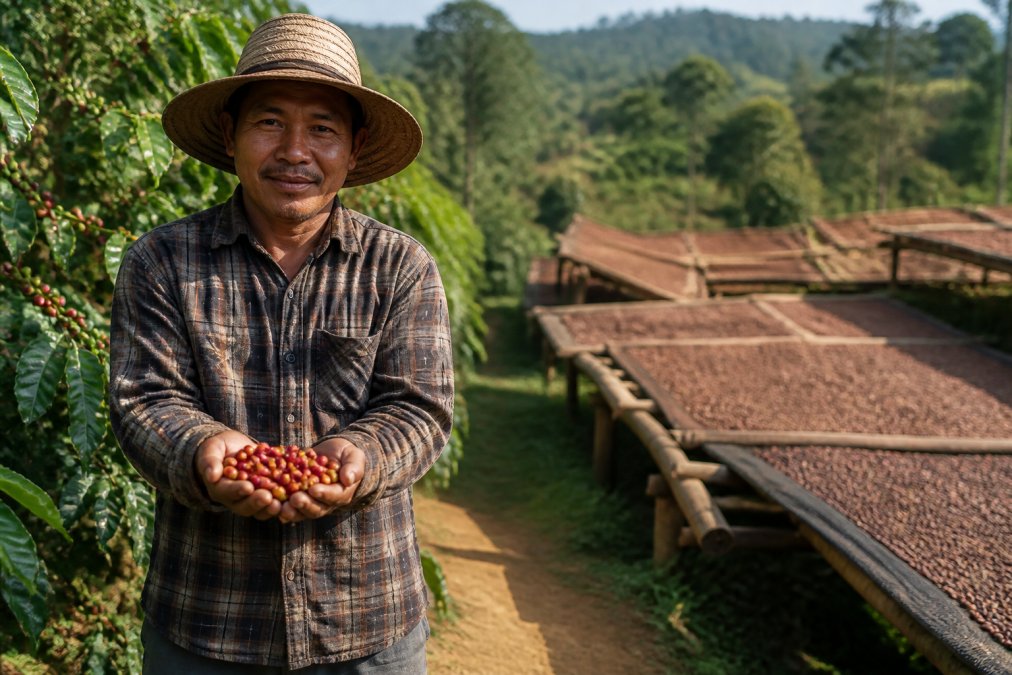
The Cost Stack a Farmer Actually Pays
A coffee farm pursuing USDA Organic certification absorbs several costs, most front-loaded before a single premium dollar arrives:
- Certification body fees. An accredited certifying agent charges an application fee plus an annual inspection fee, typically a flat base plus a per-acre or per-volume component, which penalizes the smallest farms proportionally hardest.
- The three-year transition. Land must be free of prohibited substances for 36 months before the first certified harvest. During that window the farm sells at conventional prices while carrying organic-level input costs, and yields commonly dip as synthetic nitrogen and pest control are withdrawn.
- Record-keeping and compliance labor. Inspectors review input logs, field histories, harvest records, and separation of organic from conventional lots. On a smallholder plot, the farmer maintains those records year-round, unpaid.
- Buffer and separation costs. Organic lots must be kept separate from conventional lots through harvest, milling, storage, and transport, dedicated bags, storage, and sometimes dedicated milling runs.
Why the Premium Often Stops Short of the Farm Gate
The organic premium is created at retail but distributed through exporters, importers, millers, and roasters. Each link takes a margin, and none is obligated to pass the organic differential back to the grower. A bag can carry the seal and a higher shelf price while the farm received the same per-pound price as its conventional neighbor.
Transparency closes this gap. When a roaster publishes the farm, the cooperative, and the price paid, the premium has a visible destination; when it publishes only the seal, the premium has an invisible endpoint.
The Cooperative Workaround
Because fixed costs are brutal at small scale, smallholders rarely certify individually. The common pattern is a cooperative holding a single certification covering all member plots, with internal inspection systems the external certifier audits on a sample basis, spreading the fee and record-keeping burden across dozens or hundreds of farms.
The trade-off is real: the cooperative becomes gatekeeper for the premium, and members depend on its governance and payout practices. A well-run cooperative turns certification into a net gain; a poorly run one turns it into a fee the farmer pays for a label someone else monetizes.
What This Means for Your Buying Decision
If your goal is to support farmers rather than reward a label, the seal alone is not enough. Look for roasters that name the farm or cooperative, state the relationship length, and describe how the premium is paid, the difference between buying a certification and buying an outcome.
Best Ethically Sourced Coffee Brands 2026: How Five Roasters Compare
The best ethically sourced coffee brands 2026 combine certification, third-party verification, and transparent sourcing, not just a seal on the bag. Five roasters show different approaches to the same goal.
1. Lux Brew Coffee Co. We roast every batch to order and ship within hours, so specialty-grade beans reach you at peak freshness. We source from ethical family farms around the globe, with a focus on family-farm support and supply chain transparency. If you want ethically sourced coffee without sacrificing freshness, this is the combination to beat.
2. Purity Coffee. A health-focused roaster using USDA Organic certified beans and third-party lab testing for mold and mycotoxins. Best for consumers prioritizing lab-verified purity.
3. Bean Box. A curated subscription offering organic and ethically sourced beans from multiple roasters. Best for exploring different organic roasts without committing to one brand.
4. Holistic Roasters. USDA Organic certified, low-acid beans for sensitive stomachs. Best for organic drinkers who need a gentler cup.
5. Poverty Bay Coffee Company. Offers both certified organic and non-certified lines, making the price difference visible. Best for budget-conscious buyers who want to see what certification adds to the cost.
Comparison Table: Certification, Testing, and Price
| Brand | Certification | Third-Party Testing | Starting Price | Best For |
|---|---|---|---|---|
| Lux Brew Coffee Co. | Ethical family-farm sourcing | Roasted to order, shipped within hours | See site for current pricing | Freshness plus ethical sourcing |
| Purity Coffee | USDA Organic | Lab testing for mold and mycotoxins | $20 per bag | Health-focused buyers |
| Bean Box | Curated organic selection | Roast dates provided | $24 per shipment | Exploring multiple roasters |
| Holistic Roasters | USDA Organic | Small-batch quality control | $19.95 per bag | Low-acid, sensitive stomachs |
| Poverty Bay Coffee | Certified and non-certified lines | Direct-trade sourcing | $16 per bag | Budget-conscious comparison |
Pros and Cons of Each Option
Lux Brew Coffee Co. Pros: roasted to order, shipped within hours, specialty grade, ethical farming practices. Cons: pricing reflects the freshness model.
Purity Coffee. Pros: testing exceeds basic organic requirements, high transparency. Cons: premium price.
Bean Box. Pros: access to multiple organic roasters, flexible frequency. Cons: higher cost per pound.
Holistic Roasters. Pros: organic plus low-acid processing, transparent farming. Cons: limited variety.
Poverty Bay Coffee. Pros: clear certified vs. non-certified pricing, air-roasted profile. Cons: certification fees push organic lines higher.
Common Myths About Organic Coffee Certification
Myth one: organic always tastes better. False. Roast quality and freshness drive flavor far more than certification.
Myth two: organic and Fair Trade are the same thing. They are not. One covers farming standards, the other covers trade terms and farmer income.
Myth three: the seal guarantees a chemical-free supply chain end to end. It covers production and handling, not every step after export.
Myth four: non-GMO and organic are interchangeable. Organic prohibits genetically modified inputs, but the labels are governed separately, and coffee is not a GM crop to begin with.
Consumer trust in these labels depends on third-party verification, and verification depends on funding. When certification costs outpace the market premium, smallholder farmers exit the system.
Deciding whether organic coffee certification is worth it comes down to what you value: environmental standards, farmer income, or pure cup quality. At Lux Brew Coffee Co., we built our model around freshness and ethical sourcing, roasting every batch to order and shipping within hours, sourcing specialty-grade beans from family farms, and keeping the supply chain short enough to see where your coffee comes from. Get started with Lux Brew Coffee Co. and taste what peak freshness and responsible sourcing deliver in your morning cup.
Frequently Asked Questions
Is organic coffee certification worth the extra cost for small roasters?
It depends on volume and customer base. Certification fees, annual inspections, and recordkeeping add real overhead, and those costs usually show up in retail price. For roasters whose customers ask about farming standards and supply chain transparency, the seal can justify a higher price per bag. For roasters selling mostly on price, the math often does not work, and direct-trade sourcing without the seal may serve customers better.
What does the USDA organic seal on coffee really guarantee?
It confirms the beans were grown without synthetic pesticides or synthetic fertilizers on land that has met USDA organic coffee standards for at least three years before harvest. Growers keep records, and a third-party certifier inspects annually. The seal covers the farming and handling process, not flavor, freshness, or roast quality. A certified bag can still be stale or poorly roasted, so check the roast date alongside the seal.
Does organic coffee taste better than conventional coffee?
Certification itself does not change flavor. What changes flavor is variety, altitude, soil health, processing method, and the roasting process. A well-roasted conventional bean can outperform a poorly roasted certified one. That said, organic farms often invest in crop management and shade systems that support slower cherry maturation, which can produce a more developed flavor profile. The roast date matters more than the seal for what you taste.
What is the difference between fair trade vs organic coffee certification?
They address different problems. Organic certification focuses on how the crop is grown: no synthetic pesticides or fertilizers, plus soil and biodiversity requirements. Fair trade focuses on the business relationship: minimum prices, premiums for community projects, and rules against child labor. A bag can carry one, both, or neither. If your priority is environmental sustainability, organic matters more. If it is farmer income, fair trade matters more.
Are there pesticides used in non-organic coffee production?
Yes. Conventional coffee farming commonly uses synthetic pesticides and fertilizers to manage pests and boost yield. Pesticide residue levels in roasted coffee are generally low because roasting degrades many compounds, and coffee is not a heavily consumed food by weight. Still, farm workers face the highest exposure, and runoff affects soil health and local water. That farm-level impact, more than residue in your cup, is the main argument for certified organic production.