

Table of Contents
- What Is Ethical Coffee Certification?
- Why These Labels Matter: The Real Impact on Farmers and Forests
- Quick Comparison Table: 10 Ethical Coffee Certification Labels
- 1. Fair Trade Certified: The Standard for Farmer Wages
- 2. USDA Organic: Pesticide-Free Coffee, Verified by the Government
- 3. Rainforest Alliance: Balancing People and Planet
- 4. Smithsonian Bird Friendly: The Gold Standard for Shade-Grown Coffee
- 5. Direct Trade: What It Is and How It Differs from Fair Trade
- How to Identify Sustainable Coffee Labels
- The Bottom Line on Ethical Coffee Certification
- Frequently Asked Questions
Last Updated: September 5, 2026
What Is Ethical Coffee Certification?
Ethical coffee certification is a third-party verification system that confirms coffee was produced under specific social, environmental, and economic standards. These labels signal to buyers that farmers received fair compensation, ecosystems were protected, and labor practices met defined criteria. The system exists because the global coffee coffee supply chain has historically left smallholder farmers vulnerable to price volatility and poverty.
At Lux Brew Coffee Co., we source specialty grade beans from ethical family farms, and we've learned that understanding these labels requires looking past marketing language. The challenge for consumers is that dozens of certifications exist, each with different priorities, enforcement mechanisms, and costs. Some focus on farmer wages, others on biodiversity, and a few attempt to address both. This guide breaks down the top 10 ethical coffee certification labels so you can decode what each seal actually promises before you buy.
The stakes are considerable. Coffee production affects an estimated 25 million farming families worldwide, and the methods used determine whether that production degrades or preserves the ecosystems where it happens. Smithsonian Migratory Bird Center research on shade coffee has documented how farming practices directly influence habitat quality for migratory birds. Understanding the labels is the first step toward making purchasing decisions that align with your values.
Why These Labels Matter: The Real Impact on Farmers and Forests
The gap between a $5 cup of specialty coffee and the price paid to the farmer who grew those beans is often stark. Certification programs attempt to close that gap by establishing minimum price floors, requiring direct investment in farming communities, or mandating practices that protect soil, water, and wildlife.
What most guides miss is that certifications are not interchangeable. A label guaranteeing fair wages does nothing to verify pesticide use, and an organic seal says nothing about whether workers earned a living wage. The real impact depends on which certification you choose and how rigorously it is enforced. For instance, organic certification requires annual inspections and buffer zones to prevent contamination from neighboring conventional farms, but it does not address labor conditions at all.
The environmental stakes are equally high. Coffee grown in full sun requires significant chemical inputs and destroys forest habitat, while shade-grown methods preserve canopy cover that supports biodiversity and naturally fertilizes the soil. USDA Agricultural Marketing Service organic standards provides the regulatory framework that governs organic claims in the United States. When you choose certified coffee, you are voting with your wallet for a specific set of farming practices and labor standards.
Quick Comparison Table: 10 Ethical Coffee Certification Labels
| Certification | Primary Focus | Verification Method | Key Limitation |
|---|---|---|---|
| Fair Trade Certified | Farmer wages and community investment | Third-party audits | Certification costs burden small cooperatives |
| USDA Organic | Pesticide-free growing methods | Annual government inspections | No labor or wage standards |
| Rainforest Alliance | Ecosystem conservation and worker rights | Farm and supply chain audits | Allows mass balance sourcing |
| Smithsonian Bird Friendly | Shade habitat for migratory birds | Strict canopy and organic requirements | Very limited farm availability |
| Direct Trade | Roaster-farmer relationships and quality | No standardized third-party audit | Verification varies by roaster |
| UTZ Certified | Farm efficiency and traceability | Supply chain documentation | Merged into Rainforest Alliance |
| Shade Grown | Forest canopy preservation | Varies by provider | No unified global standard |
| B Corp Certification | Whole-company social and environmental performance | Comprehensive company assessment | Expensive for small roasters |
| Fair Trade Organic | Combined wage and pesticide standards | Dual certification audits | Higher cost for farmers |
| Regenerative Organic | Soil health and carbon sequestration | Tiered certification levels | Emerging and less common |
1. Fair Trade Certified: The Standard for Farmer Wages
Fair Trade Certified is the most recognized ethical coffee certification label for ensuring farmers receive equitable compensation. The program requires payment of a Fair Trade Premium that funds community development projects, mandates strict environmental and labor standards, and demands transparent supply chain documentation from farm to roaster.
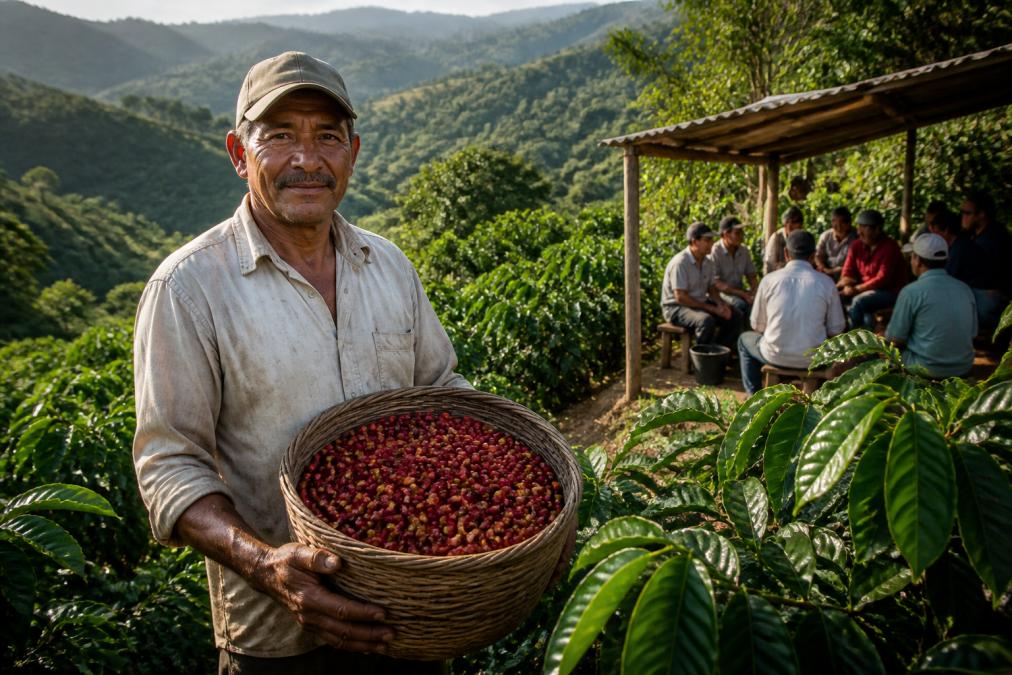
The strength of this certification lies in its global recognition and direct impact on farmer livelihoods. When you buy Fair Trade coffee, a portion of the price goes into a communal fund that farmers vote to spend on schools, healthcare, or equipment. The downside is that certification costs can be significant for small-scale cooperatives, and some critics argue the minimum price floor has not kept pace with rising production costs.
For consumers seeking to support equitable wages, Fair Trade remains the most established option. However, it is worth checking whether the coffee also carries an organic label, as Fair Trade alone does not restrict pesticide use.
2. USDA Organic: Pesticide-Free Coffee, Verified by the Government
USDA Organic certification is the government-backed standard verifying that coffee is grown without synthetic pesticides or fertilizers. The program prohibits the use of prohibited synthetic substances, requires active soil fertility and crop nutrient management, and mandates buffer zones to prevent contamination from adjacent conventional farms.
This label carries weight because it operates under strict federal oversight through the USDA National Organic Program, with enforcement and inspection protocols that third-party certifiers must follow. Annual inspections and residue testing provide a level of accountability that purely private certifications often lack. The primary benefit is long-term soil health and reduced chemical exposure for farmers and consumers alike.
The limitation is equally clear: organic certification does not inherently guarantee fair wages, safe labor conditions, or social equity. A coffee can be fully organic while the farmer who grew it earns below subsistence income. For this reason, many ethically minded consumers look for coffee that carries both organic and a social certification such as Fair Trade.
3. Rainforest Alliance: Balancing People and Planet
Rainforest Alliance certification takes a dual approach, focusing on sustainable farming practices that protect ecosystems while improving worker well-being. The program emphasizes climate-smart agriculture techniques, requires protection of forests and wildlife habitats, and mandates human rights protections for farm workers.
What sets Rainforest Alliance apart is its comprehensive audit process that examines both environmental and social criteria across the entire farm operation. Farms must demonstrate measurable progress toward sustainability goals rather than simply meeting a static checklist. The certification also requires supply chain traceability, ensuring that certified beans remain separate from conventional ones through the roasting process.
Critics point to one notable weakness: the program allows "mass balance" sourcing, meaning certified and non-certified coffee can be mixed during processing as long as the volume purchased matches the volume certified. This creates some ambiguity about whether the specific beans in your bag came from a certified farm, even though the overall system still supports sustainable production.
4. Smithsonian Bird Friendly: The Gold Standard for Shade-Grown Coffee
Smithsonian Bird Friendly certification is widely regarded as the most rigorous environmental standard for coffee production. This label requires 100% organic certification as a prerequisite, then adds strict requirements for canopy height, tree diversity, and protection of native forest ecosystems to ensure viable habitat for migratory birds.
The science behind this standard is compelling. Smithsonian Migratory Bird Center certification criteria documents that shade-grown coffee farms supporting diverse tree canopies provide critical winter habitat for birds that breed in North America. The certification goes beyond simple shade requirements, mandating specific structural complexity in the forest canopy that supports a wider range of bird species.
The tradeoff is availability. Because the requirements are so demanding, relatively few farms achieve Bird Friendly certification, and the coffee commands a premium price. For conservation-minded consumers, this label represents the highest assurance that your coffee purchase supports habitat preservation rather than contributing to deforestation.
5. Direct Trade: What It Is and How It Differs from Fair Trade
Direct trade is not a certification but a sourcing model where roasters buy directly from farmers, often paying above Fair Trade prices. The approach eliminates intermediaries, fosters long-term partnerships between roaster and farmer, and focuses on quality-based premiums that reward exceptional bean production.
The key difference from Fair Trade lies in verification. Fair Trade relies on standardized third-party audits and fixed price floors, while direct trade operates on relationship and trust between specific buyers and producers. This allows for flexibility and potentially higher farmer income, but it also means there is no standardized third-party verification to confirm claims.
When evaluating direct trade coffee, look for roasters who publish their sourcing relationships and pricing transparency. The best direct trade programs visit farms regularly, maintain multi-year relationships, and pay premiums tied to cup quality. The risk with less scrupulous roasters is that "direct trade" becomes a marketing term without meaningful substance behind it.
For those wondering what is direct trade coffee and whether it is worth seeking out, the answer depends on the roaster's commitment to transparency and relationship building.
How to Identify Sustainable Coffee Labels
Identifying sustainable coffee labels requires looking past the front-of-bag marketing and examining the specific certification seals and their claims. Start by checking for a recognizable third-party certification logo, then verify what that specific certification actually covers, because the term "sustainable" carries no legal definition on its own.
Consumer guidance on ecolabels and greenwashing from the Federal Trade Commission outlines how environmental claims must be substantiated, yet many coffee packages use vague terms like "eco-friendly" or "responsibly sourced" without any certification behind them. These unverified claims are a form of greenwashing, and they are widespread in the coffee industry.
A practical approach to evaluating labels involves three steps. First, identify which certification seals appear on the package and confirm they are legitimate by checking the certifying organization's website for the brand name. Second, understand what each seal does and does not cover, using a comparison of ethical coffee certification criteria. Third, look for roasters that go beyond minimum certification requirements by publishing supply chain details, farm names, and pricing transparency.
The Bottom Line on Ethical Coffee Certification
No single certification solves every problem in the coffee supply chain. Fair Trade addresses wages, organic addresses pesticides, Bird Friendly addresses habitat, and direct trade addresses relationships, but each has blind spots. The most responsible approach is to understand what each ethical coffee certification label guarantees and choose based on your priorities.
For many coffee drinkers, the practical answer is to look for beans that carry multiple certifications or come from roasters with demonstrated supply chain transparency. A coffee that is both USDA Organic and Bird Friendly provides strong environmental assurance, while adding Fair Trade addresses farmer compensation. Sustainable Coffee Challenge resources on certification offers additional guidance for consumers navigating these choices.
At Lux Brew Coffee Co., we believe the ethical coffee certification conversation ultimately comes down to traceability. Our commitment to sourcing from ethical family farms means we know the people behind every batch we roast, and we roast to order to deliver that quality at its peak. When you choose coffee from a roaster invested in these relationships, you support a system where quality, ethics, and freshness reinforce one another rather than compete.
Choosing coffee that aligns with your values does not require memorizing every certification standard. It requires asking the right questions and supporting roasters who can answer them with specifics rather than slogans. Lux Brew Coffee Co. offers specialty grade beans from farms we know, roasted to order and shipped within hours, so you can taste the difference that ethical sourcing makes in every cup. Get started with Lux Brew Coffee Co. and experience coffee that is good for both your palate and the planet.
Frequently Asked Questions
Which coffee certification label is the most rigorous?
Smithsonian Bird Friendly is widely considered the most rigorous environmental certification for coffee. It requires 100% organic certification as a prerequisite and mandates specific canopy height, tree diversity, and native forest protection standards. Few farms meet its strict criteria, which limits availability but ensures the highest level of habitat preservation for migratory birds.
What is the difference between Fair Trade and Direct Trade coffee?
Fair Trade is a third-party certification that guarantees minimum prices and community development premiums through cooperatives. Direct Trade is a sourcing model where roasters buy directly from farmers, often paying above Fair Trade prices for quality. Direct Trade offers more supply chain transparency but lacks standardized third-party verification, so claims depend on the roaster's honesty.
How do ethical coffee certifications impact family farms?
Certifications like Fair Trade provide premiums that fund community projects, schools, and healthcare. USDA Organic certification can open access to higher-paying markets. However, certification costs can be prohibitive for small-scale cooperatives. Direct Trade relationships often return income to family farms by eliminating intermediaries, but they require the farmer to produce specialty-grade beans to command premium prices.
Are organic coffee certifications considered ethical?
USDA Organic certification verifies that coffee is grown without synthetic pesticides or fertilizers, supporting soil health and reducing chemical exposure for farmers. However, it does not guarantee fair wages or safe working conditions. For a fully ethical choice, look for beans that combine organic certification with Fair Trade, Rainforest Alliance, or Bird Friendly seals.
What should consumers look for on coffee packaging to ensure sustainability?
Look for third-party certification seals like Fair Trade, USDA Organic, Rainforest Alliance, or Smithsonian Bird Friendly. Check for the certifying body's name and verification codes you can search online. Be wary of vague terms like 'eco-friendly' or 'sustainably sourced' without a seal. Direct Trade claims should include the farm or cooperative's name and country for traceability.
This article was written using GrandRanker