

Table of Contents
- What Direct Trade Coffee Means for Farmer Income
- The Pros and Cons of Direct Trade for Smallholder Farmers
- Fair Trade vs Direct Trade Coffee: Which Model Pays Farmers More?
- Why Verification and Accountability Matter in Direct Trade
- Coffee Supply Chain Transparency: What Roasters Owe Farmers
- Best Ethically Sourced Coffee Brands 2026: A Review
- Frequently Asked Questions
Last Updated: September 10, 2026
What Direct Trade Coffee Means for Farmer Income
Direct trade coffee is a sourcing model in which roasters buy green coffee straight from producers or cooperatives, bypassing importers and exporters while negotiating prices above commodity market rates. At Lux Brew Coffee Co., we source specialty grade beans from ethical family farms, and the question we hear most is simple: does this model actually pay farmers more? Yes, when it works as intended. Direct trade coffee typically links payment to cup quality rather than the volatile C-price, so a farmer who invests in better processing can earn a premium.
Direct Trade vs. Fair Trade: How the Models Pay Farmers
Fair trade coffee relies on third-party certification to enforce a price floor, while direct trade coffee relies on the roaster-farmer relationship itself. Fair trade sets a minimum price and social premium verified by an independent certifier; direct trade skips the certifier and ties compensation to quality-based premiums negotiated between buyer and producer (fairtrade.net).
The trade-off is structural. Fair trade offers a safety net anyone can verify; direct trade offers higher upside but only as much accountability as the roaster chooses to provide.
Quality-Based Premiums vs. Commodity Market Prices
The commodity market sets a baseline price for green coffee regardless of how it tastes. Quality-based premiums are what a roaster pays above that baseline for a high-scoring lot. A common approach is to publish the premium paid per pound so buyers can see the farm-gate price. Without that disclosure, "direct trade" is just a label.
The Pros and Cons of Direct Trade for Smallholder Farmers
The case for direct trade rests on three benefits and three real risks, but the risks only become visible when you look at the farmer's cost structure rather than the roaster's marketing copy. A smallholder lot scoring 86+ on the Specialty Coffee Association scale can command a quality premium well above the commodity C-price, but the farmer still covers land, labor, fertilizer, processing, drying, milling, and transport before that premium becomes profit (sca.coffee). When the premium is real and multi-year, direct trade can lift net income meaningfully; when it is a one-off spot purchase tied to a single harvest score, the farmer absorbs the downside.
| Factor | Benefit to Farmers | Risk to Farmers |
|---|---|---|
| Pricing | Quality-based premiums above commodity rates; potential to exceed Fair Trade floor | No enforced price floor; premium can vanish if the lot scores below target |
| Relationships | Long-term partnerships, repeat contracts, pre-harvest financing | Dependence on one buyer; if the roaster switches origins, income drops sharply |
| Accountability | Direct communication with roaster; faster feedback on processing | No mandatory third-party verification; terms are only as good as the contract |
| Logistics | Roaster may help with export, milling, or warehousing | Small farms often lack export infrastructure and must still rely on intermediaries |
| Risk transfer | Farmer gains upside from quality improvements | Farmer may take on price, currency, and shipping risk that an exporter used to absorb |
The Middleman Is Not Always the Villain
Most direct trade content treats intermediaries as pure extraction, but the logistical reality is more complicated. A smallholder farm producing a few hundred pounds of green coffee typically cannot fill a shipping container, navigate export documentation, or absorb the working-capital gap between harvest and payment. Exporters, importers, and cooperatives exist because they solve those problems, consolidating volume, arranging freight, advancing cash, and handling customs. The question is not whether a middleman exists but whether the margin is proportionate to the service and whether the farmer can see the numbers.
A common pattern in well-run direct trade programs is a hybrid: the roaster contracts directly with a cooperative or exporter of record, negotiates the farm-gate price, and lets the intermediary handle logistics for a disclosed fee, preserving traceability without pretending the farmer can become an exporter overnight.
What Farmers Actually Risk When They Bypass Cooperatives
Cooperatives are slow, political, and sometimes corrupt, but they also pool risk. A farmer who leaves a cooperative to sell direct to a single roaster trades a diversified buyer base for a concentrated one; if that roaster cuts the program, misses a payment, or shifts origin, the farmer has no fallback. Certification bodies like Fair Trade International and Rainforest Alliance also provide an auditable floor that a handshake deal does not. Farmers who go direct without a written multi-year contract or certification backstop are self-insuring against a market they do not control.
The Cost-of-Production Test
A useful filter for any direct trade claim is whether the farm-gate price covers the farmer's cost of production plus a living margin. Nonprofits and industry groups that study smallholder economics generally find many farmers sell below cost in low-price years, which is why the Fair Trade floor exists (peer-reviewed research). A roaster paying $3.50 per pound when the C-price is $1.80 looks generous until you compare it to a documented cost of production near $2.50 per pound in a high-input origin. The premium is only meaningful relative to that baseline, and few roasters publish it.
Questions to Ask Before Believing a Direct Trade Claim
- Is the farm-gate price published, and does it exceed the farmer's estimated cost of production?
- Is the relationship multi-year, or a single spot purchase?
- Does the farmer have a certification backstop, a written contract, or neither?
- Who handles export logistics, and what fee do they take?
- What happens to the farmer if the next harvest scores below the premium threshold?
If a roaster cannot answer those five questions, the "direct" label is doing marketing work rather than economic work.
Fair Trade vs Direct Trade Coffee: Which Model Pays Farmers More?
Direct trade coffee can pay more, but only when the premium is real and sustained. Fair trade guarantees a floor; direct trade aims for a ceiling. For a farmer with consistent high-quality output and a reliable buyer, direct trade usually wins on total income; for a farmer in a volatile region with inconsistent harvests, the fair trade floor provides security a single relationship cannot.
The honest answer is that the two models are not mutually exclusive. Some roasters use certification as a baseline and layer direct relationships on top.
Why Verification and Accountability Matter in Direct Trade
Verification is the structural weak point of direct trade, and it is the issue most roaster-owned blogs gloss over because they are the ones being asked to verify themselves. Fair Trade certification works because an independent third party, historically FLO-CERT, now part of the broader Fairtrade International system, audits the supply chain, inspects cooperative records, and can suspend a certificate when the price floor or social premium is not paid. Direct trade has no equivalent: no accreditation body, no standard audit protocol, no penalty for a roaster that uses the term loosely. The result is that "direct trade" can mean a published farm-gate price and a decade-long relationship, or a single container bought through an exporter with a farm name slapped on the bag.
What Third-Party Auditing Actually Checks
Certification audits are not perfect, but they verify specific, falsifiable things: that the minimum price was paid, that the social premium was disbursed to the cooperative, that child labor and forced labor prohibitions are enforced, and that records match shipments. A direct trade relationship typically verifies none of that unless the roaster voluntarily hires an auditor or publishes enough documentation for a third party to check. Some specialty importers now commission independent verification of farm-gate pricing, but it is voluntary, inconsistent, and rarely disclosed in a comparable format.
How Consumers Can Verify a Direct Trade Claim
Consumers cannot audit a farm in another hemisphere, but they can pressure roasters to publish the data that makes auditing possible. The most useful signals:
- A named farm or cooperative, not just a country of origin.
- A published farm-gate price per pound, alongside the commodity C-price for the same harvest window.
- A multi-year contract or a stated number of consecutive harvests purchased.
- A third-party audit, a certification backstop, or a transparent explanation of why neither exists.
- A sourcing report that reconciles total volume purchased with total volume sold.
Roasters that answer these clearly are worth buying from. Those that deflect, or publish a farm name but hide the price, are the reason "direct trade" has a credibility problem.
The Farmer-Side Cost of Weak Verification
Weak verification is not an abstract consumer issue; it transfers risk to the farmer. Without an auditable contract, a farmer who invests in a new drying bed, a pulping machine, or organic certification to hit a roaster's quality target has no enforceable guarantee the roaster will buy the next harvest. If the relationship sours, the farmer has sunk capital into assets that may appeal to only one buyer. Certification bodies at least provide a floor that survives a single relationship ending. That is why many practitioners argue the strongest model is direct trade layered on top of a certification baseline, the roaster relationship provides the upside, the certification the backstop.
What a Credible Verification Standard Would Require
Industry discussions about a direct trade standard have circulated for years without resolution, largely because roasters benefit from the ambiguity. A workable standard would need at minimum: a defined minimum farm-gate price tied to cost of production, mandatory disclosure of the premium paid, independent audit rights, a multi-year contracting requirement, and a public registry of participating roasters. Until then, treat the label as a starting question, not an answer.
Coffee Supply Chain Transparency: What Roasters Owe Farmers
Supply chain transparency means a roaster can trace a bag of beans back to a specific farm or cooperative and show what was paid for it. Traceability is the foundation; payment disclosure is what makes it meaningful. A roaster that names the farm but hides the price has done half the job.
In practice, full transparency looks like published sourcing reports, named farming partners, and multi-year commitments that let farmers plan. It also means acknowledging the middleman where one is genuinely necessary. Exporters and importers handle logistics, customs, and financing most smallholder farmers cannot manage alone, so the goal is not to eliminate intermediaries but to ensure they are not extracting value that should reach the farm.
Best Ethically Sourced Coffee Brands 2026: A Review
The best ethically sourced coffee brand in 2026 is one that publishes its sourcing and pays verifiable premiums. Below, we compare roasters on how transparently they handle direct trade, based on what each publishes about its own sourcing model.
1. Lux Brew Coffee Co., Best Overall for Freshness and Ethical Sourcing
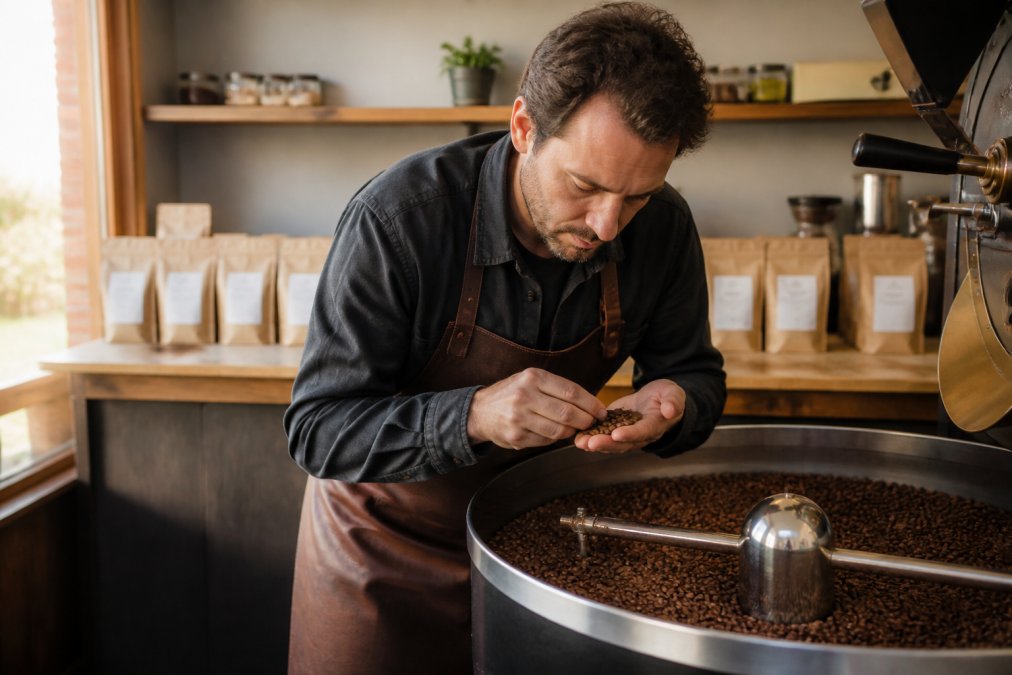
Lux Brew Coffee Co. combines specialty grade coffee with ethical farming practices and roasts every batch to order. Beans ship within hours of roasting, ensuring peak freshness. Our sourcing model centers on family farms, and our commitment to quality and freshness supports our ethical claims. Availability depends on what the farms are harvesting, so a favorite single-origin may rotate out.
2. Spirit Origin Coffee
3. Trade Coffee
4. PT's Coffee
5. Pact Coffee
6. Moustache Coffee Club
7. Farm and Forest Coffee
8. Philly Fair Trade Roasters
9. Ember Coffee
10. Hampton Coffee Company
Frequently Asked Questions
How does direct trade coffee impact the income of small-scale farmers?
Direct trade coffee often raises farmer income by paying quality-based premiums that exceed commodity market prices. Because roasters negotiate directly with smallholder farmers or cooperatives, more of the final retail price reaches the farm gate. That said, income gains depend on volume, consistency, and whether the roaster commits to long-term partnerships. Without third-party verification, some direct trade deals may still leave farmers vulnerable to price volatility and uneven bargaining power.
Does direct trade guarantee a living wage for coffee farmers?
No. Direct trade does not automatically guarantee a living wage. While premiums can lift income above commodity market rates, a living wage also depends on farm size, household costs, and regional economic conditions. Some roasters publish farm-gate prices and commit to fair compensation, but the model is largely self-regulated. Buyers should look for roasters that disclose pricing, support cooperatives, and reinvest in community infrastructure rather than relying on the direct trade label alone.
What is the difference between Fair Trade and Direct Trade coffee?
Fair Trade relies on third-party certification standards, including a price floor and social premiums, to protect farmers from market fluctuations. Direct Trade skips certification and instead builds roaster-farmer relationships, often paying higher quality-based premiums. The trade-off is accountability: Fair Trade offers verified minimums, while Direct Trade depends on roaster transparency. Some roasters combine both models to balance safety nets with direct partnerships and supply chain integrity.
How do roasters verify ethical practices in direct trade?
Verification in direct trade varies widely. Some roasters visit farms, publish farm-gate prices, and maintain traceability from harvest to roast. Others rely on importer relationships or cooperative records. Because there is no universal certification standard for direct trade, buyers should look for specific disclosures: named farms, harvest dates, pricing data, and long-term partnership commitments. Coffee supply chain transparency is the strongest signal that a roaster's ethical claims are credible.
Is direct trade coffee more expensive for the consumer?
Usually, yes. Direct trade coffee often costs more because roasters pay above-market premiums, absorb travel and relationship-building costs, and source smaller lots. Prices depend on origin, harvest, and roaster, so check each brand's website for current pricing. For consumers, the higher price reflects better bean quality, freshness, and a supply chain that returns more value to farmers. Whether that premium is worth it depends on how much you value traceability and social impact in your daily cup.
The core challenge with direct trade is that its benefits depend entirely on the integrity of the roaster, not on an external guarantee. Lux Brew Coffee Co. addresses that by pairing ethical family farm sourcing with specialty grade beans, roasting to order, and shipping within hours so freshness proves the supply chain is real. If you want coffee where the sourcing claim and the cup quality reinforce each other, get started with Lux Brew Coffee Co. and taste the difference transparency makes.