

Table of Contents
- What You'll Need Before You Start
- Step 1: Unplug and Disassemble Your Burr Coffee Grinder
- Step 2: Clean the Burrs, Hopper, and Grind Chamber
- Step 3: Dry Every Component Thoroughly
- Step 4: Reassemble and Recalibrate Your Grinder
- How Often to Clean a Coffee Grinder
- Do Coffee Grinder Cleaning Pellets Actually Work?
- Common Mistakes to Avoid
- Frequently Asked Questions
Last Updated: September 18, 2026
What You'll Need Before You Start
Learning how to clean a burr coffee grinder starts with the right tools. A clean grinder is the difference between a bright, clear cup and one that tastes dull or bitter. At Lux Brew Coffee Co., we roast every batch to order and ship it within hours, so your equipment should protect those fresh flavors instead of burying them under old oils.
The Best Tools for Cleaning Coffee Grinders
The best tools for cleaning coffee grinders are simple, cheap, and food-safe.
Here is what to gather:
- A stiff brush with nylon bristles
- A microfiber cloth
- A small vacuum with a brush attachment
- Compressed air (optional, for tight spots)
- Mild dish soap and warm water
- A shallow bowl or tray
U.S. Food and Drug Administration food contact surface guidance
Safety Warnings Before You Touch Anything
Unplug the grinder first. Burrs are razor sharp, and a grinder that powers on accidentally can cause serious injury.
Keep these warnings in mind:
- Never reach into the grind chamber while the grinder is plugged in
- Handle burrs by their edges, not the cutting surfaces
- Keep water away from the motor housing at all times
- Work over a tray to catch loose grounds and small parts
Step 1: Unplug and Disassemble Your Burr Coffee Grinder
Disassembly is where small parts get lost, so go slow.
Step 2: Clean the Burrs, Hopper, and Grind Chamber
This is the core of how to clean a burr coffee grinder. Coffee oils, fine dust, and residue collect in every corner; left alone, those oils turn rancid and ruin flavor clarity.
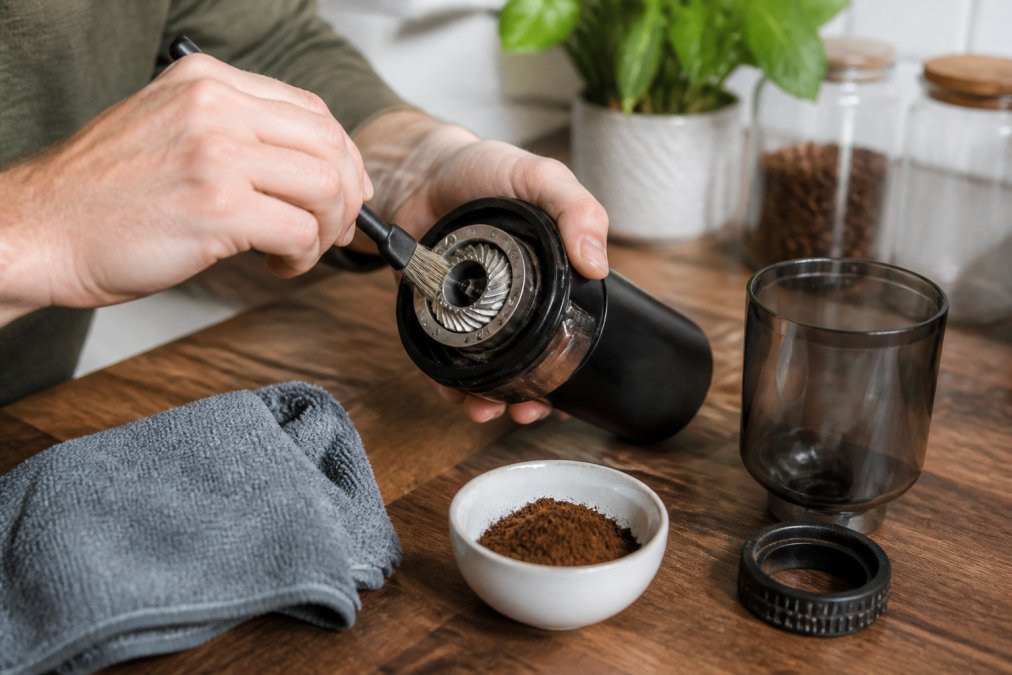
Cleaning Flat Burrs vs Conical Burrs
Flat burrs sit as two parallel discs, and grounds pack into the outer edges; brush in a circular motion around the full disc. Conical burrs nest inside each other, so residue collects deeper in the cone; lift the inner cone out and brush each surface separately.
Removing Stubborn Coffee Oils and Residue Buildup
Rancid oils cling to burrs and resist a dry brush. For stubborn residue, dampen a cloth with warm water and a drop of mild dish soap, wipe the burr surfaces, then dry immediately. Never soak burrs, moisture left on steel leads to rust, which dulls the cutting edges and hurts grind consistency.
Step 3: Dry Every Component Thoroughly
Thorough drying is the step people skip, and it causes the most damage. Any moisture left inside the grind chamber will rust the burrs and clump your next dose.
Follow this order:
- Wipe each part with a dry microfiber cloth
- Let washed parts air dry fully before reassembly
- Check the grind chamber for hidden droplets
- Confirm the burrs are completely dry to the touch
Step 4: Reassemble and Recalibrate Your Grinder
Reassembly reverses disassembly, but calibration is what most guides leave out, once parts are back in place, your grind settings will likely be off.
Calibration and Grind Consistency Checks
After cleaning, your grind setting often shifts. Recalibrate by running a small dose of beans and checking particle size.
Run these checks:
- Grind a small sample and feel the grounds
- Adjust the collar until you hit your target setting
- Look for even particle size, not a mix of dust and chunks
- Pull a shot or brew a cup to confirm flavor clarity
How Often to Clean a Coffee Grinder
There is no single correct cleaning interval. The right frequency depends on burr geometry, roast level, grind volume, and build. A fixed 'weekly brush, monthly deep clean' rule is a starting point, not a prescription.
The Baseline Schedule
For a typical home setup grinding one to two doses per day with medium-roast beans:
| Task | Frequency | Time Needed |
|---|---|---|
| Brush out grounds | Weekly | 5 minutes |
| Wipe hopper and chamber | Weekly | 5 minutes |
| Full disassembly and deep clean | Monthly | 20-30 minutes |
| Check burr wear and alignment | Every 3 months | 10 minutes |
| Replace burrs (flat, home use) | Every 500-1,000 lb of coffee | Varies by model |
| Replace burrs (conical, home use) | Every 800-1,500 lb of coffee | Varies by model |
Adjusting for Roast Level
Oily, dark roasts leave far more residue than light roasts. The oils that coat the burrs during a dark-roast grind can go rancid in as little as two to three weeks in a warm kitchen, so if dark, oily beans are your daily cup, deep clean every two to three weeks and brush weekly.
Adjusting for Burr Type
Flat burrs have a larger surface area in contact with the coffee, and grounds pack into the outer edges of the disc, so they benefit from brushing every few days if you grind daily.
Adjusting for Usage Volume
A grinder used twice a day and one used six times a day do not need the same schedule. Scale the deep-clean interval inversely with daily dose count: two doses, monthly; four doses, every two weeks; six or more, weekly.
Signs You Should Clean Sooner Than Scheduled
Do not wait for the calendar if you notice any of these:
- A stale or flat aroma when you open the hopper
- Grinds that clump or feel tacky between your fingers
- Slower grind times than usual for the same dose and setting
- Visible oil sheen on the burr faces or chamber walls
- A bitter or muddy flavor in the cup that does not match the bean
- Static that has gotten noticeably worse
Tie Cleaning to Burr Inspection
Every deep clean is a free chance to inspect your burrs. Look for:
- Rounded or polished cutting edges instead of sharp, defined ones
- Chips, nicks, or flat spots on the cutting surfaces
- Uneven wear between the two burrs, which suggests misalignment
- Rust or pitting, which usually means moisture reached the steel at some point
- A dark, gummy film that does not come off with a damp cloth, polymerized oil that has bonded to the surface
Do Coffee Grinder Cleaning Pellets Actually Work?
Coffee grinder cleaning pellets work for light maintenance between deep cleans, but they are not a replacement for disassembly. Knowing why they work, and where they fail, tells you when to reach for them.
What Cleaning Pellets Actually Do
Most pellets are made from parboiled rice, wheat, or a grain-based composite. Harder and more abrasive than coffee beans, they scrub light oil films off the burr faces and sweep loose grounds out of the grind path. Some brands add a food-safe cleaning agent.
When Pellets Help
- Between monthly deep cleans, when you want a quick refresh without disassembly
- After grinding a particularly oily or flavored batch, to pull residual oils off the burr faces before they set
- On grinders that are difficult or risky to disassemble (some sealed commercial-style units)
- As a first pass before a manual clean, to loosen caked residue so your brush does less work
When Pellets Hurt
- On flat burrs with tight tolerances. The abrasive grain can accelerate edge wear if used frequently. A common pattern among technicians is to limit pellet use to once every few weeks on high-end flat-burr grinders.
- As a substitute for disassembly. Relying on pellets alone lets oils polymerize in the areas pellets cannot reach. That buildup eventually migrates into the grind path and shows up as stale, muddy flavor.
- On grinders with plastic burr carriers or soft coatings. The abrasive action can scuff surfaces that a nylon brush would leave untouched.
- Immediately before a brew you care about. Pellets leave a faint grain residue. Always run a small dose of sacrificial beans through the grinder after using pellets, and discard those grounds.
Pellets vs. Manual Cleaning: A Direct Comparison
| Factor | Cleaning Pellets | Manual Disassembly |
|---|---|---|
| Time | 1-2 minutes | 20-30 minutes |
| Reaches burr faces | Yes | Yes |
| Reaches adjustment threads | No | Yes |
| Reaches hopper seal and chute | Partial | Yes |
| Removes polymerized oils | No | Yes |
| Risk of burr wear | Low but nonzero | None if done correctly |
| Requires recalibration after | No | Yes |
The Bottom Line
Use pellets as a maintenance tool, not a cleaning strategy. A reasonable cadence is a pellet run every one to two weeks on a daily-use grinder, paired with a monthly manual deep clean. If stale aroma or uneven extraction persists after a pellet run, the residue has moved beyond what pellets can reach, it is time to disassemble.
Common Mistakes to Avoid
- Reaching into the chamber while the grinder is plugged in
- Soaking burrs or the motor housing in water
- Reassembling before parts are fully dry
- Skipping recalibration after cleaning
- Using metal tools that scratch the burr surfaces
- Letting rancid oils build up for months
Fresh, well-roasted beans deserve a grinder that is just as clean. When your equipment is dialed in, the flavors in a single-origin roast come through the way the roaster intended.
Frequently Asked Questions
What can I run through my coffee grinder to clean it?
The safest option is a dedicated product made for the job, such as coffee grinder cleaning pellets, which are designed to absorb coffee oils and residue without damaging the burrs. Some owners run a small amount of uncooked white rice through the grinder, but rice is harder than most burr steel and can dull or chip the edges over time. Avoid running anything wet, sugary, or flavored through the burr coffee grinder, since those leave sticky films that speed up rancid oil buildup.
How often should a burr grinder be cleaned?
A quick brush-out every week works for most home setups, with a full disassembly and deep clean every four to six weeks. If you grind dark, oily beans or brew daily, clean more often. Daily espresso drinkers may want a weekly deep clean. Signs you waited too long include stale or bitter flavors, inconsistent particle size, static cling in the grind chamber, and visible residue buildup on the burrs. A consistent maintenance schedule protects grind consistency and flavor clarity.
Is it safe to clean a burr grinder with rice?
Rice is a common home remedy, but it carries real risk. Uncooked rice is harder than the steel used in most flat and conical burrs, so running it through can round off the cutting edges and throw off alignment. It also leaves a fine powder that mixes with coffee oils and packs into the grind chamber. Cleaning pellets are a safer substitute because they are formulated to be softer than burr steel while still absorbing residue.
Do I need to use water to clean my coffee grinder burrs?
No. Water is the enemy of most burr grinders because moisture rusts steel burrs, corrodes the motor housing, and turns leftover grounds into a paste that clogs the grind chamber. Stick to dry methods: a stiff brush, compressed air, and a microfiber cloth. If a burr has a stubborn oil film, wipe it with a cloth barely dampened with mild dish soap, then dry it completely before reassembly. Never pour water into the hopper or run the motor while anything is wet.
Keeping a burr grinder clean takes a little time, but it protects every cup you brew. If you want beans fresh enough to make that effort worth it, Lux Brew Coffee Co. roasts each order to your specification and ships within hours of roasting. Our specialty grade coffee comes from ethical family farms, so you get peak freshness and full flavor clarity in every batch. Get started with Lux Brew Coffee Co. and taste what properly cared-for equipment and freshly roasted beans can do together.