

Table of Contents
- What You'll Need for Pour Over Coffee at Home
- The Coffee to Water Ratio for Pour Over That Actually Works
- How to Grind Coffee Beans for Pour Over
- Pour Over Coffee Water Temperature Guidelines
- Pour Over Coffee Bloom Time: Why It Matters
- Step-by-Step Pour Over Brewing Process
- Water Chemistry and Mineral Content
- Troubleshooting Pour Over Coffee by Taste Profile
- Frequently Asked Questions
Last Updated: September 16, 2026
What You'll Need for Pour Over Coffee at Home
Making pour over coffee at home starts with a short list of gear that gives you control over every variable. The method rewards precision, and the equipment exists to deliver it. According to Specialty Coffee Association brewing standards, consistent extraction depends more on your technique and measurements than on how much you spend.
This guide from Lux Brew Coffee Co. covers ratios, grind size, water temperature, bloom timing, and how to fix a cup that tastes off.
Essential Equipment
A pour over setup needs a dripper, a paper filter that fits it, a gooseneck kettle, a digital scale, a burr grinder, and a carafe or mug. That's the whole kit.
The gooseneck kettle matters because it controls flow rate. A standard kettle dumps water in surges, disturbing the coffee bed and causing channeling, where water cuts a path through the grounds instead of saturating them evenly.
The scale matters because volume scoops are unreliable. Weighing in grams keeps your coffee-to-water ratio identical from one morning to the next.
Equipment Budget Tiers
You can brew excellent pour over coffee at three spending levels. The difference between tiers is durability and repeatability, not cup quality.
| Tier | What It Includes | Best For |
|---|---|---|
| Starter | Plastic dripper, paper filters, basic digital scale, blade grinder | Testing whether you enjoy the method |
| Mid-range | Ceramic or glass dripper, gooseneck kettle, burr grinder, 0.1g scale | Daily brewing with consistent results |
| Enthusiast | Temperature-controlled kettle, high-end burr grinder, server carafe | Chasing specific flavor profiles |
A common mistake is buying an expensive dripper before upgrading the grinder. A burr grinder produces uniform particles; a blade grinder produces dust and boulders, and no dripper can compensate.
The Coffee to Water Ratio for Pour Over That Actually Works
The coffee to water ratio for pour over that works for most people is 1:15 to 1:17 by weight. A standard starting point is 20 grams of coffee to 320 grams of water, yielding about one 10-ounce cup.
Stronger ratios (1:15) produce heavier body and intensity; lighter ratios (1:17) produce a cleaner, tea-like cup with more acidity. Start at 1:16, then adjust by taste.
Weigh your coffee beans whole, then grind. Beans lose mass during grinding, so weighing after grinding introduces error.
How to Grind Coffee Beans for Pour Over
Learning how to grind coffee beans for pour over comes down to one target: medium-fine. The grounds should look like table salt, clumping slightly when pinched but not turning to powder. That visual check is a starting point, the real test is how the brew drains and how the cup tastes.
Grind too coarse and water rushes through, leaving sourness and a thin body. Grind too fine and the bed clogs, draw-down stretches past four minutes, and bitterness takes over. The sweet spot for most drippers is a total brew time between 2:30 and 3:30.
Dialing In Your Grinder
If you're using a burr grinder, start at the midpoint of its espresso-to-French-press range. Most conical burr grinders label settings from 1 (finest) to 40 or higher (coarsest); a pour over starting point usually falls between 60% and 75% of the way toward coarse. Because every grinder's numbering is arbitrary, use the cup and draw-down time as your feedback loop rather than chasing a number.
A practical sequence:
- Brew with your current setting and time the draw-down.
- If it finishes under 2:30 and tastes sour, go two clicks finer.
- If it runs past 3:30 and tastes bitter or dry, go two clicks coarser.
- Change only one step at a time and re-taste before adjusting again.
Why Grind Uniformity Matters
Uniformity determines how evenly water extracts flavor from each particle. When grind sizes vary, small particles over-extract and large particles under-extract simultaneously, producing a cup that tastes both bitter and sour, confusing to troubleshoot because no single adjustment fixes it.
A burr grinder crushes beans between two rotating surfaces set to a fixed distance, producing consistent particle sizes. Blade grinders chop unpredictably, throwing off dust and boulders in the same batch. If you upgrade one piece of equipment, upgrade this one.
Fines, the dust-like particles every grinder produces, are the other variable. A small amount helps build the bed that filters the brew, but excessive fines stall the draw-down and create channeling, where water cuts a path through the grounds instead of saturating them evenly. If your draw-down is slow no matter how coarse you grind, fines are the likely culprit, a sign your burrs are worn or the beans unusually brittle.
Grinding Fresh vs. Buying Pre-Ground
Whole beans hold their aromatics far longer than ground coffee, because grinding exposes a much larger surface area to oxygen. Pre-ground coffee loses most of its peak flavor within a week of opening, while whole beans stay vibrant for several weeks past their roast date. Grinding immediately before brewing is one of the highest-return habits in pour over.
Pour Over Coffee Water Temperature Guidelines
The pour over coffee water temperature range that works is 195°F to 205°F (91°C to 96°C). Within that window, temperature controls how aggressively water dissolves flavor compounds. Hotter water extracts faster and pulls more of everything, sugars, acids, and bitter compounds that show up late. Cooler water extracts slower and leaves sweetness and body behind.
That is why a full rolling boil is a problem. Water straight off a boil is roughly 212°F at sea level, and pouring it onto the bed scalds the grounds, over-extracts the outer layers of each particle, and produces a harsh, drying cup. Water below 195°F under-extracts, leaving the cup flat, sour, and thin.
How to Hit the Target Without a Thermometer
Most kettles without temperature control reach a boil and then cool slowly. Without a thermometer, boil the water, then let it sit about 30 seconds before pouring, that pause drops it roughly into the 200°F range at typical kitchen elevation. A second check: pour the bloom water into a room-temperature mug and feel the outside, if it's too hot to hold comfortably, it's still above target.
If you brew often, a variable-temperature electric kettle removes the guesswork: set it to 200°F and it holds there.
Adjusting Temperature by Roast Level
Roast level changes how readily the coffee gives up its flavor, so the ideal temperature shifts with it.
Elevation Changes the Boiling Point
Pour Over Coffee Bloom Time: Why It Matters
Step-by-Step Pour Over Brewing Process
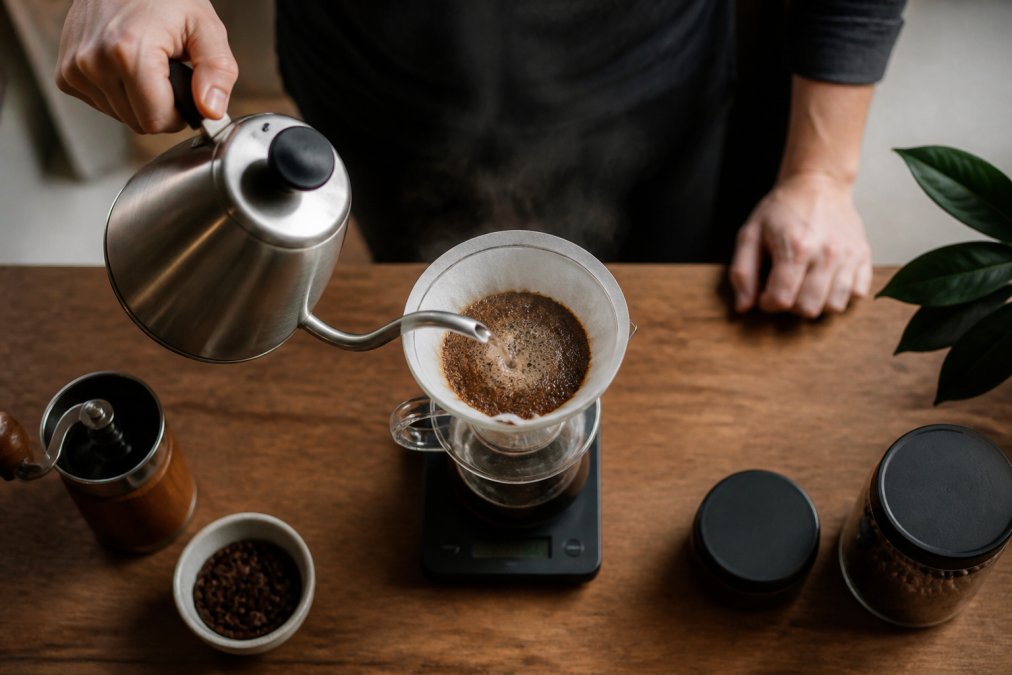
Here is the full process, start to finish, about four minutes, most of it waiting.
Pouring Technique and Spiral Motion
Start each pour at the center and spiral outward, then back in.
Water Chemistry and Mineral Content
The water you brew with makes up more than 98% of the finished cup, so its mineral content matters as much as your beans.
Troubleshooting Pour Over Coffee by Taste Profile
| Taste Problem | Likely Cause | Fix |
|---|---|---|
| Sour, sharp, thin | Under-extraction | Grind finer or raise water temperature |
| Bitter, dry, harsh | Over-extraction | Grind coarser or lower water temperature |
| Weak but bitter | Uneven extraction, channeling | Improve pouring technique, check for excessive fines |
| Muddy, heavy, slow draw-down | Grind too fine | Coarsen the grind |
| Watery, no sweetness | Ratio too light | Use more coffee per gram of water |
Sustainability matters here too. Spent grounds are rich in nitrogen and work well in compost, and paper filters break down in most home compost systems.
Frequently Asked Questions
What is the secret to good pour over coffee?
The secret comes down to controlling four variables: grind size, water temperature, coffee-to-water ratio, and pour technique. Use a burr grinder for uniform particles, heat water to 195-205°F, measure a 1:15 to 1:17 ratio, and pour in slow spiral motions. Freshly roasted beans make a noticeable difference too, since coffee loses flavor compounds within weeks of roasting.
What is the correct coffee to water ratio for pour over?
Start with 1 gram of coffee per 15 to 17 grams of water. For a standard 12-ounce cup, that means roughly 22 grams of coffee and 350 grams of water. If the cup tastes weak, tighten the ratio toward 1:15. If it tastes too intense or bitter, loosen it toward 1:17. Always use a scale rather than scoops for consistency.
Why is my pour over coffee tasting bitter or sour?
Bitter coffee usually means over-extraction: your grind is too fine, water is too hot, or brew time ran long. Sour or sharp coffee points to under-extraction: grind too coarse, water too cool, or the pour finished too fast. Adjust one variable at a time. Change grind size first, then water temperature, and taste again before making another adjustment.
Can you use regular ground coffee to make pour over coffee?
You can, but results will be inconsistent. Pre-ground coffee is typically too fine for pour over, which slows draw-down time and causes bitterness or channeling. If you must use it, choose a medium grind labeled for drip coffee and expect a faster, less controlled extraction. Grinding whole beans just before brewing gives you far better control over flavor.