

Last Updated: October 24, 2026
Quick Summary
Investing in specialty coffee equipment at home is worth it when the gear removes the variables that make a cup taste flat, since a consistent grind, stable water temperature, and a repeatable ratio let you reproduce a good cup every morning. The equipment does not add flavor; it stops losing it.
- A burr grinder is the highest-use purchase in any home setup because it controls grind consistency.
- Spend roughly half of a starter budget on the grinder, a quarter on the brewer, and the rest on scale, kettle, and beans.
- Only after grind and water are solved should you consider buying an espresso machine.
- Add up consumables, replacement parts, water treatment, energy use, and resale value before comparing two machines.
- A simple carbon filter and a routine descaling schedule prevent most equipment failures.
Table of Contents
- Why Specialty Coffee Equipment Changes What's in Your Cup
- The Best Coffee Equipment for Home: What Actually Earns Its Place
- Home Espresso Machine Buying Guide: What to Check Before You Spend
- Choosing a Coffee Grinder for Home Brewing
- Building a Budget Home Coffee Setup That Grows With You
- Total Cost of Ownership: What the Price Tag Doesn't Show
- Water Quality, Maintenance, and Keeping Gear Running for Years
- Pairing Your Setup With Freshly Roasted Specialty Beans
- Frequently Asked Questions
Why Specialty Coffee Equipment Changes What's in Your Cup
Investing in specialty coffee equipment at home is worth it when the gear removes the variables that make a cup taste flat. At Lux Brew Coffee Co., we see the difference clearly: a consistent grind, stable water temperature, and a repeatable ratio turn good beans into a cup you can reproduce every morning.
Most people upgrade in the wrong order. They buy a nicer machine, then wonder why the coffee still tastes thin or bitter. The reason is almost always upstream of the brew.
The Grinder Comes Before the Machine
A burr grinder is the highest-use purchase in any home setup. It controls grind consistency, and grind consistency controls extraction. A blade grinder chops unevenly, so fine particles over-extract while coarse ones under-extract in the same brew.
If you want to understand why this matters before you spend, read our guide to the benefits of grinding coffee beans at home. It explains the freshness curve and why pre-ground coffee loses its best qualities fast.
The Best Coffee Equipment for Home: What Actually Earns Its Place
The best coffee equipment for home is the short list that improves results on every brew: a burr grinder, a scale, a temperature-controlled kettle or machine, and a brewer you will actually use. Everything else is preference. This is where most buyers overspend, loading up on accessories before the core four are settled.
Essential Versus Optional Gear
- Essential: burr grinder, digital scale, filter or espresso brewer, fresh whole beans
- Strong second tier: gooseneck kettle, tamper and leveler for espresso, water filter
- Optional: milk pitchers, knock boxes, tamping mats, dosing cups, decorative storage
A common mistake is buying the optional tier first. It feels productive and changes almost nothing in the cup.
Home Espresso Machine Buying Guide: What to Check Before You Spend
A home espresso machine buying guide should start with four specs, not brand names: temperature stability, pressure consistency, group head quality, and whether the machine ships with a standard 58mm basket. Those four determine whether you can pull repeatable specialty-grade shots or fight the machine every morning.
Look for a single-group machine with a real portafilter and a basket that accepts a standard tamper. Check that the steam wand is a proper wand rather than a panarello sleeve, because milk steaming is where cheap machines fall apart.
Espresso Versus Pour-Over: Which Path Fits You
Espresso rewards control and punishes shortcuts. It asks for a capable grinder, a scale, and practice with dose, yield, and brew ratio.
If you want espresso without a steep learning curve, a compact option like the Breville Bambino espresso machine is a sensible entry point. If you drink lighter roasts and enjoy the ritual, pour-over will teach you more per dollar.
Choosing a Coffee Grinder for Home Brewing
A coffee grinder for home brewing should be a burr grinder with adjustable settings that hold their position.
Match the grinder to your brew method. Espresso needs fine, repeatable adjustments. Pour-over and drip are more tolerant.
For a concrete starting point, the Oxo Brew conical burr grinder is a well-known option for home setups that need reliable grind size without commercial pricing.
Building a Budget Home Coffee Setup That Grows With You
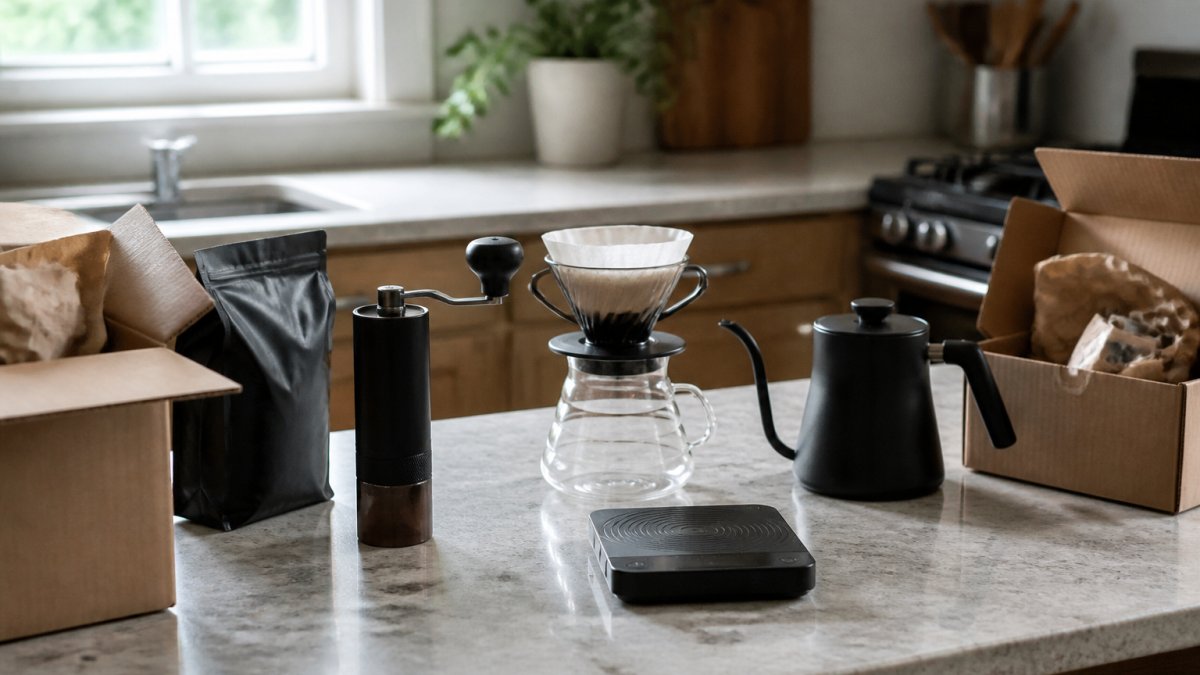
A budget home coffee setup should be staged, not assembled all at once. The mistake most buyers make is spreading a fixed budget evenly across every category, which leaves them with a mediocre grinder, a mediocre brewer, and no money left to fix either.
How to Allocate a Fixed Budget
A practical rule is to spend roughly half of a starter budget on the grinder, a quarter on the brewer, and the remainder on a scale, kettle, and fresh beans.
| Budget tier | Grinder share | Brewer share | Scale, kettle, beans | What this tier buys |
|---|---|---|---|---|
| Starter | About 50% | About 25% | About 25% | A hand grinder or entry electric burr grinder, a dripper, a digital scale, and a stovetop kettle |
| Intermediate | About 45% | About 30% | About 25% | An electric burr grinder with repeatable settings, a temperature-controlled kettle, and a water filter |
| Advanced | About 40% | About 40% | About 20% | An espresso-capable grinder and a single-group espresso machine with a standard basket |
These are proportions, not prices. The point is that the grinder stays the largest single line item at every tier until you move into espresso, where the machine legitimately becomes the bigger purchase.
Stage 1: Fix Consistency First
Start with a burr grinder, a digital scale, and a simple brewer. A hand grinder and a pour-over dripper will outperform a cheap electric blade grinder and an expensive drip machine, because the hand grinder produces a consistent particle size and the dripper gives you control over ratio and pour. Add a scale before you add anything else, since weighing dose and water is the cheapest upgrade in coffee and the one that makes every later purchase measurable.
Stage 2: Add Control and Water Quality
Once the grinder and scale are settled, add a gooseneck kettle for pour control and a carbon water filter. Water is roughly the largest ingredient by mass in every cup, and hard water both flattens flavor and scales heating elements. A filter is inexpensive relative to the equipment it protects.
Stage 3: Decide Whether Espresso Is Your Path
Only after grind and water are solved should you consider an espresso machine. Espresso demands a grinder that can make fine, repeatable adjustments, so buying the machine first usually means buying a second grinder later. If you do move to espresso, budget for a tamper that matches your basket size and a scale that fits under the group head.
Stage 4: Upgrade the Bottleneck, Not the Showpiece
When you upgrade, upgrade whatever is currently limiting the cup. If shots turn inconsistent, the grinder is the bottleneck. If temperature swings between shots, the machine is. Buying a nicer machine while the grinder is the constraint changes nothing in the cup and is the most common way home setups waste money.
Total Cost of Ownership: What the Price Tag Doesn't Show
The sticker price is the smallest part of what you will spend. Filters, descaler, replacement burrs, water, and beans recur for as long as you own the gear, and the gap between a cheap machine you replace twice and a serviceable machine you maintain once is usually larger than the difference in purchase price. Total cost of ownership is the number competitors leave out, and it is the number that should decide the purchase.
The Five Cost Lines to Add Up
- Consumables. Filters, descaler, cleaning tablets, and beans recur monthly. Beans dominate this line for most households, which is why equipment that lets you brew well with less coffee, a consistent grinder and an accurate scale, pays back through lower waste.
- Replacement parts. Burrs wear out. Gaskets, shower screens, and steam wand seals fail. A machine with standard, widely available parts costs less over five years than one with proprietary parts you cannot source.
- Water treatment. Filter cartridges and descaling supplies are inexpensive per month but prevent the scale damage that ends machine life early. Skipping them is a false saving.
- Energy use. Espresso machines that stay on all day draw power continuously. A machine with a short heat-up time or a programmable schedule costs less to run than one left hot for hours.
- Resale value. Grinders and espresso machines from established manufacturers hold resale value far better than no-name equipment, which effectively lowers the net cost of owning them.
How to Compare Two Machines Honestly
Add the purchase price to the estimated consumables and parts over the expected service life, then subtract the resale value you could reasonably expect. A machine that costs more upfront but uses standard parts, has replaceable burrs, and holds resale value often wins that comparison against a cheaper machine that fails in year three.
Ask three questions before buying:
- Can the burrs or the brew unit be replaced, and are those parts sold separately?
- Is there a published descaling and backflush routine, and will you actually follow it?
- Does the manufacturer or a service network support repairs, or is the machine disposable by design?
Repairability Is the Quiet Advantage
Repairability is mostly a design decision made before you buy. Standard basket sizes, common thread fittings, and serviceable group heads make a machine maintainable. Sealed brew units and proprietary fittings make it landfill. For a home buyer, the practical test is simple: if a gasket fails in year two, can you replace it yourself, or does the machine have to be shipped away?
Water Quality, Maintenance, and Keeping Gear Running for Years
Water quality decides both how your coffee tastes and how long your equipment lasts. Hard water scales heating elements and clogs group heads, and the damage is cumulative.
Maintenance is unglamorous and decisive. Backflush espresso machines regularly, clean grinders to remove retained oils, and replace burrs when shots turn inconsistent. Durability is mostly a habit, not a spec. The gear that lasts is the gear that gets cleaned.
Pairing Your Setup With Freshly Roasted Specialty Beans
Great equipment amplifies fresh coffee and exposes stale coffee. Store them in an airtight container away from light and heat, and our guide to how to store fresh coffee beans covers the details that keep them at their peak.
If you want a steady supply without reordering every week, our specialty coffee subscription comparison lays out the options. At Lux Brew Coffee Co., every batch is roasted to order and shipped within hours, sourced from ethical family farms, so the beans reaching your grinder are as fresh as the equipment deserves.
Frequently Asked Questions
What coffee equipment should I buy first for a home setup?
Start with a burr grinder and a digital scale, then add a brewer. A burr grinder gives you consistent grind size, which affects extraction more than most machines at this stage, and a scale lets you control dose and brew ratio so results repeat. A basic pour-over dripper or French press costs little and teaches you how grind and ratio change flavor before you commit to an espresso machine.
Is a coffee grinder more important than an espresso machine?
For most home brewers, yes. An espresso machine cannot fix an uneven grind: inconsistent particles cause channeling, sour or bitter shots, and poor shot consistency no matter how stable the machine's temperature or pressure. A quality burr grinder improves every brew method you own, from pour-over to espresso, so it earns its cost across your whole setup rather than one device.
How much should I spend on specialty coffee equipment at home?
There is no single right number, because pricing depends on the gear tier and your brew method. A sensible approach is to set a total budget, spend the largest share on the grinder, and buy the brewer second. Hold back a portion for maintenance items like descaler, filters, and cleaning tablets. Check current prices on each brand's site rather than relying on older figures, and add gear in stages as your skills grow.
How can I build a home coffee setup on a budget?
Buy in stages. Begin with a hand burr grinder, a scale, and a pour-over dripper or French press, which together cover manual brewing well. Add a gooseneck kettle when you want more control over pour rate. Save the espresso machine for later, once you know you will use it daily, and put money into fresh specialty-grade beans, since stale coffee limits any setup regardless of cost.
The real challenge is not choosing gear. It is keeping a fresh, consistent supply of beans behind it. Lux Brew Coffee Co. roasts every batch to order, ships within hours of roasting, and sources specialty-grade coffee from ethical family farms. Get started with Lux Brew Coffee Co. and give your setup coffee worth the investment.
