

Table of Contents
- What Makes a Manual Coffee Grinder Worth Your Investment
- Manual vs Electric Coffee Grinder: Which Suits Your Routine
- Key Features That Define Grind Quality and Consistency
- Coffee Grind Size Chart for Home Brewing Methods
- Top Manual Coffee Grinders for Different Brewing Styles
- Portability, Capacity, and Ergonomic Considerations
- Maintenance, Durability, and Long-Term Value
- Conclusion
Last Updated: August 22, 2026
What Makes a Manual Coffee Grinder Worth Your Investment
A quality manual coffee grinder transforms your brewing ritual from convenient to exceptional. The difference between pre-ground coffee and freshly ground beans is the gap between a flat, oxidized cup and one with vibrant acidity, complex florals, or rich chocolate notes (peer-reviewed research).
Manual grinders deliver consistent particle size across the entire grind, which directly impacts extraction and determines whether your coffee tastes bright and balanced or thin and bitter. The real investment is the daily ritual of grinding by hand, that 2-3 minute process becomes meditative, forcing you to slow down before your first cup and develop an intuitive sense for when your coffee is ready to brew.
Manual vs Electric Coffee Grinder: Which Suits Your Routine
The choice comes down to what you're optimizing for. Electric grinders win on speed and convenience, but most generate heat during grinding, which can degrade flavor compounds, and tend to produce inconsistent particle distribution that muddies extraction.
Manual grinders optimize for precision and consistency. You control grinding speed, which means less heat generation. Quality manual grinders, especially those with conical burrs, produce remarkably uniform particle size that translates to more predictable extraction and better-tasting coffee. The downside is effort: grinding 30 grams for a pour-over takes roughly 90 seconds; for espresso, 3-5 minutes.
For most home brewers grinding once or twice daily, manual is the better choice. You get superior grind consistency, lower cost of entry, and a more engaging ritual. If you're grinding for multiple people every morning, electric becomes practical.
Key Features That Define Grind Quality and Consistency
The difference between a mediocre grinder and an excellent one comes down to three factors: burr type, adjustment mechanism, and burr alignment.
Burr Type and Material: Ceramic vs. Stainless Steel
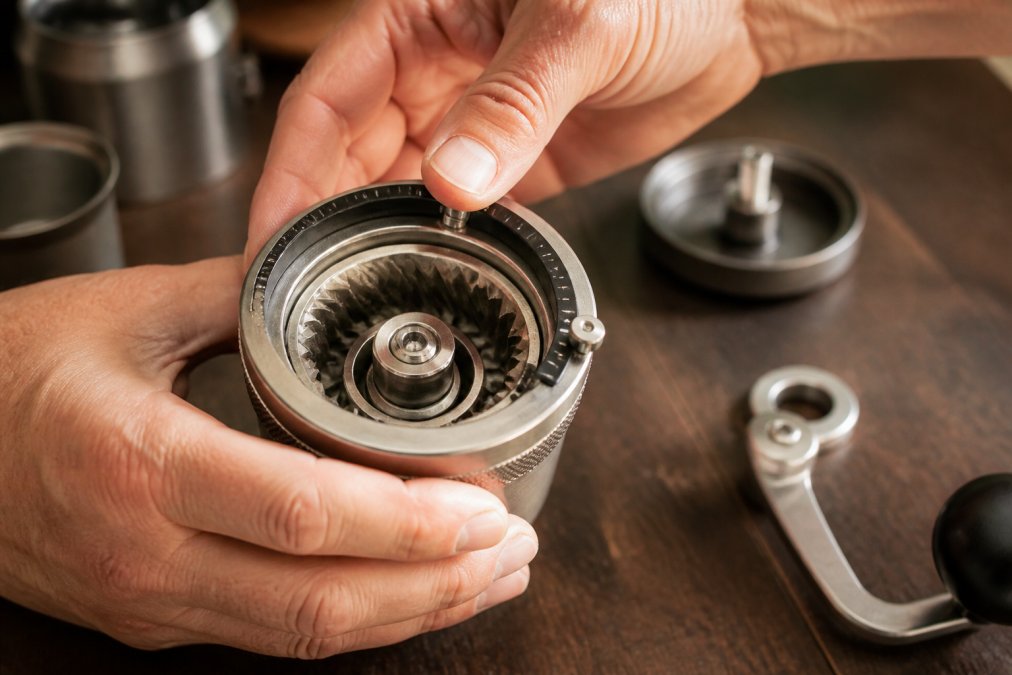
Conical burrs are the standard in quality manual grinders. They force beans through an increasingly narrow gap, producing remarkably uniform particle size.
Stainless steel conical burrs are more durable and maintain their sharp edges longer. High-nitrogen martensitic stainless steel is the premium option, harder, stays sharp through thousands of grinds, and produces minimal fines. Ceramic burrs are the budget alternative, transferring less heat and producing good particle uniformity for the price, but they're brittle and can chip easily.
The real performance difference between ceramic and stainless steel is smaller than marketing suggests. Both produce acceptable grind consistency for home brewing. The gap widens when grinding espresso daily, where burr wear becomes noticeable and stainless steel's longevity matters.
Adjustment Mechanisms: Stepped vs. Stepless Control
Stepped adjustment uses a dial with discrete click positions, typically 40-80 clicks per full rotation. Each click shifts the burrs by a fixed amount, usually 12-37 microns. This precision is more than sufficient for home brewing, and you can memorize your favorite settings.
Stepless adjustment offers infinite fine-tuning but requires more skill to dial in and return to the exact same position. Most home brewers prefer stepped adjustment for its speed and intuitiveness. Stepless shines for espresso enthusiasts who grind multiple times daily and want maximum flexibility.
Coffee Grind Size Chart for Home Brewing Methods
Grind size is the primary lever for controlling extraction. Different brewing methods require different grind sizes because they use different contact times and water temperatures:
| Brewing Method | Grind Size | Grind Consistency | Dial Setting (Typical) |
|---|---|---|---|
| Turkish | Powder-fine | Extremely uniform | 1-5 clicks |
| Espresso | Fine | Very uniform | 15-25 clicks |
| Pour-over (Chemex) | Medium-fine | Uniform | 25-35 clicks |
| AeroPress | Medium | Uniform | 30-40 clicks |
| French press | Coarse | Less critical | 50-70 clicks |
| Cold brew | Very coarse | Least critical | 70+ clicks |
Fine grinds (espresso range) are where manual grinders show their value. Most manual grinders under $100 handle fine grinds reasonably well, which is why they're popular for espresso enthusiasts on a budget. Coarse grinds are less demanding because longer contact time masks minor inconsistencies.
Top Manual Coffee Grinders for Different Brewing Styles
Premium Choice: Comandante C40 MK4
The Comandante C40 MK4 is the benchmark for manual grinder quality, built in Germany with aerospace-grade materials and high-nitrogen martensitic stainless steel burrs that maintain sharpness through thousands of grinds. The particle size distribution is remarkably uniform across all grind sizes, directly translating to better extraction. The 40-click stepped adjustment is intuitive, and it includes both amber glass and clear polymer jars.
Grinding espresso-fine takes 3-5 minutes of effort. The optional Red Clix accessory adds micro-adjustments between clicks for espresso enthusiasts. Best for coffee connoisseurs who grind daily and want the finest grind consistency available.
Espresso Precision: 1Zpresso JX-Pro
The 1Zpresso JX-Pro is the espresso specialist with a 48mm stainless steel conical burr optimized for fine grinds. The 40-click dial with 12.5-micron increments gives exceptional precision, and it grinds faster than competitors at the fine end. The internal bearing design prevents wobbling and maintains burr alignment. It's not ideal for coarse grinds, so if espresso is your primary method, this is excellent; if you grind for multiple methods, consider something more versatile.
Budget-Friendly: Timemore Chestnut C2
The Timemore Chestnut C2 costs less than half the premium options yet produces respectable grind consistency across all brewing methods. The 38mm stainless steel CNC burrs are durable, and the dual-bearing shaft prevents wobbling. The 30-gram capacity is small, requiring batch grinding for larger brewers. Grind uniformity isn't as impressive as premium grinders, especially at coarse settings, but for pour-over or AeroPress, this doesn't matter. Best for budget-conscious brewers upgrading from pre-ground coffee.
Travel-Ready: Porlex Mini II
The Porlex Mini II is the smallest manual grinder that works well, fitting inside an AeroPress. The improved ceramic burr set and compact stainless steel body are durable. The 20-gram capacity requires grinding in batches, and grinding espresso-fine takes 3-4 minutes. Best for travelers, campers, and office workers who want fresh-ground coffee without carrying a full grinder.
Beginner-Friendly: Hario Skerton Pro
The Hario Skerton Pro is affordable, compact, and intuitive. The ceramic conical burrs are durable, and the 100-gram hopper capacity reduces reloading. It grinds consistently for pour-over and French press, though grind uniformity isn't impressive for fine grinds. Best for newcomers to manual grinding who want an affordable, reliable grinder for pour-over, AeroPress, or French press.
Portability, Capacity, and Ergonomic Considerations
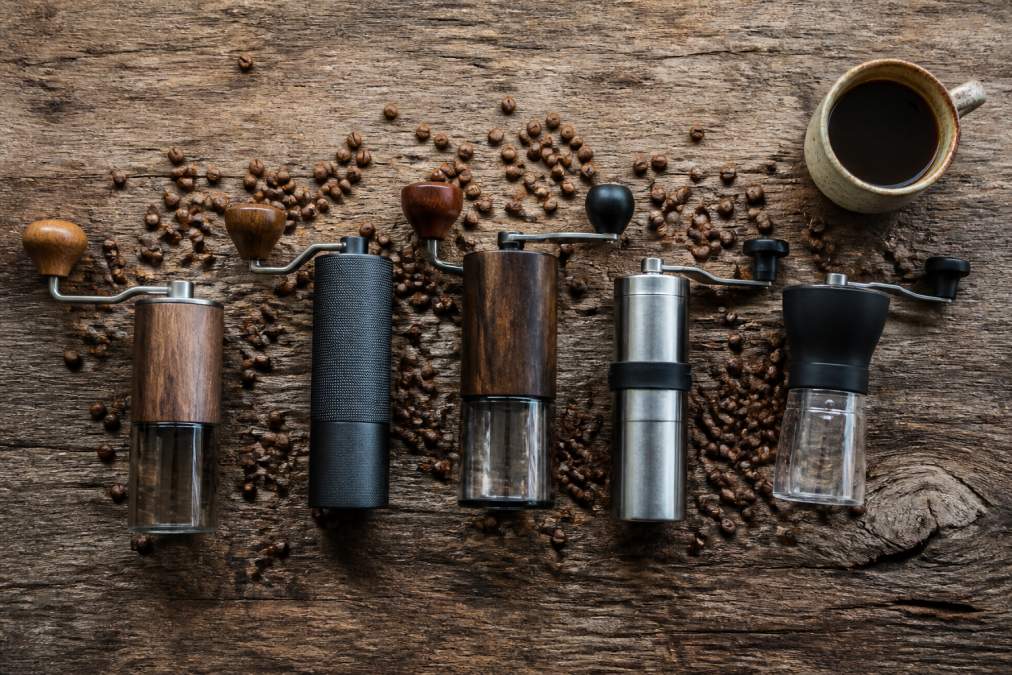
Manual grinders range from pocket-sized (20 grams) to full-sized (100+ grams). Capacity directly impacts workflow: a 20-gram grinder works for travel or single cups; a 50-gram grinder handles two cups; a 100-gram grinder lets you grind for multiple people without reloading.
Ergonomics matter significantly. Grinding espresso-fine for 5 minutes puts real strain on your hand and wrist. The Comandante C40 has excellent ergonomics with a long, comfortable crank arm. If you grind daily, prioritize ergonomics. If you grind occasionally, capacity and portability matter more.
Maintenance, Durability, and Long-Term Value
Manual grinders are simple machines with few moving parts. Stainless steel burrs last thousands of grinds, often 5-10 years of daily use. Ceramic burrs are more fragile but cheaper to replace.
Retention, the amount of coffee left in the grinder after grinding, varies significantly. Some grinders trap 0.5 grams; others trap 3 grams. For espresso, where you're dialing in multiple times, low-retention designs are worth the premium.
Cleaning is straightforward, as most manual grinders disassemble without tools. Spare parts availability matters for long-term durability. Premium grinders like the Comandante have replacement burr sets available; budget grinders often don't.
The best value manual grinder isn't the cheapest, it's the one with the lowest cost per year of use. A $300 Comandante lasting 10 years costs $30 per year. Premium grinders justify their cost through durability and consistent performance over time.
The right manual coffee grinder depends on your brewing method, frequency, and budget. If you grind daily and care about consistency, invest in quality. The Comandante C40 MK4 is the gold standard for precision. If you grind occasionally or travel frequently, the Hario Skerton Pro or Porlex Mini II deliver solid performance at lower cost.
Lux Brew Coffee Co. specializes in freshly roasted specialty-grade coffee, beans that deserve a quality grinder. When you roast to order and ship within hours of roasting, the coffee arrives at peak freshness. Pairing that freshness with a consistent manual grinder ensures you're tasting the coffee as the roaster intended. The ritual of grinding by hand, combined with fresh beans, transforms your morning cup from convenient caffeine into something worth savoring.
Frequently Asked Questions
What is the best manual coffee grinder for home brewing?
The best manual coffee grinder depends on your brewing method and budget. The Comandante C40 MK4 excels for espresso and filter coffee with its high-nitrogen stainless steel burrs and minimal grind retention. For travel, the Porlex Mini II offers portability without sacrificing grind quality. Budget-conscious brewers should consider the Timemore Chestnut C2, which delivers consistent results at an affordable price point. Match your choice to your primary brewing method and willingness to invest in manual grinding.
Are manual coffee grinders better than electric ones for home use?
Manual coffee grinders offer distinct advantages: superior grind consistency through burr quality, zero electricity consumption, and portability for travel. However, they require physical effort and take longer to grind (typically 5-15 minutes per serving). Electric grinders like the Baratza Encore grind faster and require no effort, making them ideal for busy mornings. Neither is objectively 'better', it depends on whether you prioritize grind quality and control or convenience and speed. Many coffee enthusiasts prefer manual grinders for the ritual and precision they provide.
How do burr types affect the grind consistency of manual grinders?
Burr type directly impacts particle uniformity and fines production. Stainless steel conical burrs (found in the Comandante C40 MK4 and 1Zpresso JX-Pro) produce fewer fines and more uniform particle distribution, ideal for espresso extraction. Ceramic burrs (like in the Hario Skerton Pro) transfer less heat and are durable but may produce slightly more variation in coarser grinds. The quality of burr alignment and the grinder's overall construction matter equally, even premium burrs perform poorly in a loosely built grinder. Higher-end models use precision-engineered burr sets with dual-bearing shafts to maintain alignment during grinding.
What features should I look for in a high-quality manual coffee grinder?
Prioritize these features: precise burr alignment to prevent wobbling and inconsistent grinds, adjustable settings (stepped or stepless) that allow fine-tuning for your brewing method, low grind retention to minimize waste, and durable materials (stainless steel or high-quality ceramic). Consider build quality, aerospace-grade aluminum and reinforced cranks reduce fatigue during grinding. For home use, a hopper capacity of at least 30 grams and an ergonomic handle matter for daily usability. Check whether spare parts (burrs, seals) are available for long-term maintenance.
This article was written using GrandRanker