

Table of Contents
- Light Roast vs Medium Roast Coffee Acidity: What Actually Changes
- Coffee Acidity Explained: Brightness, Liveliness, and What Your Tongue Detects
- How Roast Duration and Temperature Shape Acidity and Flavor
- Comparing Light, Medium, and Dark Roast: Flavor, Body, and Mouthfeel
- Best Brewing Temperature for Light Roast Coffee (and Why Medium Roast Differs)
- Low Acid Coffee Beans and How to Reduce Acidity in Coffee
- Conclusion: Choosing Your Roast Based on Acidity Preference
- Frequently Asked Questions
Last Updated: October 8, 2026
Light Roast vs Medium Roast Coffee Acidity: What Actually Changes
If you have ever wondered why one bag of beans tastes like a lemon tart and another like warm cocoa, the answer often comes down to roast level. The light roast vs medium roast coffee acidity differences are real, but they are widely misunderstood. At Lux Brew Coffee Co., we roast every batch to order, so we see how the same green bean transforms as it moves from light to medium.
Here is the short version: light roasts usually taste brighter and more acidic, while medium roasts taste smoother and more balanced. But the word "acidity" causes more confusion than almost any other term in coffee.
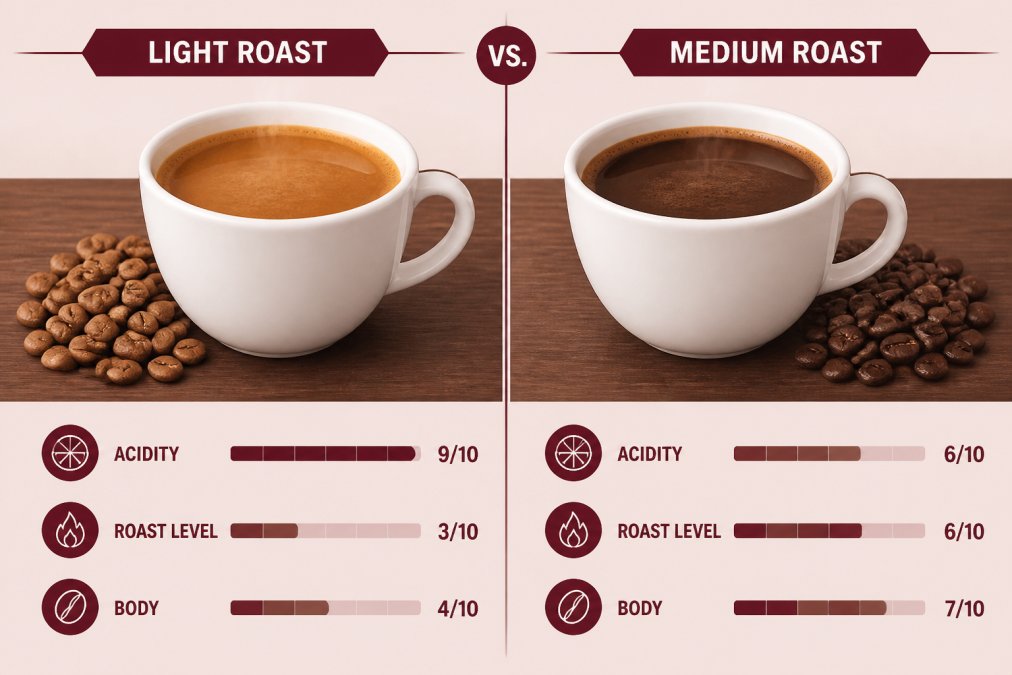
Below, we break down what actually changes during roasting, why your tongue and a lab meter disagree, and how to pick the roast that suits your taste.
Why Perceived Acidity and Measured pH Are Not the Same Thing
Perceived acidity is the bright, tangy sensation you taste on your tongue. Measured pH is a lab reading of how acidic a liquid truly is. These two things often move in opposite directions, and that is the part most guides skip.
Coffee sits somewhere around pH 4.85 to 5.10 on average, which makes it far less acidic than orange juice or soda. Yet a light roast can taste sharper than a dark roast even when their pH readings are nearly identical.
So why the gap? Roasting creates new compounds while destroying others. Your brain reads the balance of those compounds as "bright" or "smooth," not the raw pH number.
Coffee Acidity Explained: Brightness, Liveliness, and What Your Tongue Detects
Coffee acidity is the pleasant, tongue-tingling quality that gives a cup its sparkle. Tasters call it brightness or liveliness. Without it, coffee tastes flat and dull.
Think of it like the difference between fresh lemonade and flat soda. Both are sweet, but only one wakes up your palate. That zing is acidity doing its job.
Three things shape how much brightness you taste:
- The roast level of the beans
- Where the beans were grown
- How the coffee was processed and brewed
A common mistake is blaming roast level alone. In practice, origin and processing often matter just as much.
The Organic Acids Behind Fruity and Floral Notes
Several acids create the flavors you love. Citric acid brings citrus and berry notes. Malic acid adds a crisp apple-like tang. Chlorogenic acids contribute brightness and bitterness, and they break down as roasting continues.
Lighter roasts keep more of these organic acids intact, so fruity and floral notes survive. Longer roasting destroys more of them, which is why darker roasts taste more chocolatey and less bright.
This is also why a light roast from Ethiopia can taste like blueberries while a medium roast from the same region tastes more like caramel.
How Roast Duration and Temperature Shape Acidity and Flavor
Roast duration and temperature decide how much acidity survives the roasting process. Shorter roasting time at lower temperatures preserves more acids and delicate flavors. Longer roasting time at higher heat breaks those acids down.
Here is how the roast profile changes the cup:
- Light roast: dropped early, higher acidity, more origin character
- Medium roast: roasted a bit longer, balanced acidity, rounder sweetness
- Dark roast: roasted longest, low acidity, bold and bitter notes
The same beans can taste completely different depending on where the roaster stops the process. That single decision drives most of what you taste.
Comparing Light, Medium, and Dark Roast: Flavor, Body, and Mouthfeel
Each roast level delivers a distinct flavor profile, body, and mouthfeel. The table below sums up the trade-offs so you can match a roast to your taste.
| Roast Level | Acidity | Body and Mouthfeel | Typical Flavor Notes |
|---|---|---|---|
| Light | High, bright | Light and tea-like | Fruity, floral, citrus |
| Medium | Balanced | Medium and smooth | Caramel, nuts, cocoa |
| Dark | Low | Full and heavy | Dark chocolate, smoky |
Light roasts feel thin and lively on the tongue. Medium roasts land in the middle, which is why they appeal to so many drinkers. Dark roasts coat your mouth with a heavier, richer body.
If you want fruit and floral notes, go light. If you want balance, go medium. If you want bold and bitter, go dark.
Best Brewing Temperature for Light Roast Coffee (and Why Medium Roast Differs)
The best brewing temperature for light roast coffee is generally hotter, around 200 to 205 degrees Fahrenheit. Medium roasts often taste best a few degrees cooler, near 195 to 200 degrees.
Why the difference? Light roasts are denser and less soluble, so they need more heat to extract flavor. Medium roasts give up their flavor more easily, so slightly cooler water prevents bitterness.
Brew method matters too. A pour-over gives you control over temperature and timing, while a drip machine runs at a fixed heat. If your light roast tastes sour, your water is probably too cool. If your medium roast tastes bitter, it is likely too hot.
Low Acid Coffee Beans and How to Reduce Acidity in Coffee
If acidity upsets your stomach, you have options. But first, a distinction most guides blur: the tangy brightness you taste is not the same thing as the acidity that can trigger digestive discomfort. Sensory acidity is a flavor perception driven by organic acids and their balance with sweetness and body. Physiological acidity relates to the total acid load and how your stomach responds to it. Roast level affects both, but not always in the same direction or to the same degree.
What Actually Lowers Acid in the Cup
Several levers matter more than roast level alone:
- Origin and variety. Beans grown at higher elevations tend to be denser and often carry more perceived brightness, while some varieties and origins are naturally lower in total acids. A medium roast from a naturally mild origin can taste gentler than a light roast from a high-acid one.
- Processing method. Washed coffees usually show cleaner, more pronounced acidity. Natural and honey processes can round off sharp notes through added sweetness and body.
- Roast level. Darker roasts break down more chlorogenic acids, which is why they often taste smoother. The trade-off is that longer roasting can also create bitter compounds that bother some stomachs more than acidity does.
- Brew method. Cold brew extracts fewer acids because cold water is a weaker solvent for them, which is why it is frequently recommended for sensitive drinkers. French press and other immersion methods can also produce a rounder cup than a fast, high-pressure espresso shot.
- Extraction variables. Grind size, water temperature, brew ratio, and contact time all change how much acid ends up in your cup. Under-extraction pulls sour, sharp notes forward; over-extraction pushes bitterness forward. Neither is the same as lowering total acid.
How to Reduce Acidity in Coffee: Brewing Adjustments That Work
You can shift the cup with a few deliberate changes:
- Choose a medium or dark roast instead of a light roast
- Try cold brew, which is naturally smoother
- Brew with slightly cooler water (around 195 degrees Fahrenheit instead of 205)
- Use a coarser grind to slow extraction and avoid sour under-extraction
- Increase your brew ratio slightly (more water per gram of coffee) to dilute total acids
- Add a pinch of salt to mask sharp notes without changing the underlying chemistry
A common mistake is over-extracting to "mellow out" a bright coffee. That usually just adds bitterness on top of the acidity. Change one variable at a time and taste as you go.
At Lux Brew Coffee Co., we roast to order and ship within hours, so the beans you brew are as fresh as possible. Freshness alone can smooth out harsh notes that come from stale coffee, and it gives you a cleaner baseline for testing which variables actually help your cup.
Conclusion: Choosing Your Roast Based on Acidity Preference
Choosing a roast comes down to one question: how much brightness do you want in your cup? Light roasts deliver lively, fruity acidity. Medium roasts balance that brightness with sweetness and body. Dark roasts trade acidity for bold, smoky depth.
The good news is that acidity is not fixed. You can shift it with roast level, origin, brew method, and water temperature. Start with your taste preference, then adjust one variable at a time.
If you want beans roasted to your order and shipped within hours, explore the single-origin and specialty blends at Lux Brew Coffee Co. Every batch is roasted fresh, sourced from ethical family farms, and built to deliver an exceptional cup. Get started with Lux Brew Coffee Co. and taste the difference freshness makes.
Frequently Asked Questions
Which is more acidic, light roast or medium roast coffee?
Light roast coffee tastes more acidic because it retains more of the organic acids naturally present in green coffee beans. Medium roast undergoes longer roasting, which breaks down some of these acids and caramelizes sugars, producing a smoother, more balanced cup. However, measured pH levels are similar across roast levels, so the difference is primarily in perceived acidity and flavor, not chemical acidity.
Is coffee acidity the same as pH?
No. Coffee acidity refers to the bright, tangy sensation you taste, driven by organic acids like citric and malic acid. pH measures actual hydrogen ion concentration. Black coffee typically falls between pH 4.85 and 5.10 regardless of roast level. A light roast can taste sharply acidic while having nearly the same pH as a smooth medium roast, which is why perceived acidity and measured pH are different concepts.
Which roast is easier on a sensitive stomach?
Medium and dark roasts are generally easier on sensitive stomachs because longer roasting reduces the concentration of certain acids that can trigger irritation. If you prefer light roast flavor but experience discomfort, try cold brew or lower your brewing temperature slightly. Low acid coffee beans from regions like Brazil or Sumatra also tend to be gentler, especially when roasted to a medium level.
What is the ideal brewing temperature for light roast coffee?
The best brewing temperature for light roast coffee is between 195°F and 205°F. Light roasts are denser and less soluble, so they need hotter water to extract flavor properly. If your light roast tastes sour or underdeveloped, increase the temperature toward 205°F. If it tastes bitter, drop to 195°F. Medium roasts extract well across the same range but are more forgiving at lower temperatures.