

Last Updated: November 1, 2026
Quick Summary
The environmental impact of specialty coffee production depends heavily on where and how the beans are grown and processed, not on the specialty label alone. Land use, water use and wastewater, soil management, and carbon emissions all vary from farm to farm, so buyers should ask specific questions about each stage.
- Clearing forest for coffee can release stored carbon and fragment wildlife habitat across a region.
- Washed processing can use several cubic meters of water per tonne of cherry, and wastewater carries a heavy organic load.
- Ocean-freighted green coffee often contributes a relatively small share of total emissions compared with other stages.
- A carbon footprint is only comparable when it states its functional unit and the stages it covers.
- Shade-grown coffee supports biodiversity and resilience but usually produces lower yields and is not a complete solution.
Table of Contents
- How Specialty Coffee Production Affects the Environment
- Land Use, Deforestation and Biodiversity Loss
- Sustainable Coffee Farming Practices and Their Trade-Offs
- Coffee Processing Water Use and Wastewater
- Coffee Carbon Footprint From Farm to Roastery
- Shade-Grown Coffee Benefits and Limits
- Choosing Specialty Coffee With Lower Environmental Impact
- Frequently Asked Questions
How Specialty Coffee Production Affects the Environment
Specialty coffee has a reputation for being the more responsible choice, but the environmental impact of specialty coffee production is more complicated than the label suggests.
Coffee production touches water, soil, land, energy and the climate, and each stage of the supply chain adds its own pressures.
Coffee production is the set of farming, harvesting, processing and export steps that turn a coffee cherry into green beans.
Specialty coffee is usually grown at higher elevations and harvested by hand, which tends to mean slower growth and more selective picking. Those conditions can reduce some pressures while increasing others, such as the labor and transport needed to reach remote farms.
Land Use, Deforestation and Biodiversity Loss
Land use is often the largest environmental question in coffee. Clearing forest for full-sun plantations has historically reduced habitat and biodiversity, and the effects can persist long after a plot is planted.
Clearing forest for coffee can release stored carbon and fragment wildlife habitat across an entire region. Specialty farms that expand into intact forest raise the same concerns as any other producer, so buyers should ask where a coffee was grown, not just how it was processed.
Some farms maintain native trees, rely on existing canopy or keep buffer strips of forest between plots. These choices protect habitat and soil, but they also lower yields, which is one reason the trade-off matters for farmers' incomes.
Sustainable Coffee Farming Practices and Their Trade-Offs
Sustainable coffee farming covers a range of methods, from organic cultivation and integrated pest management to agroforestry and water-efficient processing. Many farmers adopt these practices because they improve long-term soil fertility and resilience, not only because certifications reward them.
The trade-off is that sustainable methods often require more labor, more careful record-keeping and sometimes lower output per hectare. For smallholder farmers operating on thin margins, those costs can be hard to absorb without fair prices or direct buyer support.
A common mistake is treating a single certification as proof of overall sustainability. Certifications address specific criteria, and a farm can meet one standard while struggling with another, so it helps to ask what a label actually covers.
Soil Health, Erosion and Chemical Inputs
Soil health determines how long a coffee farm stays productive. Erosion on steep slopes can wash away topsoil, while heavy reliance on synthetic fertilizers can degrade soil structure over time and increase chemical runoff into nearby waterways.
Organic matter, cover crops and shade trees all help hold soil in place and feed soil organisms. Pesticide and fertilizer use varies widely across farms, so the most useful question for a buyer is how a specific farm manages its inputs, not whether coffee in general uses chemicals.
Coffee Processing Water Use and Wastewater
Water is the input most likely to be invisible to a coffee drinker and most consequential to the community living downstream of a mill. The volume and quality of water used in processing depend heavily on the method, and the difference between methods is large enough that processing choice can matter more than farm-level water efficiency.
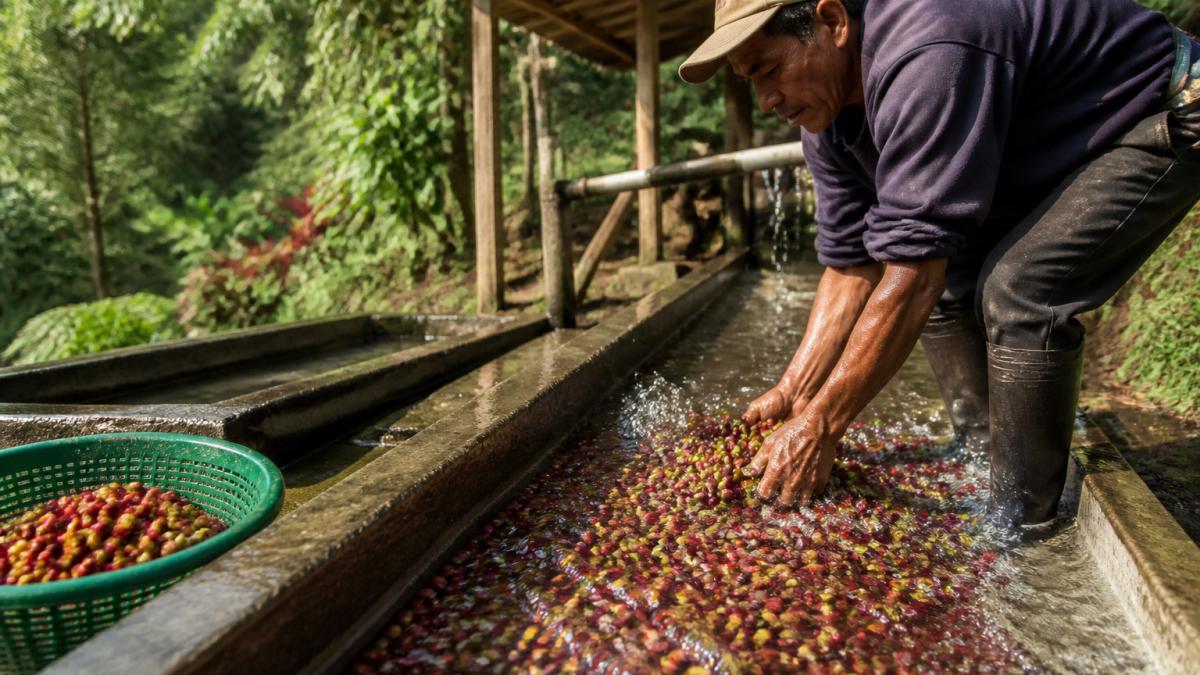
Wet (washed) processing removes the fruit and mucilage using water: depulping, fermentation, washing channels, and often grading in tanks. When released untreated into streams, the organic load drives oxygen down as microbes break it down, which can stress or kill aquatic life (5.2 Dissolved Oxygen and Biochemical Oxygen Demand | Monitoring & Assessment).
What mills can do about it:
- Recirculation and eco-pulpers. Mechanical demucilagers and recirculating wash systems reduce fresh water intake per unit of cherry, sometimes dramatically compared with traditional channel washing.
- Wastewater treatment. Settling ponds, anaerobic digestion, and constructed wetlands are common approaches; anaerobic systems can also capture methane for use as fuel, turning a waste stream into an energy source.
- Land application. Some mills spread treated or partially treated effluent on fields under controlled conditions, which can recycle nutrients but requires care to avoid overloading soils and waterways.
- Water accounting. Mills that meter intake and discharge can report water use intensity per kilogram of green coffee, a figure that is far more useful to buyers than a general statement about 'water conservation.'
For specialty buyers, the useful comparison is not 'washed vs. natural' in the abstract but the specific mill's water intensity and treatment setup. Two washed coffees from the same region can have very different downstream footprints depending on whether the mill recirculates and treats, and that is a question worth putting directly to the importer or exporter.
agricultural water use and water quality guidance
The table below summarises the main processing methods and their water considerations as described in the article.
| Method | Water use | Key concern |
|---|---|---|
| Wet (washed) | Several cubic meters per tonne of cherry | Wastewater carries organic load |
| Dry (natural) | Little to no water in the mill | Shifts burden to drying and labor |
| Honey | Lower than fully washed | Drying management is critical |
| Recirculation and eco-pulpers | Reduces fresh water intake | Cuts intake versus channel washing |
| Anaerobic treatment | Treats wastewater | Can capture methane as fuel |
Coffee Carbon Footprint From Farm to Roastery
Carbon is the impact most often reduced to a single number on a bag, but the number only means something if you know which stages it covers and what unit it is measured in. A credible coffee carbon footprint is built stage by stage against a consistent functional unit, typically kilograms of CO2-equivalent per kilogram of green coffee, or per kilogram of roasted beans, or per cup brewed. Without that unit and a stated boundary, a footprint claim cannot be compared to anything else.
The stages that matter, and the mechanisms behind each:
- Cultivation and inputs. Nitrogen fertilizer production is energy-intensive, and applied nitrogen can also generate nitrous oxide, a potent greenhouse gas. On-farm diesel for equipment and transport of pickers and cherry adds smaller amounts. Shade trees can sequester carbon in biomass and soil, which is one reason agroforestry systems sometimes show lower net cultivation emissions, but the accounting depends on whether tree biomass is counted and for how long.
- Processing. Washed processing uses pumps, pulpers, and sometimes mechanical dryers; natural and honey processing lean more heavily on drying, which may be sun-dried or machine-dried depending on humidity and scale. Mechanically dried lots can carry meaningfully higher processing-stage emissions than sun-dried lots at the same farm.
- Milling, grading, and bagging. Dry milling, sorting, and jute or vacuum packaging add modest but non-zero emissions, and packaging material choice (jute, GrainPro-style liners, vacuum bricks) shifts the profile.
- Transport. Green coffee typically moves by ocean freight, which is far less carbon-intensive per ton-kilometer than air freight. A common pattern is that ocean-shipped green coffee contributes a relatively small share of total life-cycle emissions, while air-freighted or small-parcel expedited shipments can dominate the transport line. The claim that transportation is 'often the largest' contributor is therefore boundary-dependent and frequently wrong for ocean-freighted green coffee; it becomes more plausible when roasting, packaging, and last-mile delivery to the consumer are included.
- Roasting. Roasting energy depends on roaster type (drum vs. fluid-bed), fuel (natural gas vs. electric), batch size, and how often the roaster runs partial batches. A roastery running full batches on efficient equipment will show lower per-kilogram roasting emissions than one running small batches frequently.
- Packaging and disposal. Bag material, valve hardware, and whether the bag is recyclable, compostable, or landfill-bound all enter the boundary if the assessment is cradle-to-grave rather than cradle-to-gate.
- Brewing and grounds disposal. For a per-cup figure, brewing energy (heating water, keeping a carafe warm) and the fate of spent grounds, compost, landfill, or anaerobic decomposition, can be a substantial share of the total. This is why per-cup numbers are usually much larger than per-kilogram green coffee numbers, and why the two are not interchangeable.
For buyers, the practical takeaway is to ask three questions of any carbon claim: What stages are included? What is the functional unit? Who verified it, and against what standard? A roaster that can answer those questions is giving you more than a slogan, it is giving you a number you can actually use.
life-cycle assessment methodology for agricultural products
Shade-Grown Coffee Benefits and Limits
Shade-grown coffee grows under a canopy of native or agroforestry trees rather than in full sun. The canopy supports birds, insects and soil organisms, helps regulate temperature and can make farms more resilient to drought and heavy rain.
Shade is not a complete solution. Shaded farms generally produce lower yields, and some shade systems can compete with coffee for water or nutrients if poorly managed. Shade-grown coffee is best understood as one tool among several rather than a guarantee of low impact.
Choosing Specialty Coffee With Lower Environmental Impact
Choosing a lower-impact coffee starts with asking practical questions: where the beans were grown, how the farm manages water, soil and shade, and how the coffee was processed. If you're looking for single-origin Brazil Santos beans, you can browse that origin's offering alongside the others discussed here.
Lux Brew Coffee Co. roasts every batch to order and ships within hours of roasting, which keeps freshness high. Lux Brew Coffee Co. offers single-origin and specialty blends, and you can browse our roast to order coffee benefits to see how freshness plays into your choice.
Ask farmers, roasters and certifiers for specifics rather than slogans. The most credible specialty coffee shows you where it comes from, how it was grown and what trade-offs the farm has made, and that information is worth more than any single label.
Frequently Asked Questions
What is the environmental impact of coffee production?
Coffee production affects water supply, soil, forests and the climate. Cultivation can drive deforestation and land-use change when forest is cleared for farms, and agrochemicals can run off into waterways. Processing, especially wet processing, uses substantial water and produces wastewater that needs management. Emissions come from land clearing, fertilizer production, drying, and transport. Impacts vary widely by farm type, altitude, processing method and distance to market, so the same bag of coffee can have very different footprints.
Is specialty coffee more sustainable than commercial coffee?
Not automatically. Specialty coffee is often grown at higher altitudes and sourced from smaller farms, which can mean more shade cultivation and closer farmer relationships. However, specialty labels describe quality grading, not environmental performance. Some specialty coffee is grown with heavy inputs, and some commercial coffee is grown under shade. Buyers should look for verified practices, such as traceability to the farm and documented water and waste management, rather than assuming a specialty label guarantees lower impact.
Which coffee farming practices reduce environmental impact?
Practices with the clearest benefits include shade-grown or agroforestry systems that preserve tree cover, cover crops and composting to protect soil, reduced synthetic fertilizer and pesticide use, and efficient wet processing that recycles water and treats wastewater. Each practice involves trade-offs. Shade can lower yields, and organic methods may require more labor. Evaluating a farm's full system gives a more accurate picture than any single practice.
How can consumers choose more sustainable specialty coffee?
Look for specific information rather than general claims. Traceability to a named farm or cooperative, details on shade cultivation, and descriptions of water and waste handling are stronger signals than broad words like eco-friendly. Ask roasters how they source and verify practices. Buying whole beans and brewing at home can reduce packaging and transport impacts, and choosing a roaster that ships efficiently can also help. Pricing depends on quantity, delivery and product selection, so check the Lux Brew Coffee Co. website for current prices and details.
