

Table of Contents
- Why Fresh Roasted Coffee Tastes Better: The Science Behind Peak Flavor
- How the Coffee Degassing Process Affects Flavor
- Oxidation and Flavor Degradation in Stored Beans
- How to Store Coffee Beans for Freshness
- Signs of Stale Coffee Beans and When to Replace Them
- The Brewing Method Difference: Fresh Beans vs. Aged Coffee
- Finding Your Freshness Window: The Sweet Spot for Brewing
- Conclusion
Last Updated: August 12, 2026
Why Fresh Roasted Coffee Tastes Better: The Science Behind Peak Flavor
Fresh roasted coffee tastes better because it contains volatile aromatic compounds and carbon dioxide that dissipate over time. At Lux Brew Coffee Co., we've observed that the flavor profile of coffee peaks within days of roasting, then gradually degrades through oxidation and staling. The difference between a bag roasted last week and one roasted two months ago is the difference between tasting the bean's origin characteristics and tasting cardboard.
When coffee beans are roasted, the heat triggers the Maillard reaction, which creates hundreds of aromatic compounds. These volatile oils and amino acid derivatives are what make coffee smell and taste exceptional. But they're unstable. The moment roasting stops, these compounds begin breaking down through oxidation and degassing. This process explains why your morning cup tastes dramatically different depending on when those beans were roasted.
How the Coffee Degassing Process Affects Flavor
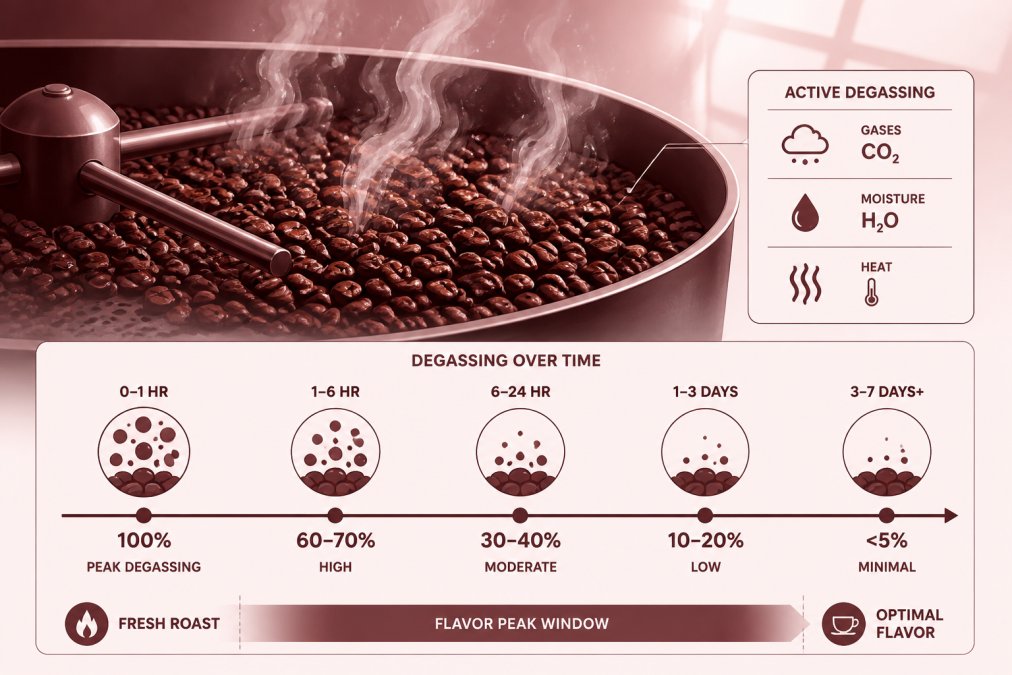
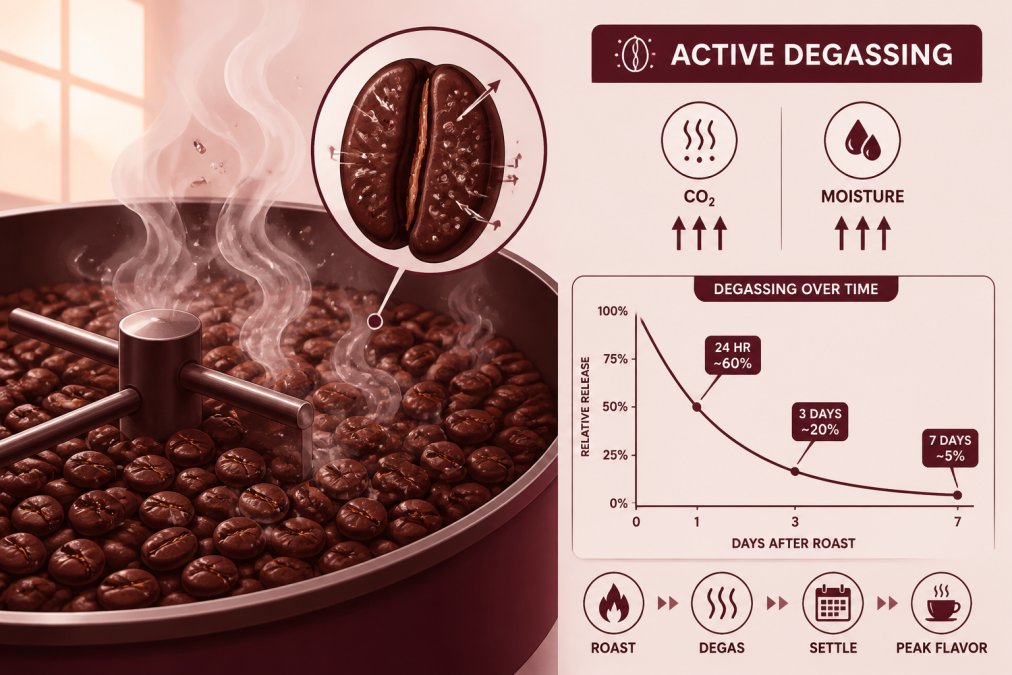
The coffee degassing process is the release of carbon dioxide and volatile aromatic compounds from the bean after roasting. This happens automatically as the bean cools and internal pressure equalizes. During degassing, the bean loses mass and most importantly, loses the compounds responsible for complex flavor notes.
The first 12-24 hours after roasting are when degassing is most active. Carbon dioxide escapes rapidly, so rapidly that many specialty roasters use one-way valves on their bags to allow gas to escape while preventing oxygen from entering. If you've ever noticed a bag puffing up at the grocery store, that's degassing in action.
The First 12-24 Hours: When Degassing Is Most Active
Immediately after roasting, the bean's interior is still warm and the pressure differential between inside and outside is extreme. This is why some roasters recommend waiting 12-24 hours before brewing, the bean needs time to stabilize so the brewing water can extract properly without excessive bloom or channeling.
However, while the bean needs some degassing time to brew well, it's also losing aromatic compounds during this window. The compounds that make a single-origin Ethiopian bean taste like blueberries, or a Colombian bean taste like chocolate, are volatile and escaping with the carbon dioxide. This is why fresh roasted coffee tastes best when brewed 2-5 days after roasting, the bean has degassed enough to extract cleanly, but hasn't lost so many aromatics that the flavor is muted.
By day seven, most rapid degassing is complete and the flavor window is closing. What remains is a bean that's technically stable but aromically diminished.
The Degassing Window and Brewing Extraction
When you pour hot water over a freshly roasted bean that's still actively degassing, the escaping gas creates resistance and prevents even water penetration. You get uneven extraction and a muddy, inconsistent cup.
As degassing slows (around day 3-5), the bean becomes more porous and water flows through uniformly. This is why many specialty roasters recommend a 3-5 day rest before brewing. The aromatic compounds are still abundant, but the bean's structure is stable enough for clean extraction. This sweet spot is where fresh roasted coffee tastes its absolute best, you're getting both the complexity of the aromatics and the clean, balanced extraction that lets those aromatics shine.
After day 14, degassing is essentially complete and volatile aromatic compounds have largely dissipated. You can still taste the coffee, but you're tasting residual, more stable compounds, the bitterness and body, but not the nuanced notes that made it interesting.
Oxidation and Flavor Degradation in Stored Beans
Oxidation is the process where oxygen molecules react with the lipids and aromatic compounds in coffee, breaking them down into simpler, less flavorful molecules. This is the primary mechanism of staling and continues indefinitely as long as the bean is exposed to oxygen.
Fresh roasted coffee initially resists oxidation because it still contains antioxidant compounds created during roasting. But these protective compounds are finite. As oxidation progresses, the bean's flavor becomes flatter, more bitter, and less distinctive. The origin characteristics fade and complexity collapses into one-note bitterness.
The speed of oxidation depends on oxygen exposure, temperature, light, and humidity. A bean stored in an airtight container in a cool, dark place will oxidize much more slowly than one sitting in a clear jar on a sunny counter. But oxidation still happens. Even in ideal conditions, the flavor window closes progressively over weeks and months.
This is why Lux Brew Coffee Co. roasts to order and ships within hours. Every day in transit and storage before brewing, oxidation is happening. By minimizing the time between roasting and your cup, you're maximizing the window when the bean still contains the aromatic compounds that make it taste exceptional.
How to Store Coffee Beans for Freshness
Proper storage is about slowing three processes: oxidation, degassing, and moisture absorption. The goal is to preserve the aromatic compounds while allowing enough degassing for clean extraction.
The best storage method uses an airtight container in a cool, dark location. Glass or ceramic containers with airtight seals work well. Avoid clear containers, light degrades flavor compounds. If you're buying whole beans, keep them in their original bag if it has a one-way valve, or transfer them to an airtight container immediately.
Protecting Against Oxygen Exposure and Light
Oxygen is the enemy of fresh roasted coffee. Every time you open a bag or container, you're introducing fresh oxygen that will accelerate oxidation. This is why buying smaller quantities more frequently is better than buying in bulk. A half-pound bag you'll use in two weeks will taste better than a two-pound bag you'll use over two months, even if stored identically.
Light is equally destructive. UV rays break down aromatic compounds and accelerate oxidation. This is why specialty roasters use opaque bags. Avoid storing coffee in clear jars on your counter. Freezing can extend the freshness window, but it requires care. If you freeze beans, they must go into an airtight container to prevent moisture absorption when they thaw. Freeze in small portions so you thaw only what you'll use immediately.
Temperature and Humidity Control
Temperature directly affects the rate of oxidation and degassing. Cooler storage slows both processes. Room temperature (around 70°F) is acceptable. Refrigerator temperature (around 40°F) is better. Freezer temperature (around 0°F) is best for long-term storage, but introduces condensation risk.
Humidity is critical. High humidity can cause beans to absorb moisture, which promotes mold growth and degrades flavor. Low humidity is preferable. Avoid storing coffee above the stove or near the sink, as these are high-humidity zones. A clear jar on a sunny kitchen counter combines light exposure, temperature fluctuation, and oxygen exposure, all three enemies of fresh roasted coffee working simultaneously. Moving to an opaque airtight container in a cabinet will make an immediate, noticeable difference in flavor.
Signs of Stale Coffee Beans and When to Replace Them
Stale coffee beans show predictable signs. The most obvious is smell. Fresh roasted coffee has a rich, complex aroma. Stale coffee smells flat, muted, or slightly musty. If you open a bag and the aroma is weak, the bean is past its peak.
Visual inspection can also help. Fresh beans have a slight sheen from the oils on the surface. As oxidation progresses, this sheen dulls. Very old beans look dull and sometimes develop visible cracks from moisture loss.
The most reliable indicator is taste. Stale coffee tastes thin, bitter, and one-dimensional. It lacks the complexity and brightness of fresh roasted coffee.
Generally, whole beans in airtight storage maintain their peak flavor for 2-4 weeks after roasting. By week 6-8, most beans have noticeably degraded. By week 12, they're significantly stale. Ground coffee stales much faster than whole beans because grinding dramatically increases surface area exposed to oxygen. Ground coffee should be used within days, not weeks. If you're buying pre-ground coffee from a grocery store with no roast date visible, you're almost certainly drinking stale coffee.
The Brewing Method Difference: Fresh Beans vs. Aged Coffee
Fresh roasted coffee with abundant volatile aromatic compounds is more forgiving across different brewing methods. Aged coffee is less forgiving. With fewer aromatic compounds to work with, the brewing method becomes critical. A slightly over-extracted cup made from fresh beans might still taste good because the aromatics are there. The same over-extraction with aged beans produces a thin, bitter cup.
This is why specialty coffee enthusiasts obsess over brewing precision. With fresh roasted coffee, you have margin for error. With aged beans, you don't.
Espresso is particularly sensitive to bean age. Fresh beans produce shots with crema, complexity, and sweetness. Aged beans produce thin, bitter shots with minimal crema. Pour-over methods like V60 or Chemex are slightly more forgiving because the slower contact time allows for cleaner extraction even with older beans. French press is the most forgiving method for aged beans, but the difference between fresh and stale is still unmistakable.
If you're investing in quality brewing equipment, using aged beans is like using premium gas in a sports car and then never changing the oil. The equipment can't compensate for stale beans.
Finding Your Freshness Window: The Sweet Spot for Brewing
The freshness window for fresh roasted coffee is the period when the bean has degassed enough for clean extraction but still contains abundant aromatic compounds. This window is typically days 3-14 after roasting, with peak flavor usually around days 5-10.
The exact timing depends on roast level, bean density, altitude of origin, and your personal taste preferences. A lighter roast reaches its sweet spot slightly earlier than a darker roast. For espresso, many people prefer beans at day 5-7. For pour-over, day 7-10 often produces better results. For French press, anywhere from day 3-21 can work well depending on your taste.
Buy coffee with a roast date on the bag and plan your brewing around that date. If you receive beans roasted on August 1st, plan to start brewing around August 4th or 5th. You'll have a 10-14 day window where the coffee tastes exceptional. This is why subscription services that deliver fresh roasted coffee are valuable. Instead of buying a month's worth of beans at once, you receive smaller quantities more frequently, always brewing coffee at or near its peak.
The difference between fresh roasted coffee and stale coffee is chemistry. The aromatic compounds that make coffee taste exceptional are volatile and unstable. They dissipate through degassing in the first week and through oxidation over subsequent weeks. By understanding this process, how storage affects flavor, and how brewing method interacts with freshness, you can make deliberate choices that keep your coffee in its peak flavor window.
The simplest choice: buy smaller quantities more frequently from a roaster that includes the roast date on the bag. Brew within 3-14 days of roasting. Store in an airtight container away from light and heat. This alone will transform your daily coffee experience. The brightness, complexity, and origin characteristics that make specialty coffee worth seeking out only exist in fresh roasted coffee. Once you've tasted what fresh actually tastes like, stale coffee becomes undrinkable.
Scientific American's guide to coffee chemistry and flavor compounds
Specialty Coffee Association standards for coffee freshness and storage
USDA guidelines on proper food storage and oxidation prevention
Frequently Asked Questions
Why does fresh roasted coffee taste so much better than grocery store coffee?
Fresh roasted coffee retains volatile aromatic compounds and lipid oils that degrade quickly through oxidation. Grocery store beans often sit for weeks or months, losing these flavor compounds. The roast date determines how recently the Maillard reaction created the complex flavors you taste. Beans roasted within days deliver peak aroma and acidity, while aged beans taste flat and bitter.
How long should you wait after roasting before brewing fresh roasted coffee?
The ideal window is 3-14 days after roasting. During the first 12-24 hours, active degassing releases carbon dioxide that can interfere with brewing extraction. After 3 days, the beans have released enough CO2 for clean extraction while retaining volatile aromatic compounds. Beyond 2-3 weeks, oxidation begins breaking down flavor compounds. Check the roast date on your bag and brew within this sweet spot for best results.
What signs tell you that coffee beans have gone stale?
Stale beans show a dull, matte surface instead of the slight sheen of fresh beans. They may smell flat or lack aroma when you open the bag. Visually, look for discoloration or a grayish cast. When brewed, stale coffee tastes thin, bitter, or lacking in acidity and complexity. If your coffee tastes one-dimensional or lacks the flavor notes listed on the bag, the beans have likely oxidized and lost volatile oils.
Does the brewing method change how much freshness matters?
Yes. Pour-over and espresso methods are most sensitive to bean age because they depend on precise extraction of soluble compounds. Espresso especially requires fresh beans for proper bloom and crema formation. French press brewing masks some staleness because immersion extraction is less selective. Cold brew can work with slightly older beans since the long steep time compensates for some volatile compound loss. For the best sensory experience across all methods, fresh roasted beans within 2-3 weeks of roast date deliver superior results.
This article was written using GrandRanker