

Table of Contents
- Why Your Espresso Shots Pull Too Fast
- Espresso Grind Size Guide: The Foundation
- Ideal Espresso Extraction Time and Shot Yield
- Espresso Puck Preparation Techniques
- Coffee Bean Freshness and Degassing
- Basket Size, Dose Ratio, and Puck Resistance
- Water Pressure, Pre-Infusion, and Flow Rate
- Dialing In Your Machine: Step-by-Step
- Frequently Asked Questions
Last Updated: September 19, 2026
Why Your Espresso Shots Pull Too Fast
When your espresso shots pull too fast, you're extracting less flavor and getting thin, watery shots instead of rich, balanced espresso. This problem almost always traces back to a handful of fixable issues. The good news is that diagnosing and correcting the problem doesn't require expensive equipment or advanced skills.
Fast shots happen when water rushes through your coffee grounds without enough resistance. This means you're missing out on the soluble compounds that make espresso taste good. Most shots should take 25-30 seconds from the moment you start your pump to the moment you stop. If yours finish in 15-20 seconds, something needs adjustment.
The real problem isn't usually one thing, it's a combination of factors working together. A grind that's too coarse, a dose that's too light, and weak tamping pressure all add up to fast flow. The fix involves testing each variable systematically until your extraction time hits the sweet spot.
Espresso Grind Size Guide: The Foundation
Your grinder is the most important tool in your espresso setup. Grind size controls how much surface area water contacts as it flows through the coffee bed. A finer grind creates more resistance and slows water down. A coarser grind lets water rush through.
How grind affects flow rate
If your espresso shots pull too fast, grind size is usually the first place to look. Espresso demands a fine, consistent grind, finer than pour-over but not as fine as Turkish coffee. When particles are too large, water finds the path of least resistance and channels through the bed instead of extracting evenly.
The relationship is direct: finer grind equals slower flow. Coarser grind equals faster flow.
Most grinders have numbered settings. If you're pulling fast shots, moving your setting toward the finer end by one or two notches is a common adjustment. Then pull a test shot and time it. If it's still fast, going finer is often the next step. If it chokes and produces no flow, you've likely gone too far, and backing off slightly is recommended.
Adjusting your burr calibration
Burr alignment matters more than most people realize. Your grinder's burrs cut coffee particles to a consistent size. If they're misaligned or worn, you get uneven particle sizes. Large particles create channels. Small particles create dead spots. Both cause problems.
Check your grinder's manual for calibration instructions. Many grinders let you adjust the distance between burrs. If burrs are too far apart, particles can come out coarser than the setting suggests. If they're too close, there's a risk of grinding too fine and jamming the mechanism.
A simple test: grind a small amount and look at the consistency. Uniform particle size is generally desired. If there's a mix of dust and chunks, the burrs may need attention.
Ideal Espresso Extraction Time and Shot Yield
Extraction time is your most reliable diagnostic tool. It tells you whether your espresso shots pull too fast, too slow, or just right. Timing your shots takes seconds and gives you real data to work with.
Target extraction windows
The standard target for espresso is 25-30 seconds from the moment water contacts the grounds to the moment you stop the shot. This window allows enough contact time for proper solubility, the process where water dissolves the good flavors from the coffee.
If your shot finishes in under 20 seconds, it's underextracted. You're getting sour, thin espresso. If it takes longer than 35 seconds, it's overextracted. You're getting bitter, harsh flavors. The sweet spot is somewhere in the middle.
Here's what to measure:
- Start your timer when water first flows
- Stop when you reach your target yield (usually 1 to 2 ounces of espresso)
- Note the time
Pull three shots with the same settings and average the times. One fast shot might be a fluke. Three fast shots in a row means something needs fixing.
Measuring shot consistency
Consistency matters as much as hitting the target time. If one shot takes 26 seconds and the next takes 32 seconds, your puck preparation is inconsistent. This creates unpredictable results and makes it hard to dial in your machine.
The fix is reproducibility. Use the same dose weight every time. Distribute grounds the same way. Apply the same tamping pressure. When your routine is consistent, your shots will be too.
Espresso Puck Preparation Techniques
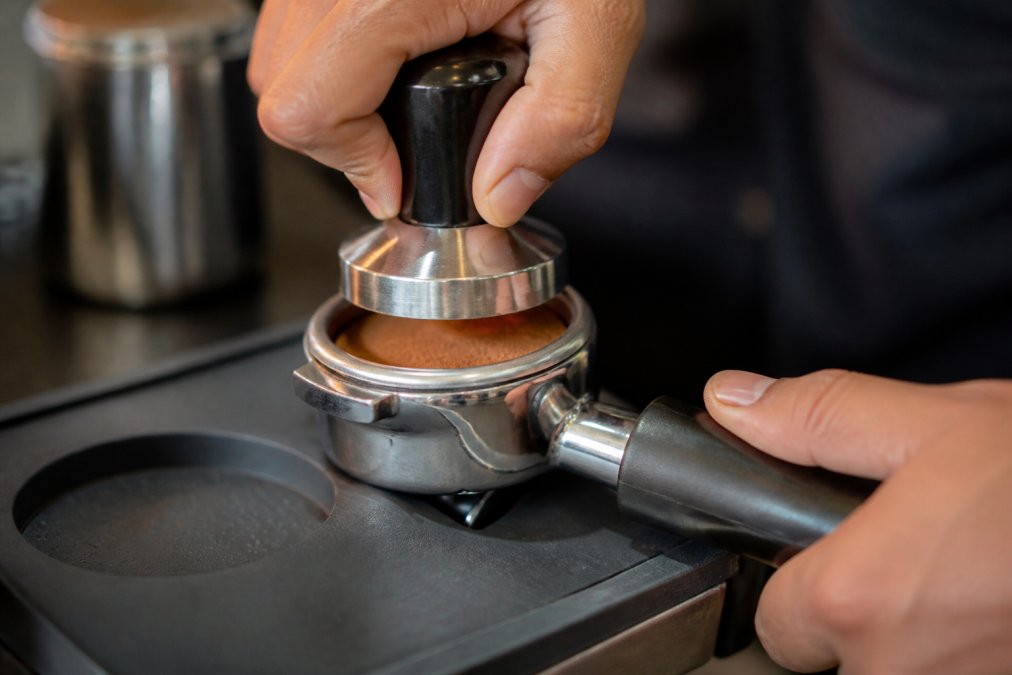
The coffee puck, the compressed cake of grounds inside your portafilter, is where extraction happens. How you prepare it determines whether water flows evenly or channels through weak spots.
Dose weight and distribution
Your dose is the amount of ground coffee you put in the basket. It's usually measured in grams. A typical dose ranges from 18-20 grams for a double shot, depending on your basket size.
If your dose is too light, the puck has less mass and less resistance. Water flows through quickly. If it's too heavy, the puck becomes dense and restricts flow too much.
The process:
- Fill your basket with ground coffee
- Use a distribution tool to gently level the surface
- Break up any clumps
- Tamp straight down with even pressure
Tamping pressure and technique
Tamping compresses the puck and creates resistance. Proper tamping pressure is around 30 pounds of force, enough to compress the grounds without crushing them into a brick.
How to tamp correctly:
- Hold the portafilter level
- Keep your hand straight, don't angle the tamper
- Apply steady pressure for about one second
- Use the same pressure every time
Coffee Bean Freshness and Degassing
Fresh coffee extracts better than stale coffee. Freshness affects how water moves through the puck and how many soluble compounds are available for extraction.
Basket Size, Dose Ratio, and Puck Resistance
Your basket is the metal insert that holds ground coffee. It has a specific capacity measured in grams. Common sizes are 15g, 18g, 20g, and 22g baskets.
Water Pressure, Pre-Infusion, and Flow Rate
Your espresso machine pump creates pressure that forces water through the puck. Standard espresso machines deliver 9 bars of pressure. This pressure is what creates resistance and extraction.
Dialing In Your Machine: Step-by-Step
Dialing in means adjusting your settings until your espresso shots pull too fast no longer, they extract at the right speed with good flavor. It's a systematic process that takes 5-10 minutes per adjustment.
Step 1: Start with your grind setting
Begin with a grind setting that's slightly finer than where you started. Pull a test shot and time it. If it's still fast, go finer. If it's slow, go coarser. Make small adjustments, one or two notches at a time.
Step 2: Adjust dose and distribution
Once your grind is in the ballpark, look at your dose. Weigh your grounds to make sure you're hitting your target dose. Use a distribution tool to level the grounds before tamping.
Step 3: Refine tamping and pressure
Check your tamping technique. Make sure you're applying even pressure and keeping the portafilter level. Increase pressure slightly if shots are still fast.
Step 4: Monitor extraction time and crema
Your target is 25-30 seconds. Watch the espresso flow from your group head. Proper extraction looks like a steady stream that gradually slows as the shot progresses.
| Adjustment | Effect on Flow | Best For |
|---|---|---|
| Finer grind | Slows flow | Fast shots |
| Coarser grind | Speeds flow | Slow shots |
| Higher dose | Slows flow | Thin shots |
| Lower dose | Speeds flow | Choked machine |
| Stronger tamp | Slows flow | Underextracted |
| Lighter tamp | Speeds flow | Overextracted |
Specialty Coffee Association standards for espresso extraction
National Coffee Association brewing guidelines
Coffee Science Institute research on extraction time and flavor
Frequently Asked Questions
How fast should an espresso shot pull?
A proper espresso shot should pull between 25-30 seconds from the moment water contacts the coffee bed to when the shot finishes flowing. Shots pulling faster than 20 seconds are under-extracted, meaning water passes through the coffee too quickly to dissolve the right amount of soluble compounds. This results in thin, sour, or weak-tasting espresso. If your extraction time is consistently faster, your grind is too coarse, your dose is too light, or your puck preparation needs adjustment.
Does grind size affect espresso extraction speed?
Yes, grind size is the primary factor controlling extraction time. Finer grinds create more surface area and resistance, slowing water flow. Coarser grinds allow water to pass through faster. When shots pull too quickly, a finer grind setting is usually the first adjustment. Start by moving your burr calibration slightly finer and pull a test shot. Small changes matter: even a quarter-turn on most grinders can shift extraction time by 2-3 seconds.
Can stale coffee beans cause fast espresso shots?
Yes. Stale beans have lost CO2 and moisture, becoming more brittle and compressing less under tamping pressure. This reduces puck resistance, allowing water to channel through and flow faster. Fresh beans, still degassing, pack more densely and create natural resistance. Lux Brew Coffee Co. roasts every batch to order and ships within hours to ensure your beans retain maximum freshness and proper degassing. Using fresh beans can help address fast shots by providing optimal freshness.
What's the relationship between dose weight and shot pull speed?
Dose weight directly affects puck density and resistance. A heavier dose (more grams of coffee) creates a denser bed that water must push through, slowing flow. A lighter dose allows faster flow. The ideal dose depends on your basket capacity and desired shot yield. If your extraction time is too fast, increase your dose weight by 0.5-1 gram and re-tamp with consistent pressure. This increases puck resistance and extends extraction time without changing grind.