

Last Updated: November 4, 2026
Quick Summary
Pairing specialty coffee starts with roast level: light roasts are bright and fruity and suit fruit and delicate foods, while medium and dark roasts have more body and suit sweets, savory dishes and rich foods. Matching the coffee's flavor notes or contrasting its acidity with fat helps the pairing work.
- Check the roast level on the bag first; it signals the cup's acidity and body.
- Light roasts pair with berries, sliced pear and plain biscuits.
- Medium roasts suit buttery pastries and aged hard cheeses.
- Dark roasts match dark chocolate, with bitterness matched rather than exceeded.
- Serve a light roast before a dark roast when hosting so guests can compare the contrast.
Table of Contents
- Step 1: Identify Your Coffee's Flavor Notes
- Step 2: Pair Light Roast Coffee with Fruit and Delicate Foods
- Step 3: Match Medium and Dark Roasts with Sweets, Pastries and Savory Dishes
- Step 4: Use a Coffee Pairing Chart to Plan Snacks
- Step 5: Build a Pairing Menu for Guests
- Choosing the Snack That Goes Best With Your Next Cup
- Frequently Asked Questions
Pairing specialty coffee with food is less about rules than about matching what is already in your cup. Freshly roasted beans show their acidity and sweetness most clearly. Roast level is the first thing to check, because a light roast tastes bright and fruity, while a dark roast tastes rich and bitter-sweet. Those two profiles call for very different foods.
Acidity is the second key. A bright, citrus-forward coffee can cut through creamy or fatty foods, while a low-acid, chocolatey coffee lines up well with sweets. Think of it as a simple question: does the food need the coffee to wake it up, or does it need the coffee to soften it? Once you answer that, most pairings become obvious.
- Light roasts: bright, fruity, sharp acidity
- Medium roasts: balanced, caramel and nutty notes
- Dark roasts: heavy body, bittersweet, lower acidity
Starting with roast level is a practical approach, since it is usually printed on the bag. The steps below build on that idea.
Step 1: Identify Your Coffee's Flavor Notes
Before you pick a snack, read the bag. Look for flavor notes such as citrus, berry, cocoa, toffee or spice. These words describe the cup, and they point you toward foods with matching or contrasting flavors. A common mistake is trusting the roast name alone, since two medium roasts can taste very different. Our Pecan Pie - Southern Comfort Blend shows how a single medium-dark profile can carry sweet, buttery notes.
Brew a small cup and taste it plain, without milk or sugar. Note whether it feels sharp, round or heavy on the tongue. That sensation is body, and it tells you whether the coffee will stand up to rich food.
Step 2: Pair Light Roast Coffee with Fruit and Delicate Foods
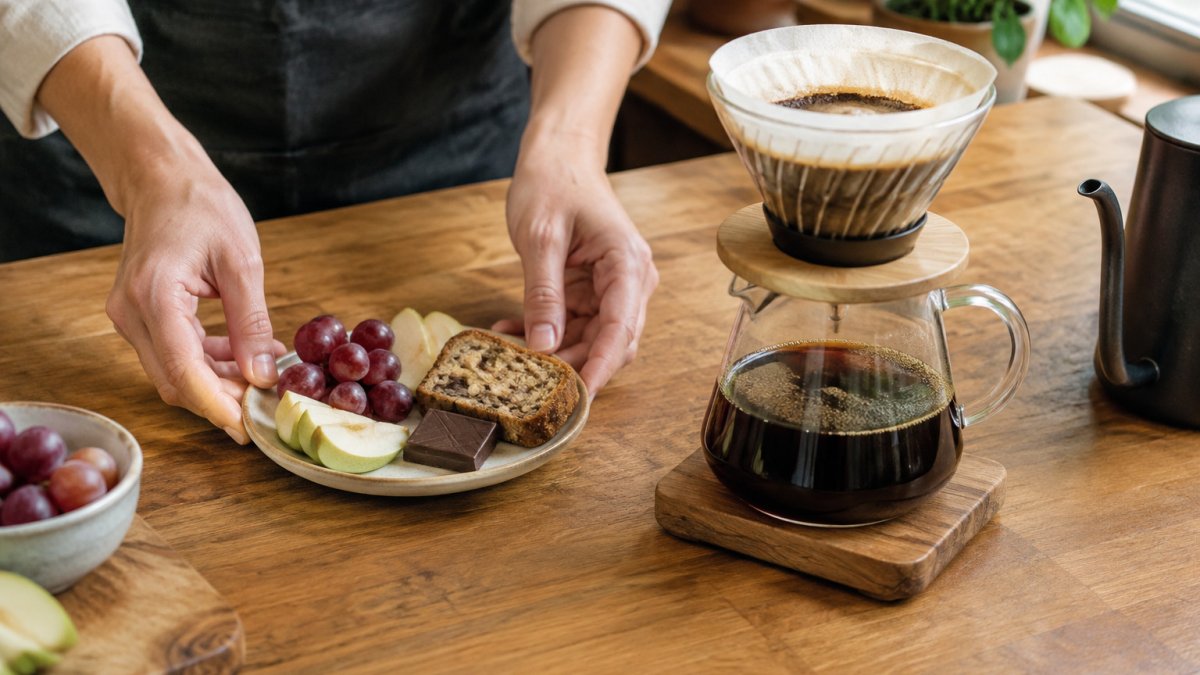
Light roasts with bright, citrusy profiles pair well with fruit. Berries, sliced pear, and a plain biscuit all let the coffee's acidity shine without overpowering the food. Delicate foods work because a loud coffee would bury them.
Avoid heavy cream sauces or very sweet desserts with a light roast. The acidity can clash, and the cup can taste sour. Keep the food simple and let the coffee lead.
Step 3: Match Medium and Dark Roasts with Sweets, Pastries and Savory Dishes
Medium and dark roasts carry more body and less perceived acidity, which makes them the workhorses for richer food. Darker roasting develops more toasted, bittersweet and cocoa-like flavors that echo browned and roasted foods. That is why a medium roast with caramel and nut notes feels seamless next to a butter croissant, and why a dark, chocolate-forward blend stands up to a 70% cacao bar instead of being buried by it. Try the Chocolate Hazelnut - Velvet Roast Blend for cocoa, cinnamon, and vanilla notes.
Sweets and pastries
- Buttery, laminated pastries (croissant, kouign-amann): medium roast with caramel, toffee, or almond notes. The fat coats the palate; the coffee's remaining acidity and roast bitterness cut through it.
- Dark chocolate and brownies: dark roast or a chocolate-forward blend. Match the bitterness level rather than exceed it, or the dessert tastes flat.
- Cinnamon and spice desserts (snickerdoodle, carrot cake, pecan pie): medium-dark roast with toasted pecan, brown sugar, or baking-spice notes.
- Nut-based sweets (almond tart, hazelnut biscotti): a chocolate-hazelnut blend mirrors the nut's roasted character; a medium roast with a clean finish keeps the pairing from turning heavy.
Savory and umami pairings, the lane most guides skip
This is where medium and dark roasts earn their keep, and it is the pairing category most coffee-and-food content ignores in favor of pastries. Coffee's roast-derived bitterness and body can help reset the palate between bites of rich, salty, or fatty food.
- Aged hard cheeses (aged cheddar, gouda, Parmesan): medium roast with nutty or cocoa notes. The cheese's crystalline crunch and salt need the coffee's body to avoid tasting thin. Very dark, ashy roasts can clash with sharp cheese, so keep the roast in the medium-to-medium-dark band.
- Cured meats (prosciutto, salami, jerky): medium-dark roast. The fat and salt in the meat are balanced by the coffee's bitterness; a bright light roast tends to taste sour against cured pork.
- Grilled or braised red meat: medium roast with cocoa or spice notes. The Maillard crust on the meat and the roast notes in the cup are the same family of flavors, so they read as complementary rather than competing.
- Roasted vegetables (charred broccoli, roasted carrots, mushrooms): medium roast. Mushrooms in particular are high in glutamate, and the umami reads as sweetness against a nutty, low-acid cup.
- Spice-forward dishes (chili, dry-rubbed chicken, mole): medium-dark roast with baking-spice or dark-fruit notes. The coffee's body carries the heat instead of being drowned by it.
A quick working matrix
| Food family | Best roast band | Why it works |
|---|---|---|
| Buttery pastry | Medium | Caramel notes meet browned butter |
| Dark chocolate | Dark | Bitterness matched, not exceeded |
| Aged hard cheese | Medium to medium-dark | Body and bitterness balance salt and fat |
| Cured meat | Medium-dark | Bitterness cuts fat; salt is buffered |
| Grilled red meat | Medium | Shared Maillard/cocoa notes |
| Roasted mushrooms | Medium | Umami reads sweet against nutty cup |
| Spice-forward dishes | Medium-dark | Body carries heat |
Use the matrix as a starting point, then adjust by tasting.
Step 4: Use a Coffee Pairing Chart to Plan Snacks
A pairing chart only earns its place on the fridge if it is specific enough to settle an argument. The version most guides describe, roast level down one side, food types across the top, is a fine start, but it collapses two variables that matter just as much: how you brewed the coffee and how hot you are serving it. Build the chart around all three and it becomes a tool rather than a decoration.
The three axes
- Roast band: light, medium, medium-dark, dark.
- Brew method: this changes the pairing profile of the same bean more than most drinkers expect. A V60 or other pour-over produces a cleaner, more acidic, lighter-bodied cup; a French press produces more body and sediment, which reads as heavier and rounder; an espresso concentrates sweetness and bitterness into a small volume and changes how the coffee interacts with fat and sugar. The same medium roast that pairs with a croissant as a pour-over may overpower it as a French press.
- Serving temperature: hot versus iced changes perceived sweetness and acidity. Cold temperatures suppress perceived sweetness and mute aromatics, so an iced coffee often needs a sweeter or more aromatic food partner than the same coffee served hot; hot coffee amplifies aromatics and can make a delicate pastry taste bland by comparison.
How to score each cell
Use a simple three-point scale instead of a checkmark, because a checkmark hides the difference between "fine" and "excellent":
- 2 = match: the coffee and food share a flavor family (cocoa with chocolate, nut with nut, fruit with fruit).
- 1 = contrast: the coffee and food oppose each other on purpose (bright acidity against fat, bitterness against salt).
- 0 = clash: one flattens the other (very dark roast with delicate fish; very light roast with cured meat).
A row of 2s is a safe menu. A row of 1s is the interesting one, that is where guests notice the pairing. A 0 is worth writing down too, because knowing what not to serve is half the value of the chart.
A worked example
Take one medium roast with caramel and almond notes and run it through three brew methods against three foods:
| Brew method | Butter croissant | Aged cheddar | Dark chocolate square |
|---|---|---|---|
| Pour-over (V60) | 2, clean cup, caramel meets butter | 1, acidity cuts the cheese's fat | 0, coffee too light for the chocolate |
| French press | 2, body matches the pastry's richness | 2, rounder cup meets the salt | 1, body holds up, bitterness contrasts |
| Espresso | 1, concentrated sweetness vs. butter | 1, intensity vs. salt | 2, concentrated cocoa meets cocoa |
That single bean produces three different pairing maps. This is the part most pairing guides leave out, and it is the reason a chart built only on roast level keeps giving you wrong answers.
Building and using the chart
Start with four roast bands as rows and three food families (fruit, baked goods, savory) as columns, then keep a separate sheet per brew method you actually use at home. Fill cells in after real tastings, not from memory. Keep portions small, a quarter-pastry and a two-ounce pour are enough to judge a pairing, and note the serving temperature in the margin, since an iced version of the same cup will score differently.
Step 5: Build a Pairing Menu for Guests
When you host, plan a short menu with one light and one dark coffee. Serve the light roast first with fruit and light bites, then the dark roast with desserts. This order lets guests notice the contrast between the two cups.
Keep portions small so the coffee stays the focus. Offer water between tastings to reset the palate. Guests usually enjoy comparing notes, which makes the pairing feel like a shared activity rather than a formal meal.
Choosing the Snack That Goes Best With Your Next Cup
The best pairing starts with the coffee in your hand. Check the roast, read the flavor notes, and decide whether the food should match or contrast. Start with simple combinations, keep notes on what works, and build from there. Browse the Lux Brew Coffee Co. range to find a roast that fits your next snack.
Frequently Asked Questions
What foods pair well with specialty coffee?
Specialty coffee pairs well with foods that either echo or contrast its flavor notes. Bright, fruity light roasts go well with berries, citrus and lightly sweetened pastries. Chocolate, caramel and nut flavors in medium and dark roasts match dark chocolate, shortbread and toasted nuts. Savory options such as aged cheese or salted nuts also work with fuller-bodied coffees. Start with one pairing, taste both together, and adjust the sweetness of the food until the cup and the bite complement each other.
Should coffee be paired with sweet or savory foods?
Both work, and the choice depends on the coffee. Sweet foods soften the bitterness of darker roasts and highlight chocolatey notes. Savory foods, such as salted nuts, cured meats or sharp cheese, pair well with low-acid, full-bodied coffees and bring out their depth. Very sweet desserts can overwhelm a delicate light roast, so pair those with brighter coffees that have enough acidity to keep the flavors balanced.
How do you pair coffee with food for guests?
Keep the menu to three or four items so guests can taste each pairing clearly. Offer one light roast with a fruit-based item, one medium roast with a pastry or cookie, and one dark roast with chocolate or a savory snack. Serve coffees from light to dark so the palate adjusts gradually. Provide water between tastings to cleanse the palate and let guests note which flavors they prefer.
