

Table of Contents
- Is Specialty Coffee Worth the Price? A Framework for Evaluation
- Specialty Coffee vs Regular Coffee: Understanding the Core Differences
- Benefits of Specialty Coffee Beyond the Cup
- Cost of Specialty Coffee Per Cup: Breaking Down the Real Investment
- How to Appreciate Specialty Coffee: Practical Steps for Every Drinker
- What You're Actually Paying For: The Price Justification
- Is Specialty Coffee Worth It for Your Situation?
- Conclusion: Making Your Specialty Coffee Decision
Last Updated: July 27, 2026
Is Specialty Coffee Worth the Price? A Framework for Evaluation
When you're staring at a twenty-dollar bag of specialty coffee next to a five-dollar grocery store option, the question feels urgent: does the difference justify the cost? Lux Brew Coffee Co. works with coffee enthusiasts who wrestle with this tension daily. The answer depends on how you brew, what you value, and whether you'll invest in the equipment and technique that unlocks specialty coffee's potential.
This guide breaks down what you're paying for, how to calculate real cost per cup, and how to determine if that investment makes sense for your situation.
Specialty Coffee vs Regular Coffee: Understanding the Core Differences
Specialty coffee meets a measurable standard: the Specialty Coffee Association requires beans to score 80 points or higher on their 100-point scale. This reflects consistent quality in bean density and flavor complexity. Commodity-grade coffee scores below 80, comes from larger operations prioritizing volume over consistency, and is roasted for shelf stability rather than flavor development.
The sensory difference is obvious. Specialty coffee has distinct flavor notes, chocolate, citrus, stone fruit, depending on origin and processing. Grocery store coffee tastes generic: bitter, flat, one-dimensional.
SCA Scoring and Quality Standards
An SCA score of 80+ means the coffee was grown at appropriate altitude, harvested at peak ripeness, processed carefully, and stored properly. Defects are minimal. An 85-point coffee is noticeably better than an 80-point coffee; a 90-point coffee is exceptional. These aren't subjective opinions but based on trained cupping, a standardized tasting methodology where multiple evaluators assess the same coffee blind.
Beans scoring below 80 lack the complexity and cleanliness that define specialty coffee. They may have off-flavors, inconsistent body, or muddled acidity.
Benefits of Specialty Coffee Beyond the Cup
When you buy specialty coffee, you're paying for freshness, ethical sourcing, and roaster expertise. These benefits compound with the right brewing setup.
Flavor Complexity and Sensory Experience
A single-origin specialty coffee will have distinct flavor notes based on altitude, soil, climate, and processing method. An Ethiopian natural process might taste like blueberry and floral; a Colombian washed might taste like chocolate and nuts. This complexity results from careful cultivation, precise harvesting, and intentional processing choices. The roaster develops the beans to highlight inherent flavors rather than bury them.
For people who care about flavor, this transforms coffee from a caffeine delivery system into something worth tasting.
Ethical Sourcing and Direct Trade Impact
Many specialty roasters work directly with farmers through direct trade relationships, paying prices that reflect actual quality and often significantly above commodity market prices. Farmers benefit from stable income and recognition; roasters get consistent access to high-quality beans and understand exactly where their coffee comes from.
Lux Brew Coffee Co. sources from ethical family farms and maintains transparency about sourcing practices. When you buy from a roaster committed to direct trade, you support sustainable farming practices and fair compensation for growers.
Freshness from Roast Date to Your Cup
Coffee is freshest within 2-4 weeks of roasting. Most specialty roasters print the roast date on every bag; grocery store coffee often doesn't. By the time grocery store coffee reaches your cup, it might be months old.
Specialty roasters ship quickly after roasting. Lux Brew Coffee Co. roasts to order and ships within hours, ensuring peak freshness.
:::pro Track your coffee's roast date. If it's older than 4 weeks when you open it, flavor will noticeably decline. :::
Cost of Specialty Coffee Per Cup: Breaking Down the Real Investment
A typical bag of specialty coffee contains 12 ounces and costs eighteen to thirty dollars, roughly $1.50 to $2.50 per ounce. A single cup requires about 0.5 ounces of beans, so bean cost per cup is $0.75 to $1.25.
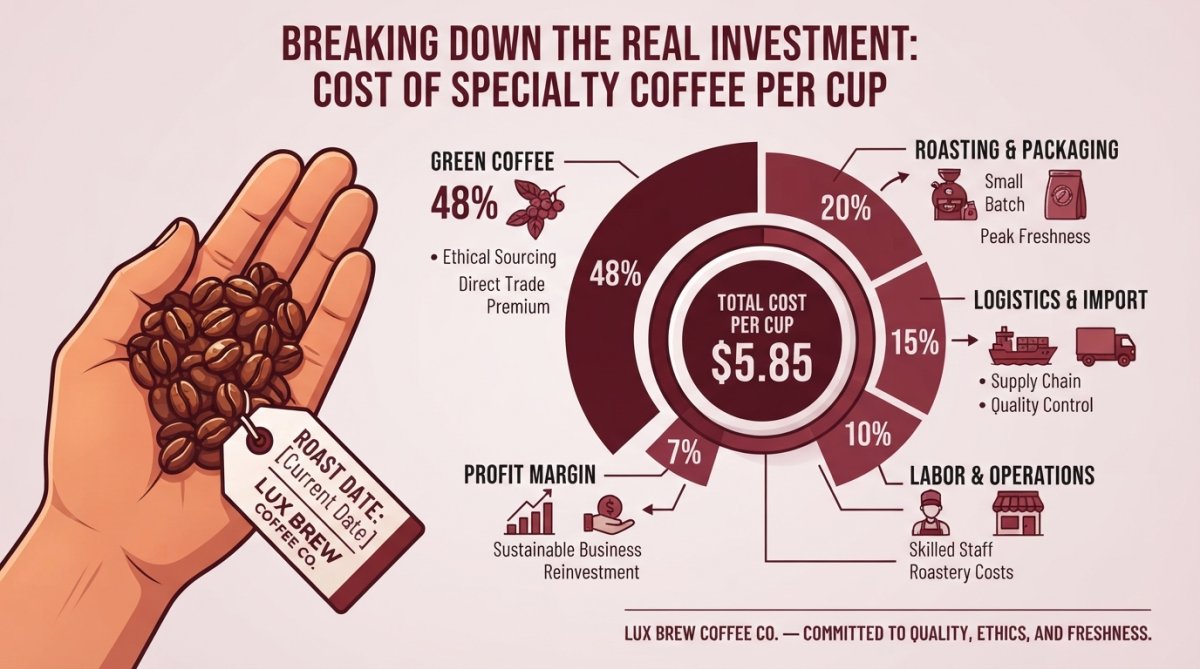
Grocery store coffee costs five to eight dollars for 12 ounces, or $0.40 to $0.65 per ounce, putting bean cost per cup at $0.20 to $0.33.
On the surface, specialty coffee costs three to four times more per cup. But this misses critical variables: brewing efficiency, water quality, and grind consistency. Quality burr grinders and proper technique extract more flavor from specialty beans, meaning you get more satisfaction from the same amount of coffee.
| Brewing Method | Beans per Cup | Specialty Cost | Grocery Cost | Equipment Cost |
|---|---|---|---|---|
| French press | 0.5 oz | $0.75-$1.25 | $0.20-$0.33 | $30-$50 |
| Pour over | 0.5 oz | $0.75-$1.25 | $0.20-$0.33 | $15-$40 |
| Espresso | 0.5 oz | $0.75-$1.25 | $0.20-$0.33 | $150-$500+ |
| Automatic drip | 0.5 oz | $0.75-$1.25 | $0.20-$0.33 | $30-$100 |
| Moka pot | 0.5 oz | $0.75-$1.25 | $0.20-$0.33 | $20-$40 |
Calculating True Cost Per Serving Across Brewing Methods
True cost per cup includes beans, equipment, and time. A French press costs thirty to fifty dollars, brews a full pot in four minutes, and requires no electricity. Per-cup bean cost is $0.75 to $1.25, plus five cents for water and electricity. Total: under two dollars per cup with specialty beans.
An espresso machine can cost hundreds or thousands of dollars. At two shots per day, that's roughly one dollar in beans per cup, but you're amortizing a five-hundred-dollar machine over years of use.
For most people, the actual cost-per-cup difference between specialty and grocery coffee is smaller than sticker price suggests, maybe fifty cents to a dollar more per cup.
Equipment Barrier to Entry and Hidden Costs
Specialty coffee doesn't taste better without the right equipment. A cheap automatic drip machine with specialty whole beans might taste only marginally better than commodity coffee, because the machine can't control water temperature or contact time well enough to extract the beans' potential.
To taste specialty coffee's difference, you need:
- A burr grinder (blade grinders produce inconsistent particle size, ruining extraction)
- A brewing method that controls water temperature and contact time
- Whole beans ground fresh before brewing
- Filtered water if your tap water is very hard or chlorinated
A basic burr grinder costs forty to eighty dollars. A French press or pour-over costs fifteen to fifty dollars. Total entry cost: under one hundred fifty dollars for a system that actually extracts specialty coffee properly.
The hidden cost is learning: understanding grind size, water temperature, brew time, and ratio.
How to Appreciate Specialty Coffee: Practical Steps for Every Drinker
If you're spending more on specialty coffee, you should taste why.
Blind Taste Test Methodology and Self-Verification
Brew specialty and grocery store coffee using the same method, water, grind size, and brewing time. Pour each into unmarked cups. Taste both without knowing which is which. This removes bias and lets you taste the actual difference.
Most people find specialty coffee noticeably more complex, cleaner, and more interesting. Some don't taste much difference, which is also valuable information, it tells you specialty coffee might not be worth the premium for your palate.
Brewing Variables That Unlock Flavor Potential
Specialty coffee's flavor complexity only emerges when you control these variables:
Water temperature: Brew water should be 195-205°F. Too hot creates bitter, astringent flavors; too cool creates sour, weak coffee.
Grind size: Coarser grinds for longer contact times (French press, 4 minutes), finer grinds for shorter contact times (espresso, 25-30 seconds).
Coffee-to-water ratio: A standard ratio is 1:16 (one part coffee to 16 parts water by weight). Adjust based on taste preference.
Brew time: Contact time varies by method. French press is 4 minutes; pour-over is 3-4 minutes; espresso is 25-30 seconds.
Freshness: Grind immediately before brewing. Whole beans stay fresh for weeks; ground coffee goes stale in hours.
When these variables are dialed in, specialty coffee's flavor notes become obvious.
What You're Actually Paying For: The Price Justification
Specialty coffee's price premium reflects real costs and real value.
Roaster Expertise and Freshness Commitment
A specialty roaster employs trained professionals who understand how to develop each coffee's unique characteristics. They test different roast profiles, adjusting time and temperature to highlight inherent flavors. They also commit to roasting to order and shipping quickly, adding operational complexity and cost compared to bulk roasting and warehouse storage.
Lux Brew Coffee Co. roasts every batch to order and ships within hours, guaranteeing freshness but requiring higher labor costs and sophisticated logistics.
Single-Origin Selection and Processing Methods
Commodity coffee is typically a blend of beans from multiple origins, often including lower-quality beans. Specialty coffee is often single-origin, all beans from one farm, region, or harvest, allowing the roaster and farmer to showcase unique characteristics.
Processing method fundamentally changes flavor profile. A washed process results in cleaner, brighter flavors. A natural process results in more sweetness and fruitiness. A honey process splits the difference.
Single-origin specialty coffees are more expensive because they're more difficult to source consistently and are marketed based on unique characteristics rather than as interchangeable commodities.
Sustainability ROI and Long-Term Value
When you buy specialty coffee from roasters committed to direct trade and ethical sourcing, you support farming practices that are more sustainable long-term. Farmers paid fairly and valued for quality invest in soil health, water conservation, and biodiversity. Commodity farming, driven by price pressure, often depletes soil and relies on chemical inputs.
Buying specialty coffee supports the supply chain that will continue producing excellent coffee in the future.
Is Specialty Coffee Worth It for Your Situation?
The answer depends on three factors: your brewing method, your palate, and your budget.
Matching Coffee Quality to Your Brewing Method
If you're using an automatic drip machine without temperature control, specialty coffee probably isn't worth the premium. Your equipment can't extract the flavor complexity that justifies the higher price.
If you have a French press, pour-over, or other manual brewing method with temperature control, specialty coffee is worth trying. The difference will be noticeable.
If you have an espresso machine, specialty coffee is almost essential. Espresso amplifies both good and bad characteristics of beans. Commodity coffee will taste harsh and one-dimensional; specialty coffee will taste complex and balanced.
Common Mistakes That Waste Specialty Coffee's Potential
The most common mistake is buying specialty coffee and brewing it like commodity coffee: grinding with a blade grinder, brewing in an automatic drip machine with inconsistent temperature, using water that's too hot or too cool.
The second mistake is leaving specialty coffee open in a paper bag for months. Freshness degrades rapidly after opening. Store beans in an airtight container away from light and heat.
The third mistake is buying specialty coffee without understanding what you're tasting. Each origin has distinct characteristics. A natural process Ethiopian tastes completely different from a washed process Colombian. Understanding this helps you appreciate what you're experiencing.
Conclusion: Making Your Specialty Coffee Decision
The question "is specialty coffee worth the price" has a practical answer once you account for freshness, sourcing transparency, flavor complexity, and the equipment investment required to taste the difference.
For someone using an automatic drip machine and buying pre-ground coffee, specialty coffee probably isn't worth the premium. For someone with a burr grinder, manual brewing method, and genuine interest in flavor, specialty coffee is almost certainly worth it.
The real value is in the experience of tasting coffee grown, processed, and roasted with intention. Lux Brew Coffee Co. delivers this through single-origin specialty beans roasted to order and shipped within hours of roasting, ensuring peak freshness. The combination of ethical sourcing, expert roasting, and guaranteed freshness creates a product worth the investment if you have the equipment and technique to extract what the beans offer.
Start with a blind taste test. Invest in a burr grinder and manual brewing method. Buy fresh, single-origin specialty coffee from a roaster committed to quality. Then decide for yourself whether the difference justifies the cost.
According to the Specialty Coffee Association's standards documentation, beans scoring 80 points or higher meet the organization's strict quality criteria across aroma, flavor, aftertaste, acidity, body, balance, and overall impression. Research from the National Coffee Association's consumer survey indicates that specialty coffee consumption has grown steadily among consumers who prioritize flavor and sourcing transparency. For those ready to invest in the equipment and technique required to appreciate specialty coffee, the Barista Guild's brewing guides provide evidence-based recommendations for optimizing extraction across different brewing methods.
Frequently Asked Questions
What makes specialty coffee more expensive than grocery store coffee?
Specialty coffee commands higher prices due to multiple factors: SCA scoring standards (80+ points), single-origin bean selection, direct trade relationships with family farms, careful processing methods (washed, natural, honey process), and roaster expertise. Additionally, roasting to order ensures peak freshness, which requires smaller batch sizes and faster shipping. You're paying for verifiable quality, supply chain transparency, and the sensory experience, not just caffeine.
How much more does specialty coffee cost per cup compared to regular coffee?
Cost-per-cup depends heavily on your brewing method, bean price, and serving size. Specialty coffee beans typically cost more upfront, but the actual per-cup expense varies: a single-origin pour-over may cost $0.75-$1.50 per cup, while grocery store coffee averages $0.25-$0.50. However, specialty coffee's flavor concentration often requires less bean volume, and the enhanced extraction from proper brewing technique can offset the higher initial cost. Visit Lux Brew Coffee Co.'s website for current pricing to calculate your specific cost-per-cup.
Can casual coffee drinkers actually taste the difference with specialty coffee?
Yes, if brewing variables are controlled. Specialty coffee's flavor notes (acidity, body, sweetness, aftertaste) become apparent when grind consistency, water temperature, and extraction time are optimized. A burr grinder and proper brewing method matter more than expensive equipment. Start with a simple blind taste test: brew commodity coffee and specialty coffee side-by-side under identical conditions. Most drinkers notice clearer flavor profiles in specialty beans, even without advanced palates. The key is matching bean quality to your brewing method.
Is specialty coffee worth it if I don't have an espresso machine or fancy equipment?
Absolutely. Specialty coffee shines across all brewing methods, French press, pour-over, AeroPress, and standard drip brewers all reveal single-origin complexity when freshness and grind quality are prioritized. You don't need expensive equipment to appreciate specialty coffee's flavor potential. A burr grinder (modest investment) and attention to brewing basics unlock most of the value. The equipment barrier to entry is lower than many assume; freshness and proper technique matter far more than having premium machinery.
This article was written using GrandRanker