

Last Updated: November 7, 2026
Quick Summary
Price per ounce is the total cost divided by the net weight in ounces, so you can compare bags of different sizes fairly. Convert every bag to ounces first, then include shipping, tax, and subscription discounts in the total before dividing.
- Convert every bag to ounces first: 1 pound equals 16 ounces, and 1 ounce equals about 28.35 grams.
- Divide total cost by ounces: a $15.00 bag of 12 ounces costs $1.25 per ounce.
- Add shipping and tax, and subtract subscription discounts, before you compare bags.
- Compare only like-for-like coffees by roast level, form, origin, and roast date.
Table of Contents
- Why Bag Price Alone Misleads You
- Step 1: Find the Net Weight and Convert It to Ounces
- Step 2: Divide Total Cost by Ounces to Get Price Per Ounce
- Step 3: Add Shipping, Tax, and Subscription Discounts
- How Your Coffee Price Per Ounce Compares to the Average
- Turning Price Per Ounce Into Coffee Cost Per Cup
- Using Your Comparison Worksheet to Choose a Bag or Subscription
- Frequently Asked Questions
Why Bag Price Alone Misleads You
Most people compare coffee by the sticker price on the bag. That is the first mistake. A $18 bag of whole bean coffee can cost less per ounce than a $12 bag if the bigger one holds far more coffee. Comparing bags this way often leads to paying more than you need to.
Price per ounce, also called unit price, fixes this problem. It tells you the cost of each ounce of coffee, so you can compare bags of different sizes side by side.
Here is the core problem with bag price alone:
- Bags come in different sizes, from 12-ounce bags to 5-pound bags
- Sale prices and subscription discounts change the real cost
- Shipping and tax can add to the total you actually pay
Once you know the price per ounce, the comparison gets simple. This guide walks through the method step by step.
Step 1: Find the Net Weight and Convert It to Ounces
Start by finding the net weight printed on the bag. Net weight is the amount of coffee inside, not the weight of the bag itself. Most US coffee labels show it in ounces, pounds, or both, but imported and specialty roasters increasingly print grams or kilograms. You need every bag in the same unit before you divide.
Use these conversions and write the result down for each bag:
- 1 pound = 16 ounces
- 1 ounce = 28.35 grams (round to 28 for quick math) (Approximate Conversions from U.S. Customary Measures to Metric | NIST)
- 1 kilogram = 1,000 grams = about 35.27 ounces
- 1 gram = 0.035 ounces
Worked conversions for common bag sizes:
- A 12-ounce bag is already in ounces: 12 oz.
- A 1-pound bag is 16 oz (1 × 16).
- A 2-pound bag is 32 oz (2 × 16).
- A 5-pound bag is 80 oz (5 × 16).
- A 340-gram bag is about 12 oz (340 ÷ 28.35 = 11.99).
- A 1-kilogram bag is about 35.3 oz (1,000 ÷ 28.35 = 35.27).
Watch out: some bags list "net weight" in one unit and a "roasted in" or "packed on" date nearby, do not confuse the date or the gross shipping weight with the coffee weight. If a listing shows only "1 lb 8 oz," convert the parts separately and add them: 16 + 8 = 24 oz.
When a bag lists both ounces and grams, trust the ounces for a US comparison and use the grams only to double-check. If the two do not roughly agree (for example, 12 oz but 400 g), the label may be a misprint or a different fill, measure the bag on a kitchen scale if the difference matters.
Write down the net weight in ounces before you move on. Mixing pounds, ounces, and grams is the most common source of math errors in this step, and normalizing every bag to ounces is what makes the next division comparable.
Step 2: Divide Total Cost by Ounces to Get Price Per Ounce
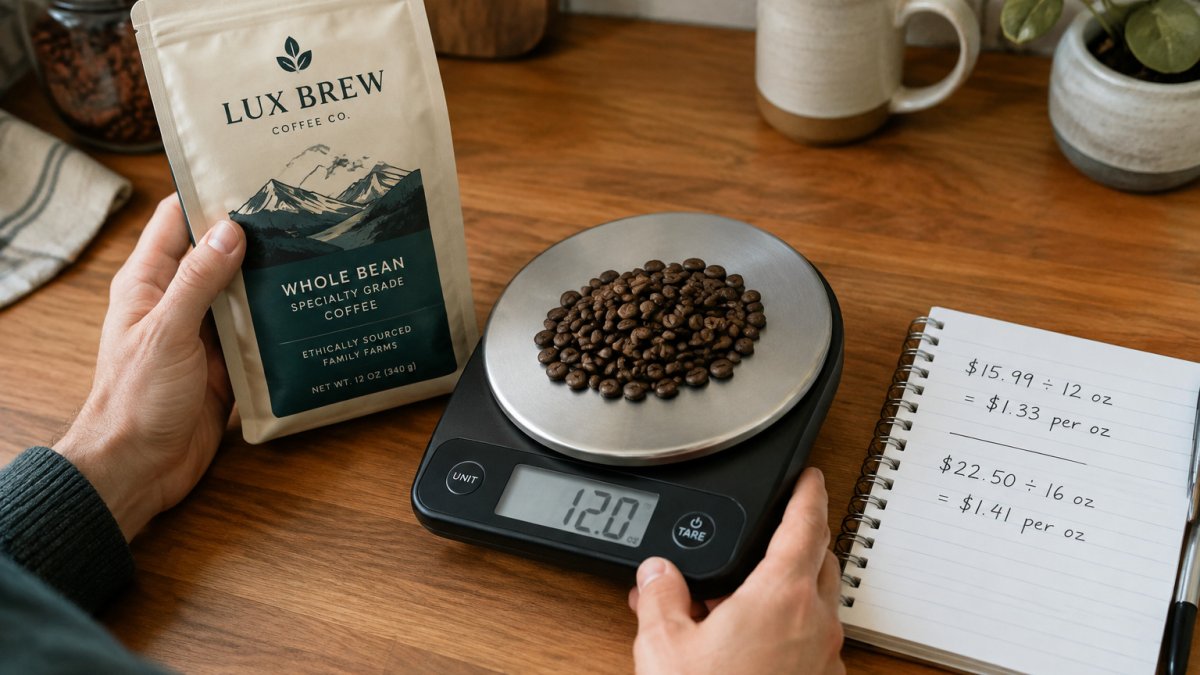
Now divide the total cost by the number of ounces. The formula is:
Price per ounce = Total cost ÷ Ounces
For example, a 12-ounce bag that costs $15.00 works out to $15.00 ÷ 12 = $1.25 per ounce.
Use the same steps for every bag you compare:
- Write down the total price you pay
- Write down the net weight in ounces
- Divide the price by the ounces
- Round to the nearest cent
A quick check helps here. Pick a bag you know and run the math twice. Two matching answers mean your numbers are right.
Here is how the main numbers in the calculation compare, using the figures from the worked examples.
| Item | Value | Note |
|---|---|---|
| Price per ounce formula | Total cost ÷ Ounces | Use the same steps for every bag |
| Example bag | $15.00 ÷ 12 oz | Works out to $1.25 per ounce |
| Quick check | Run the math twice | Two matching answers mean the numbers are right |
Step 3: Add Shipping, Tax, and Subscription Discounts
The shelf price is rarely what you pay. Before you compare, adjust the total cost to match your real checkout price.
- Shipping: Add any delivery fee to the total cost
- Sales tax: Add the tax your state charges, if it applies to online orders
- Subscription discounts: Subtract the percentage off a recurring order
Here is an example. A $20.00 bag with a $4.00 shipping fee costs $24.00 in total. Divided by 16 ounces, that is $1.50 per ounce. A $22.00 bag with free shipping and a 10% subscription discount costs $19.80. Divided by 16 ounces, that is about $1.24 per ounce. The second bag is the better buy, even though its sticker price is higher.
Always compare final totals, not sticker prices.
How Your Coffee Price Per Ounce Compares to the Average
A single price per ounce means little on its own. You need a reference point, and the reference has to be the same kind of coffee. Comparing a dark roast blend to a light roast single origin on price alone tells you nothing about value.
Build your comparison set around like-for-like attributes:
- Roast level: compare dark to dark, medium to medium, light to light.
- Form: whole bean versus ground changes shelf life and often price; compare the same form.
- Origin and process: single-origin, washed, natural, and decaf carry different costs.
- Freshness and roast date: a bag roasted last week is not the same product as a bag with no roast date, even at the same per-ounce price.
- Certification: organic and Fair Trade labels often add cost per ounce; note them so you are not comparing a certified bag to an uncertified one.
Grocery-store commodity coffee generally sits at the low end of the per-ounce range, while specialty and single-origin beans sit higher. Larger bags lower the per-ounce price only if you finish the coffee before it stales. Whole bean holds flavor longer than ground, so a big bag of ground coffee can lose value before you brew it all.
Use a simple tier check rather than a single "average":
- Sort your candidate bags by price per ounce.
- Group them by roast, form, and origin so each group is like-for-like.
- Within each group, flag the lowest per-ounce price that still meets your freshness and flavor bar.
Watch out: a low per-ounce price on a 5-pound bag only wins if your brewing volume uses it before staleness sets in. If you brew a cup a day, a smaller fresh bag at a slightly higher per-ounce price can be the better value.
Keep the same coffee type in each comparison, and treat price per ounce as one input alongside freshness, flavor, and roast style. Once you have the lowest per-ounce price among coffees you actually enjoy, you have found a real value rather than just a cheap number.
Turning Price Per Ounce Into Coffee Cost Per Cup
Price per ounce becomes more useful when you turn it into cost per cup. Most brewing guides use about 2 tablespoons of ground coffee, roughly 10 grams, for an 8-ounce cup. Measure your own brew to confirm, since strength varies by taste and method.
Multiply your price per ounce by the coffee used per cup. If you use 0.5 ounces per cup and pay $1.25 per ounce, each cup costs about $0.63 in coffee.
Track how many cups a bag yields. A 12-ounce bag at 0.5 ounces per cup gives you about 24 cups. Divide the bag price by 24 to see your cost per cup.
Using Your Comparison Worksheet to Choose a Bag or Subscription
Use this worksheet to compare any two or more bags:
Bag name: ______ Total price paid (including shipping and tax, minus discounts): $______ Net weight in ounces: ______ Price per ounce (total ÷ ounces): $______ Cost per cup (price per ounce × ounces per cup): $______
Fill out one copy for each bag. Then sort the results from lowest to highest price per ounce.
Price per ounce is one factor, not the only one. Freshness, flavor, and roast style matter too. Once you have the lowest price per ounce among coffees you enjoy, you have found a real value. If you are ready to pick one, you can look at the Italian Roast bag. Browse our current selection at Lux Brew Coffee Co. to compare options, and check the site for current pricing, since prices depend on bag size, quantity, and delivery.
Ready to put this method to work? Explore the Lux Brew Coffee Co. collection and find a roast you enjoy at a price per ounce that makes sense for you.
Frequently Asked Questions
How do you compare the cost per cup of different coffees?
Start with price per ounce, then multiply by the ounces of coffee you use per cup. Most home brewers use about 0.6 ounces (roughly 17 grams) of ground coffee for a standard 8-ounce cup, though this varies with brew method and taste. Multiply the price per ounce by that dose to get cost per cup. Compare coffees using the same dose so the results are directly comparable, and remember that stronger brews use more coffee per cup and cost more to make.
How many ounces are in a pound of coffee?
A pound contains 16 ounces. To convert a price per pound to a price per ounce, divide the pound price by 16. For example, a 1-pound bag priced at $18.00 costs $1.125 per ounce. Check the net weight printed on the bag, since some packages are labeled in grams or in ounces that differ from the pound price you see on a retailer page. Always convert to the same unit before comparing two products.
Does a lower price per ounce mean better value for coffee?
Not always. A lower price per ounce means you pay less for each ounce of coffee, but value also depends on freshness, roast date, bean origin, and whether you will drink the coffee before it goes stale. A cheaper bag that sits on a shelf for months may deliver less flavor per dollar than a pricier bag roasted recently. Use price per ounce as one factor alongside roast date and how much you actually enjoy the taste.
Should you compare coffee by bag price or price per ounce?
Compare by price per ounce. Bag prices hide differences in package size, so a $20 bag and a $12 bag can cost the same per ounce or differ widely. Dividing each bag's total cost by its net weight in ounces puts every product on the same scale. Include shipping and taxes in the total cost before dividing, because those charges can change which option is actually cheaper.
