

Table of Contents
- Understanding Specialty Coffee Brewing Methods
- Coffee to Water Ratio for Specialty Coffee
- Water Temperature for Brewing Coffee
- Selecting the Right Coffee Grinder for Specialty Coffee
- Water Chemistry and Filtration for Better Extraction
- Tasting Notes and Sensory Training for Specialty Coffee
- Essential Equipment: What You Need to Brew Specialty Coffee at Home
- Common Mistakes to Avoid When Brewing Specialty Coffee
Brew Specialty Coffee at Home: A Complete Guide
Last Updated: July 29, 2026
Learning how to brew specialty coffee at home transforms your morning ritual from routine to remarkable. The difference between mediocre and exceptional coffee comes down to method, not just beans. At Lux Brew Coffee Co., we've worked with thousands of coffee enthusiasts who discovered that understanding brewing fundamentals unlocked flavors they didn't know existed in their beans. What separates a truly great cup from a decent one isn't mystery, it's precision. Temperature, grind size, coffee-to-water ratio, and brew time all matter. This guide covers all of it, with practical steps you can implement today.
Understanding Specialty Coffee Brewing Methods
Specialty coffee brewing requires intention. The core principle is extraction: pulling the right amount of soluble material from ground coffee using hot water. Too little extraction and your coffee tastes sour and thin. Too much extraction and it becomes bitter and harsh. Each brewing method achieves extraction differently, which is why the same beans can taste dramatically different depending on how you brew them.
The best brewing method depends on your lifestyle, budget, and how much control you want over variables.
Pour Over Brewing
Pour over remains one of the most popular specialty brewing methods because it offers excellent control and produces clean, bright cups. Hot water passes through ground coffee and a filter, then drips into a vessel below. Popular devices include the Hario V60, Melitta, Chemex, and Kalita Wave.
To brew pour over specialty coffee, use medium-fine grounds, water between 195-205°F, and a 1:16 coffee-to-water ratio (for example, 25 grams of coffee to 400 grams of water). Begin by pouring just enough water to saturate the grounds, this bloom phase lasts 30-45 seconds and allows CO2 to escape. Then pour the remaining water in slow circles, keeping the water level consistent. The entire brew typically takes 2.5 to 4 minutes depending on your grind size and pouring technique.
Pour over demands focus, which appeals to people who enjoy the ritual. It's also forgiving; if your technique isn't perfect, you'll still get good coffee. Cleanup is minimal.
French Press Technique
The French press uses immersion brewing: coffee grounds steep directly in hot water for several minutes before being separated by pressing a metal filter down. This method produces full-bodied coffee with visible oils and sediment, which many coffee lovers prefer for its richness.
Use coarse grounds; fine grounds will slip through the metal filter and cloud your cup. Add coffee and hot water (195-205°F), stir gently after 30 seconds, then let it steep for 4 minutes. Press the plunger down slowly over 20-30 seconds. Pour immediately into your cup, leaving coffee in the pot causes continued extraction and bitterness.
French press works beautifully with medium and dark roasts and is one of the most affordable brewing methods.
Aeropress Instructions
The Aeropress is a hybrid brewing device that combines immersion and percolation, using air pressure to force water through grounds. It creates a quick, concentrated brew that's clean like pour over but rich like French press, in about 90 seconds.
Standard method: place a paper filter in the metal basket, rinse it with hot water, add medium-fine grounds, pour hot water (195-205°F) to fill about one-third of the chamber, stir for 10 seconds, add more water to fill the chamber, insert the plunger gently, and press down over 20-30 seconds.
The inverted method flips the device upside down, allowing more precise control over steep time. Start with the plunger inserted about one inch into the cylinder, add grounds, pour water, stir, let it steep for 1-2 minutes, then flip it onto your cup and press.
Aeropress excels with single-origin, lighter roasted coffees and is nearly unbeatable for travelers and people with limited kitchen space.
Moka Pot Brewing
The Moka pot brews coffee by passing hot water pressurized by steam through ground coffee, producing a strong, concentrated coffee closer to espresso than true espresso.
Fill the bottom chamber with water just below the safety valve. Add finely ground coffee to the filter basket, pack it gently but firmly. Screw the top chamber onto the bottom chamber and place it on medium heat. When you hear a gurgling sound, the water has begun forcing through the coffee. Remove from heat when the gurgling becomes a hiss.
Moka pot coffee works beautifully with milk, making it ideal for cappuccinos and lattes. Single-origin coffees from Central and South America shine in Moka pots, where their natural sweetness and body come through beautifully.
Coffee to Water Ratio for Specialty Coffee
The coffee-to-water ratio is one of the most important variables in brewing. The industry standard is 1:16, meaning one part coffee to 16 parts water by weight. This works well for most brewing methods and produces a balanced cup.
However, the ideal ratio depends on your brewing method and taste preference. Pour over and Aeropress typically work best at 1:16. French press often benefits from 1:15 because the immersion method extracts more efficiently. Moka pot can go as strong as 1:12 or 1:13 because the concentrated brew is meant to be mixed with milk.
To use ratios practically, invest in a small kitchen scale that measures in grams. Weigh your coffee first, then multiply by your desired ratio number to find the water weight. For example, 25 grams of coffee × 16 = 400 grams of water.
| Brewing Method | Recommended Ratio | Ratio Range | Notes |
|---|---|---|---|
| Pour Over | 1:16 | 1:15 to 1:17 | Adjust finer for lighter roasts |
| French Press | 1:15 | 1:14 to 1:16 | Coarser grounds extract more |
| Aeropress | 1:16 | 1:15 to 1:17 | Flexible method allows experimentation |
| Moka Pot | 1:13 | 1:12 to 1:14 | Produces concentrated brew |
| Immersion (cold brew) | 1:8 | 1:6 to 1:10 | Steep 12-24 hours |
Starting with 1:16 and adjusting from there is the smart approach. If your coffee tastes sour, it's under-extracted; use less water or finer grounds. If it tastes bitter, it's over-extracted; use more water or coarser grounds.
Water Temperature for Brewing Coffee
Water temperature dramatically affects extraction speed and flavor development. Too hot and you'll over-extract, pulling out bitter compounds. Too cool and you'll under-extract, leaving behind pleasant flavors. The specialty coffee industry consensus is 195-205°F, with most coffee tasting best between 200-202°F.
Most brewers hit the target by heating water to a boil (212°F) and letting it cool for 30-60 seconds before brewing. Pour over is very temperature-sensitive; a 5-degree difference can noticeably change the cup. French press is more forgiving because the long steep time compensates for minor temperature variations.
Water chemistry also matters. Tap water with high mineral content (hard water) can actually improve extraction, while distilled water produces flat-tasting coffee. If your tap water tastes bad, brew with filtered water. If it tastes good, use it as-is.
Selecting the Right Coffee Grinder for Specialty Coffee
Your grinder is arguably more important than your brewing device. A poor grinder produces inconsistent particle sizes, which means some grounds over-extract while others under-extract, resulting in muddy, unbalanced coffee. A good grinder produces uniform particles, ensuring even extraction and clean flavors.
There are two types of grinders: blade grinders and burr grinders. Blade grinders chop beans with a spinning blade, producing inconsistent sizes and generating heat that damages delicate flavors. Skip them entirely if you care about quality.
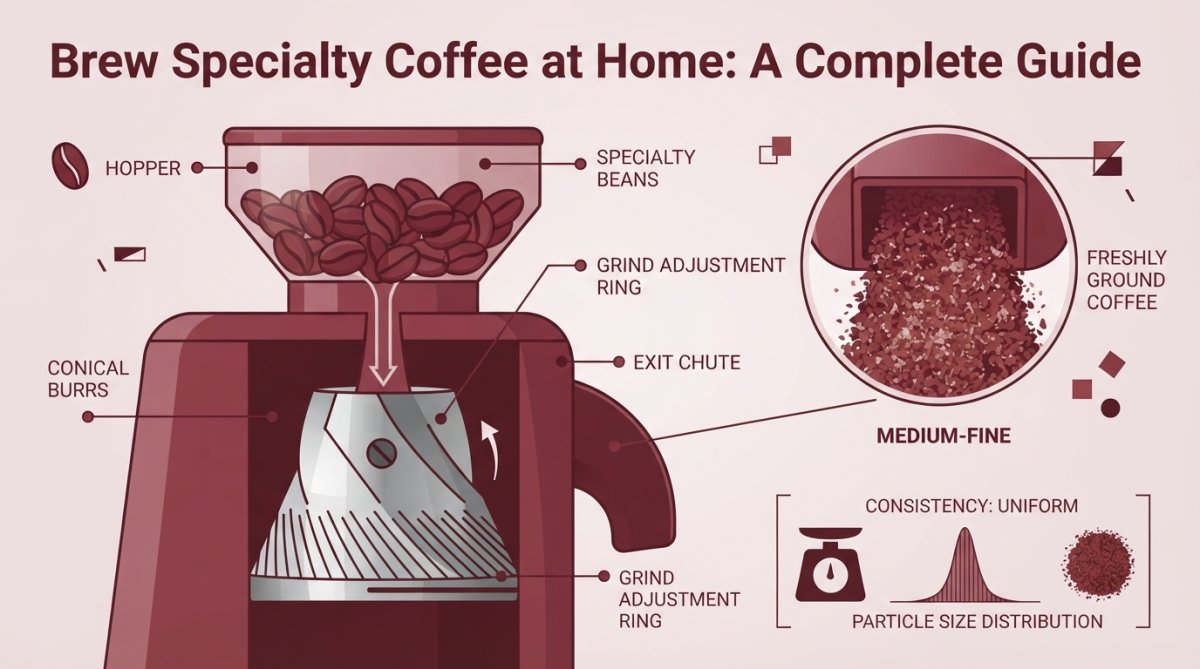
Burr Grinder Types and Grind Size Importance
Burr grinders use two rotating burrs to crush beans between them, producing uniform particle sizes. Conical burrs are slightly more forgiving and work well across different bean densities. Flat burrs produce slightly more uniform particles and are preferred by espresso enthusiasts, though they're overkill for pour over or French press.
For specialty coffee at home, a quality burr grinder in the $30-80 range will serve you excellently. Manual grinders are affordable and produce great results, though they require 5-10 minutes per brew. Electric burr grinders are faster and less labor-intensive.
Grind size is the most important variable you control after water temperature and coffee-to-water ratio. Finer grounds expose more surface area to water, speeding extraction. Coarser grounds slow extraction. Pour over requires medium-fine grounds. French press requires coarse grounds. Aeropress works best with medium-fine grounds. Moka pot needs fine grounds. Cold brew uses coarse grounds and steeps for 12-24 hours.
Start with the recommended grind size for your brewing method, then adjust: if your coffee tastes sour, grind finer; if it tastes bitter, grind coarser.
Water Chemistry and Filtration for Better Extraction
Water makes up 98% of your coffee, yet most home brewers pay it zero attention. Hard water (high mineral content) actually improves extraction because minerals interact with coffee compounds, pulling out more flavor. Distilled water produces flat, unbalanced coffee because minerals play an essential role in flavor development. The ideal water has moderate mineral content, roughly 50-150 parts per million (ppm) of total dissolved solids.
If your tap water tastes good and doesn't have visible mineral deposits, it's probably fine for coffee. If your tap water tastes bad, use a simple activated charcoal filter pitcher (like Brita or PUR), which removes chlorine and improves taste without stripping minerals.
Tasting Notes and Sensory Training for Specialty Coffee
Specialty coffee packages often list tasting notes like "chocolate," "berry," or "floral," which confuses people who don't taste those flavors. The notes aren't marketing fiction; they're real flavors present in the coffee. But tasting them requires training and attention.
Your palate needs exposure and practice to identify subtle flavors. Start by tasting two coffees side-by-side and noticing differences. Taste the same coffee multiple times at different temperatures; flavors change as coffee cools.
Acidity in specialty coffee is a positive quality, it's the brightness and liveliness you taste, not sourness. Lighter roasts have more acidity. Darker roasts have less. Body refers to the weight and texture on your tongue; full body feels heavier, light body feels delicate. Sweetness is the natural sugars in the coffee, which develops during roasting and extraction. A well-extracted cup tastes sweet. An under-extracted cup tastes sour.
Essential Equipment: What You Need to Brew Specialty Coffee at Home
You don't need expensive equipment to brew excellent specialty coffee. Essential equipment includes a burr grinder (non-negotiable), a brewing device (pour over, French press, or Aeropress), a kettle, and ideally a kitchen scale.
Budget-Friendly Specialty Setup
You can brew exceptional specialty coffee for under $100 in total equipment investment. A hand-crank burr grinder ($25-40), a pour over dripper like the Hario V60 ($8-12), paper filters ($3-5), a simple electric kettle ($15-25), and a basic kitchen scale ($10-15) total roughly $60-95 depending on brands.
This setup produces coffee that rivals expensive equipment because the fundamentals, grind consistency, water temperature, and brewing ratio, are covered.
If you prefer convenience, add an electric burr grinder ($40-80) and a gooseneck kettle with temperature control ($30-50). Avoid expensive equipment until you understand what you actually need. Many people buy espresso machines or high-end grinders before they've mastered basic brewing, then abandon coffee entirely because it feels complicated. Start simple, master the fundamentals, then upgrade if you want.
Common Mistakes to Avoid When Brewing Specialty Coffee
Understanding what goes wrong helps you avoid the most common pitfalls.
Using stale coffee is the biggest culprit. Specialty coffee loses flavor within 2-3 weeks of roasting. Buy smaller quantities more frequently, or look for roasters who print roast dates on bags. Lux Brew Coffee Co. roasts every batch to order and ships within hours, ensuring peak freshness when it arrives at your door.
Grinding too fine happens constantly. Finer actually means faster extraction, which often leads to over-extraction and bitterness. Start with the recommended grind size for your brewing method, then adjust if needed.
Using water that's too hot burns delicate flavors, especially in lighter roasts. Stick to 195-205°F. If you don't have a thermometer, wait 30 seconds after boiling before pouring.
Inconsistent ratios make it impossible to dial in your preferred flavor. Use a scale and stick with a ratio (1:16 is a safe starting point) until you understand how changes affect the cup.
Leaving coffee in contact with grounds too long happens with French press and immersion methods. Press or pour immediately after the recommended brew time, or the coffee will over-extract and taste bitter.
Not blooming your pour over means CO2 trapped in the grounds interferes with even water saturation. Spend 30-45 seconds pouring just enough water to saturate the grounds, then proceed with the rest of your brew.
Using tap water that tastes bad affects every cup. If your water tastes off, use filtered water.
Buying pre-ground coffee guarantees stale, inconsistent results. Grind immediately before brewing.
Brewing specialty coffee at home reveals how much flavor and complexity exist in quality beans. The process rewards attention and consistency but doesn't require expensive equipment or advanced skills. Start with a simple setup, a burr grinder, a brewing device, and good beans, then practice the fundamentals until they become automatic. Lux Brew Coffee Co. provides freshly roasted specialty-grade beans sourced from ethical family farms, roasted to order and shipped within hours of roasting to guarantee peak freshness. Get started with Lux Brew Coffee Co. and discover how transformative fresh, properly brewed specialty coffee can be.
Frequently Asked Questions
What equipment do I need to brew specialty coffee at home?
At minimum, you need a burr grinder, a brewing device (pour over, French press, or Aeropress), a gooseneck kettle for precise pouring, a kitchen scale for accurate coffee-to-water ratios, and a digital timer. A carafe or cup completes the setup. Budget-friendly options exist for each component, though investing in quality equipment, especially a consistent burr grinder, significantly improves extraction and brings out the specialty coffee's unique tasting notes.
What is the best coffee to water ratio for specialty coffee?
The standard coffee-to-water ratio is 1:16 (one part coffee to 16 parts water by weight), though this varies by brewing method and personal preference. Pour over and drip methods typically use 1:15 to 1:17, while immersion methods like French press often use 1:15 for fuller body. Use a scale to measure precisely; this consistency is crucial for achieving the intended extraction and flavor profile that specialty roasters designed into single-origin and specialty blend beans.
What water temperature should I use when brewing specialty coffee?
The ideal water temperature for brewing specialty coffee ranges from 195°F to 205°F (90°C to 96°C). Water that's too hot can over-extract and create bitter, harsh flavors; water that's too cool under-extracts, leaving the cup thin and sour. Let boiling water cool for 30 seconds before brewing. Using a gooseneck kettle with temperature control gives you precision, especially important when brewing single-origin beans where subtle flavor nuances matter.
How do I know what grind size to use for specialty coffee?
Grind size depends on your brewing method and brew time. Coarser grinds work for longer immersion (French press, 4+ minutes); medium grinds for pour over and Aeropress (2-3 minutes); fine grinds for espresso and Moka pot. A burr grinder lets you adjust precisely. If your brew tastes sour, try a finer grind; if it's bitter, go coarser. Consistency matters, use the same grind size for the same method to develop a repeatable process that highlights your specialty coffee's intended tasting notes.
This article was written using GrandRanker