

Table of Contents
- How Coffee Subscription Services Work
- Freshness Benefits of Coffee Subscriptions
- Is a Coffee Subscription Cheaper Than Buying Beans at the Store?
- Best Specialty Coffee Subscriptions for 2026
- Hidden Costs: Waste, Cancellation, and Storage
- How to Choose the Right Coffee Bean Subscription
- Conclusion
- Frequently Asked Questions
Last Updated: September 23, 2026
How Coffee Subscription Services Work
A coffee bean subscription ships freshly roasted beans to your door on a schedule you choose. Most let you set frequency, bag size, and grind preference, then match you with roasts via a taste quiz or curated selection.
Freshness Benefits of Coffee Subscriptions
Fresh-roasted beans taste noticeably different from beans that sat on a shelf for months. Coffee loses aroma and complexity within weeks of roasting, and grocery bags often carry a roast date well before the purchase date, if they print one at all.
Practical signs you are getting genuinely fresh coffee:
- A printed roast date, not just a best-by date
- A one-way degassing valve on the bag
- Beans that smell sweet and complex when opened, not flat
- Whole bean options so you grind right before brewing
Is a Coffee Subscription Cheaper Than Buying Beans at the Store?
A coffee subscription usually costs more per bag than grocery store beans, but the cost-per-cup comparison is closer than the sticker price suggests. "Worth the money" is a math problem, not a flavor opinion, and the math changes with the tier you buy and how much you drink.
The only metric that matters: cost per finished cup
Cost per cup = bag price ÷ (bag weight in grams ÷ grams per cup)
Here is the framework applied to three tiers:
| Tier | Typical bag price | Bag size | Grams per cup | Cups per bag | Cost per cup |
|---|---|---|---|---|---|
| Grocery store (mass-market) | $8-$12 | 12 oz (340 g) | 18 g | ~18-19 | ~$0.45-$0.65 |
| Mid-tier subscription | $15-$20 | 12 oz (340 g) | 18 g | ~18-19 | ~$0.80-$1.05 |
| Premium subscription | $22-$28 | 12 oz (340 g) | 18 g | ~18-19 | ~$1.15-$1.50 |
The waste adjustment
Stale coffee is the hidden tax on cheap beans. Toss even 25% of a $10 grocery bag and your effective cost per cup rises by roughly a third, from about $0.55 to about $0.73. A subscription bag finished within two weeks has almost no waste, so its effective cost stays close to its raw number.
- Grocery store: ~$0.55 raw → ~$0.73 waste-adjusted
- Mid-tier subscription: ~$0.90 raw → ~$0.92 waste-adjusted
- Premium subscription: ~$1.30 raw → ~$1.33 waste-adjusted
Budget-tier vs. premium-tier ROI
The real question is not "is a subscription cheaper?" but "which tier gives the best return for how I drink?"
- Light drinker (under 1 cup/day, ~15 cups/month): A premium tier at ~$1.30/cup costs about $20/month. A mid-tier at ~$0.90/cup costs about $14/month. The $6 gap buys a marginal quality jump most light drinkers will not notice. Mid-tier wins on ROI.
- Moderate drinker (2 cups/day, ~60 cups/month): Premium runs about $78/month, mid-tier about $54/month. At this volume the freshness difference is obvious in the cup, and the per-cup premium is under $0.50. Premium starts to justify itself.
- Heavy drinker (3+ cups/day, ~90 cups/month): Premium runs about $117/month. At this point a mid-tier subscription plus one premium bag per month as a treat often delivers the best blend of cost and quality.
When the subscription loses
Be honest about the losing scenarios. Under about 10 cups a month, almost any subscription outpaces your consumption and you will be freezing or wasting beans. If you cannot finish a bag within three to four weeks of the roast date, the freshness premium evaporates.
Best Specialty Coffee Subscriptions for 2026
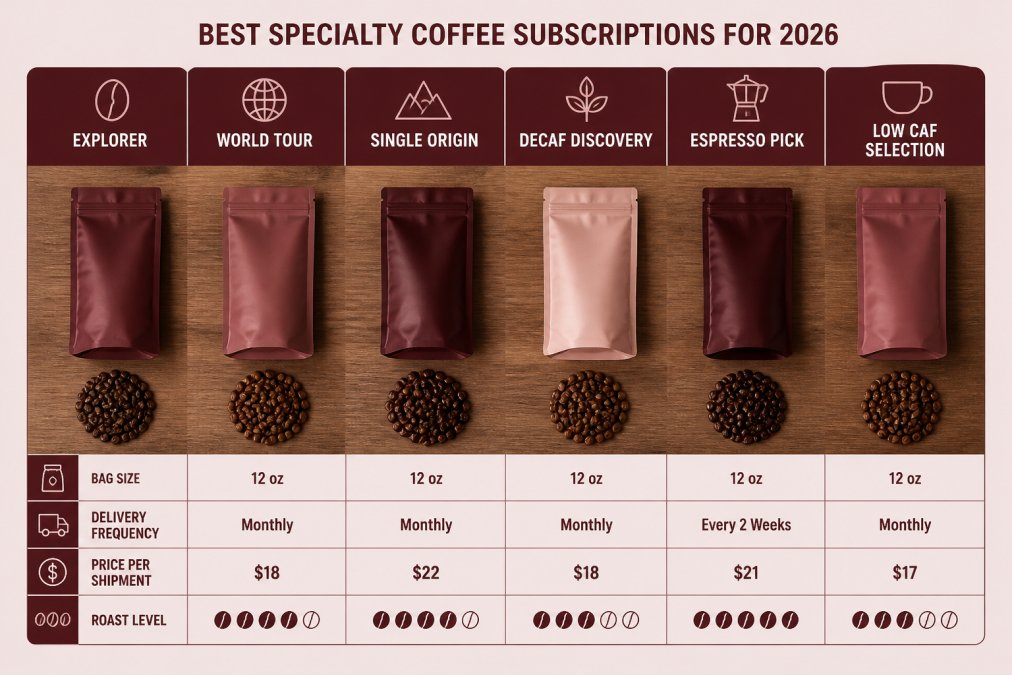
The best specialty coffee subscriptions in 2026 balance freshness, selection, and flexibility. Below are the services worth your money, starting with our top pick.
Lux Brew Coffee Co.
Our top pick for most households. Lux Brew Coffee Co. roasts every batch to order and ships within hours, so beans arrive as fresh as the model allows. The collection spans single-origin beans, specialty blends, and artisan tea from ethical family farms.
- Best for: Drinkers who want peak freshness and traceable sourcing
- Standout features: Roasted to order, shipped within hours, specialty grade, ethical farming
- Trade-off: Premium positioning means it costs more than mass-market beans
Trade Coffee
A personalized service drawing from dozens of independent roasters nationwide, with a taste quiz and deep customization.
- Best for: Variety seekers who want to explore many roasters
- Trade-off: Shipping times vary because beans ship from different roasters
Atlas Coffee Club
A single-origin focused club that sends beans from a different country each month, with flavor cards and brewing tips.
- Best for: Adventurous drinkers curious about global coffee culture
- Trade-off: Less control over the specific roaster
Bean Box
Small-batch curation from top-tier roasters, with whole bean or pre-ground options and tasting notes.
- Best for: Fans of artisanal, curated variety
- Trade-off: Premium pricing versus standard store beans
Onyx Coffee Lab
Direct-from-roaster with competition-grade beans and transparent sourcing.
- Best for: Enthusiasts chasing the highest bean quality
- Trade-off: Higher price per bag
| Service | Starting Price | Best For | Key Strength |
|---|---|---|---|
| Lux Brew Coffee Co. | See site | Freshness-first drinkers | Roasted to order, shipped within hours |
| Trade Coffee | $15.75/bag | Variety seekers | 450+ roasts from 60+ roasters |
| Atlas Coffee Club | $14.00/shipment | Global discovery | Single-origin world tour |
| Bean Box | $18.00/month | Curated small-batch | 600+ coffees, 60+ roasters |
| Onyx Coffee Lab | $22.00/bag | Serious hobbyists | Competition-grade beans |
Hidden Costs: Waste, Cancellation, and Storage
The costs that determine whether a subscription is worth the money never appear on the invoice: how hard it is to cancel, how long beans stay good, and how much you throw away.
Cancellation friction: the cost you cannot see
A subscription you cannot easily pause is an expensive habit. Read the cancellation policy the way you would read a lease. Friction varies widely:
- Self-serve, instant: You can pause, skip, or cancel from your account dashboard in under a minute. This is the standard to look for.
- Self-serve with a notice window: You can cancel online, but changes must be made a set number of days before the next shipment. Miss the window and you pay for one more bag.
- Email or chat only: Cancellation requires contacting support during business hours. This is the most common friction point and the one that traps people.
- Phone-only or "contact us to cancel": The highest-friction model. Treat this as a red flag unless the coffee is exceptional.
Storage and shelf-life: how to make a bag last
If a subscription delivers more coffee than you drink, storage decides between fresh beans and a pantry full of stale ones. Whole beans hold up far better than pre-ground.
A simple shelf-life framework:
- Whole bean, sealed bag with a one-way valve: peak flavor for roughly 2-4 weeks after roast, drinkable for 6-8 weeks.
- Whole bean, opened and stored in an airtight container: best within 2 weeks, acceptable for about 4.
- Pre-ground: loses aroma within days; treat it as a 1-2 week product at most.
- Frozen whole bean (unopened or vacuum-sealed): can hold quality for several months if you freeze immediately after roast and thaw only once.
Waste reduction: matching frequency to consumption
The biggest hidden cost is over-subscription. A weekly plan sounds generous until three unopened bags sit going stale. Size your plan to real consumption.
A quick sizing method:
- Count your actual daily cups for one week. Be honest.
- Multiply by 30 to get monthly cups.
- Divide by cups-per-bag (roughly 18-19 cups per 12 oz bag at 18 g per cup).
- Round down, not up. It is easier to add a bag than to waste one.
How to Choose the Right Coffee Bean Subscription
Choosing the right coffee bean subscription comes down to matching three variables to your routine: frequency, grind, and roast profile.
A simple decision framework:
- If you brew daily and finish a bag in two weeks: choose a biweekly or monthly plan
- If you brew occasionally: choose the longest interval offered and skip as needed
- If you use a pour-over or drip machine: whole bean with a medium grind
- If you use espresso: whole bean with a fine grind, or grind fresh yourself
- If you prefer light, bright cups: look for light roast profiles
- If you prefer chocolate and caramel notes: look for medium to dark roasts
Conclusion
The challenge with any coffee subscription is matching it to how you actually drink coffee, not how you wish you did. Get frequency and roast profile right, and fresh beans become the easiest part of your morning.
Frequently Asked Questions
Is a coffee bean subscription worth the money?
It depends on how much you value freshness and convenience. If you drink at least one cup daily and buy specialty beans anyway, a coffee bean subscription can match grocery store prices per cup while delivering beans roasted days, not months, ago. If you drink occasionally or prioritize lowest cost, a subscription may not be worth it. Calculate your monthly consumption and compare cost-per-cup before committing.
Which coffee bean subscription service is considered the best?
There is no single best service; it depends on your priorities. Lux Brew Coffee Co. focuses on roasting to order and shipping within hours for peak freshness. Match the service to your brewing method and taste preferences.
How does roasting-to-order impact the value of a coffee subscription?
Roasting to order means beans are roasted after you place your order, not sitting in a warehouse. Most grocery store beans are roasted weeks or months before purchase, losing aroma and complexity. A subscription that roasts to order and ships quickly delivers beans at peak flavor, so you get more out of each bag. This freshness is the main value driver for coffee bean subscription services worth the money.
What should I look for in a premium coffee subscription service?
Check four things: roast date transparency (ideally printed on the bag), shipping speed (within 24-48 hours of roasting), customization (grind size, frequency, roast level), and sourcing ethics (direct trade or fair trade). Also review cancellation policy and whether you can skip or pause deliveries. A service that roasts to order and ships within hours, like Lux Brew Coffee Co., addresses the two biggest freshness factors.