

Table of Contents
- Why You Don't Need to Spend a Fortune on a Coffee Grinder
- How to Grind Coffee Without a Grinder: Substitutes That Actually Work
- Manual vs Electric Coffee Grinder: Which Saves You More?
- Best Budget Burr Grinder Options Under $250
- Long-Term Cost of Ownership: Why Cheap Grinders Can Cost More
- Used and Refurbished Grinders: How to Buy Smart
- Taste Test: Does a Budget Grinder Ruin Your Coffee?
- Conclusion
- Frequently Asked Questions
Last Updated: September 27, 2026
Why You Don't Need to Spend a Fortune on a Coffee Grinder
The grinder matters more than the brewer, yet the price gap between entry-level and flagship models keeps widening. Alternatives to expensive coffee grinders now deliver most of the performance for a fraction of the cost. This guide from Lux Brew Coffee Co. breaks down where your money goes.
How to Grind Coffee Without a Grinder: Substitutes That Actually Work
You can grind coffee without a dedicated grinder using a blender, food processor, or mortar and pestle. Each produces uneven particles, but with the right technique the results are drinkable. These methods work best for French press or cold brew, where a coarser grind hides inconsistency, and fall apart for espresso.
Blender and Food Processor: Quick Fixes With Trade-Offs
A blender or food processor crushes beans in seconds. Pulse in two-to-three-second bursts to avoid heat that scorches delicate flavors. The trade-off is particle distribution: fines and boulders mixed together. Sift through a mesh strainer to remove the dust, and use the coarser remainder for French press.
Mortar and Pestle: The Oldest Method Still Standing
The mortar and pestle predates every electric grinder and still works. Grind in small batches with a firm, circular press rather than a smash. Expect five to ten minutes per cup; the payoff is control, since you feel the grind progress and can stop at any texture.
Manual vs Electric Coffee Grinder: Which Saves You More?
A manual coffee grinder costs less upfront and needs no power, while an electric model saves time and effort. For most daily drinkers, the manual vs electric coffee grinder decision comes down to cups brewed, grind fineness, and convenience, but the real difference is mechanical.
| Factor | Manual Grinder | Electric Grinder |
|---|---|---|
| Upfront cost | Lower | Higher |
| Grind time | 30-90 seconds | 5-15 seconds |
| Portability | High | Low |
| Noise | Minimal | Moderate |
| Heat at burr | None | Varies by motor type |
| Best for | Travel, small doses, espresso on a budget | Daily volume, multiple brew methods |
The Modification Angle Most Guides Skip
A budget grinder's weak point is rarely the burr itself, it's alignment, retention, and dosing. Three low-cost mods close much of the gap:
- Burr alignment shimming. On many budget electrics, the burr carrier sits slightly off-axis. Thin shim stock under the carrier levels it and reduces the boulder/fines spread, the highest-impact mod on flat-burr budget grinders.
- Single-dosing and bellows. Removing the hopper and adding a silicone bellows atop the burr chamber purges retained grounds. On grinders that retain 2-5 grams per dose, this recovers most of that coffee and eliminates stale-ground contamination between shots.
- Anti-static grounding. A wire from the burr carrier to the chassis bleeds off static, cutting the chaff cling that plagues plastic-bodied budget units.
Taste-Based Comparison: What the Difference Actually Tastes Like
Specs tell you what a grinder does; the cup tells you whether it matters. Side by side with the same beans and brew ratio, the gap between a budget and premium grinder shows up three ways:
- Clarity. A uniform grind lets you taste distinct notes, fruit, chocolate, acidity as separate layers. An uneven grind muddles them into one flat impression.
- Balance. Fines over-extract and read bitter; boulders under-extract and read weak or sour. A budget grinder's wider spread means both defects appear in the same cup.
- Finish. Premium grinders leave a cleaner, longer finish because fewer fines carry harsh compounds into the aftertaste.
Best Budget Burr Grinder Options Under $250
The best budget burr grinder under $250 balances burr quality, adjustability, and repairability. Several models now rival machines costing far more, but only if you understand what you're buying. The two variables that matter most are burr geometry and adjustment mechanism.
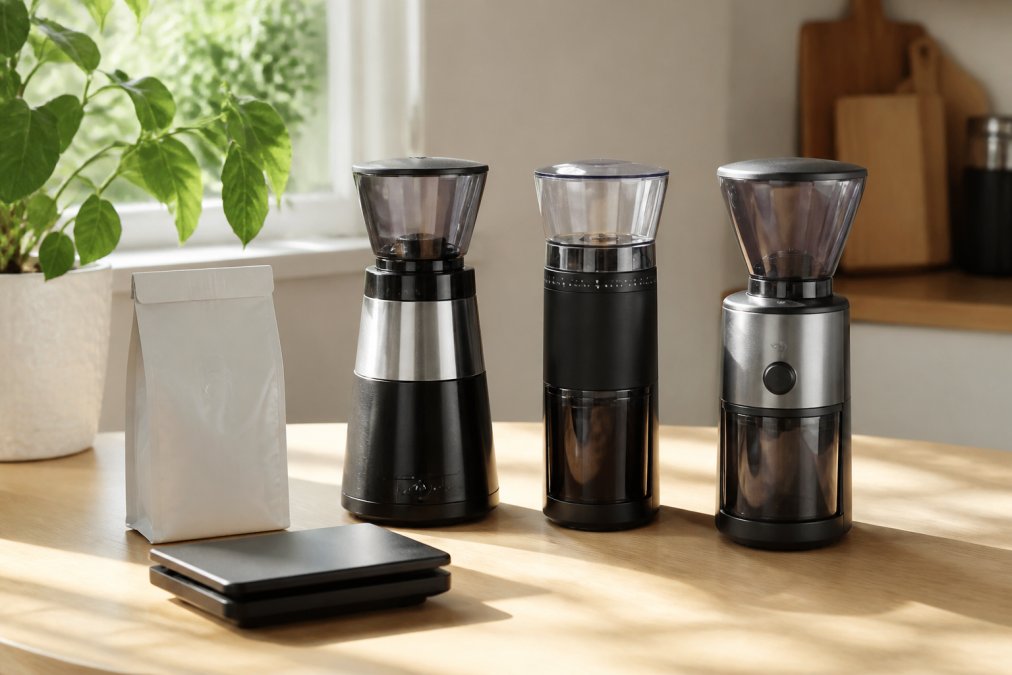
Burr Geometry: Conical vs Flat
Conical burrs feed beans downward between a cone and a ring. They're cheaper to make, run cooler at low RPM, and produce a wider particle distribution that suits drip and French press. Flat burrs grind between two parallel discs for a narrower distribution with more uniform fines, which is why espresso grinders favor them, at the cost of more torque and friction.
Adjustment Mechanism: Stepped vs Stepless
Stepped grinders click through numbered settings, repeatable and easy to return to a known setting, ideal for drip and pour-over. Stepless grinders adjust continuously, giving espresso drinkers the fine control to dial in a shot. If you brew espresso, prioritize stepless or a very fine stepped range.
Here's how the leading picks compare:
| Grinder | Price | Burr Type | Adjustment | Best For |
|---|---|---|---|---|
| OXO Brew Conical Burr | $99.99 | 40mm conical | Stepped | Value-focused daily brewing |
| Baratza Encore | $149.95 | 40mm conical | Stepped (40 settings) | Repairable long-term use |
| Timemore C5 Pro | $80.00 | Stainless steel conical | Stepped | Travel and manual brewing |
| Mavo Phantox Pro | $180.00 | Precision-aligned conical | Stepped | Low-retention single dosing |
| Fellow Opus | $195.00 | 40mm conical | Stepped (41+ settings) | Switching brew methods |
| Baratza Encore ESP | $199.95 | Optimized conical | Stepped | Entry espresso |
| DF54 | $229.00 | 54mm flat | Stepless | Budget espresso clarity |
Top Picks for Every Brewing Style
For drip and pour-over, the Baratza Encore is the safest long-term buy. Its 40 grind settings and user-replaceable parts mean you repair rather than replace, and the high-torque DC motor handles daily use. It isn't built for fine espresso, though, the stepped adjustment is too coarse to dial in a shot.
Retention: The Spec Nobody Lists
Retention is how much ground coffee stays inside the grinder after each dose. Budget electrics commonly retain 2-5 grams, so the first shot of the morning is partly yesterday's stale grounds. Single-dosing grinders like the Mavo Phantox Pro minimize this, and bellows-equipped units purge retained grounds with a squeeze. If you switch beans often or brew espresso, retention matters more than motor wattage.
Long-Term Cost of Ownership: Why Cheap Grinders Can Cost More
A grinder's sticker price is only part of the story. Long-term cost of ownership includes burr replacement, repair, and how often you replace the whole unit.
Used and Refurbished Grinders: How to Buy Smart
The used market is where patient buyers find the best value. Refurbished and secondhand grinders often sell for a fraction of new, and quality electrics are built to last.
Follow this checklist before buying used:
- Ask for the total grind count or approximate usage
- Confirm the burrs are original and not chipped
- Check that the adjustment mechanism moves smoothly through its full range
- Request a video of the grinder running
- Verify replacement parts are still available from the maker
- Confirm the seller accepts returns
Taste Test: Does a Budget Grinder Ruin Your Coffee?
A budget grinder does not ruin your coffee, but it changes it. In a side-by-side taste test, the difference between a budget and premium grinder shows up as clarity and balance, not "good" versus "bad."
Conclusion
Choosing among the alternatives to expensive coffee grinders comes down to matching the tool to your brewing habits, not chasing the highest price tag. A manual grinder, a sub-$250 electric, or a smart used purchase all deliver excellent cups when paired with fresh beans.
Frequently Asked Questions
Do I really need an expensive coffee grinder for home brewing?
No. A quality budget burr grinder under $250 can deliver consistent grounds for most brew methods. The key is burr type, not price. Manual grinders offer excellent consistency. Electric options are repairable and last years. Expensive grinders add convenience and espresso-level precision, but for drip, pour-over, or French press, a budget model works well.
What can I use as a substitute for a grinder if I'm in a pinch?
A blender or food processor can crush beans, but you'll get uneven particles that lead to bitter or weak coffee. A mortar and pestle gives more control but takes time. If you must use a blender, pulse in short bursts and sift out the fines with a strainer.
Is a manual hand grinder a better value than an electric one?
It depends on your priorities. Manual grinders offer exceptional grind quality per dollar because you're not paying for a motor. They're quiet and portable. Electric grinders save time and effort, especially for multiple cups. If you brew one or two cups daily and don't mind a minute of grinding, a manual model is often the better value.
What features should I look for in an affordable coffee grinder?
Focus on burr type (conical or flat), adjustability, and build quality. Conical burrs are common in budget models and handle a range of grind sizes. Look for stepless or micro-adjustments if you plan to brew espresso. Check for replacement parts availability, since a repairable grinder lasts longer. Static reduction features help keep your counter clean. Avoid blade grinders if consistency matters to you.
Can I use a blender or food processor as a substitute for a coffee grinder?
Yes, but with caveats. Blenders and food processors chop beans unevenly, creating a mix of fine dust and coarse chunks. This leads to inconsistent extraction: some grounds over-extract (bitter) while others under-extract (sour). For French press, where some sediment is acceptable, it's passable. For pour-over or espresso, the results are poor. Use short pulses and sift out fines if you have no other option.